Fermentation Beforehand
Mash & Fermentation
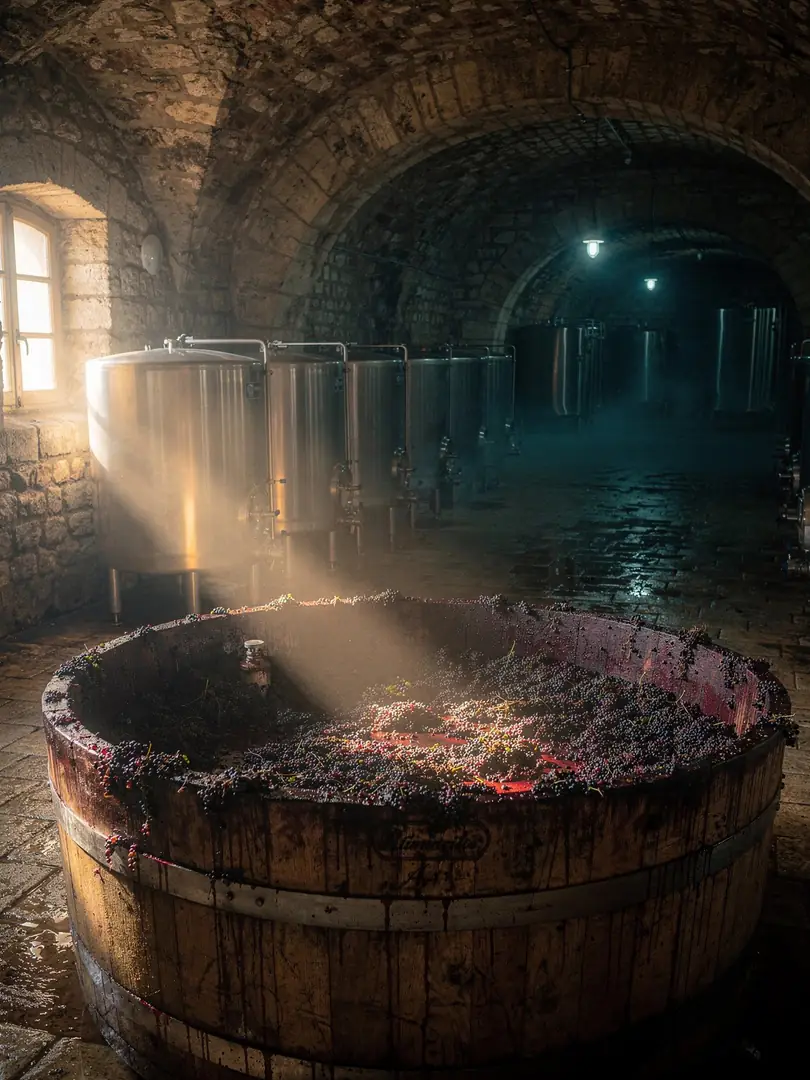
Marc doesn't involve a fruit mash in the usual sense, since fermentation has already been handled by the wine. EU law requires pomace brandy to be made exclusively from fermented grape pomace. For red wine, the pomace comes from the press after fermentation; for white wine, the sugar in the pomace must ferment before distillation can begin.
Marc de Bourgogne follows a fixed deadline: the pomace must be distilled by 31 March following the harvest. Until then it's stored within the region, and the date forces producers to process it over the winter following the harvest.
EU law sets further limits. No more than 25 kilograms of lees may be added per 100 kilograms of pomace, and alcohol from the lees may account for no more than 35 percent of the total alcohol. The pomace is distilled either with steam or after adding water, and the first distillation must take place with the pomace present.
Fine de Bourgogne contains no pomace at all. Its raw material is wine—more precisely, wine along with the fine lees left behind when it's racked off the sediment. The EU classifies it as a brandy, a distillate made exclusively from wine, permitting a maximum of 200 grams of methanol per hectolitre of pure alcohol. For pomace brandy, the limit is 1,000 grams.
Distinct from these brandies is Ratafia. It never even begins as a fermentation: fresh, unfermented grape must is fortified with a brandy—Marc de Bourgogne in Burgundy, Marc de Champagne in Champagne. The technical term for this is a mistelle. Ratafia champenois carries its own protected geographical indication. It remains a sweet fortified wine and doesn't belong in the ranks of brandies.