Fermenting on the Stone
Mash & Fermentation
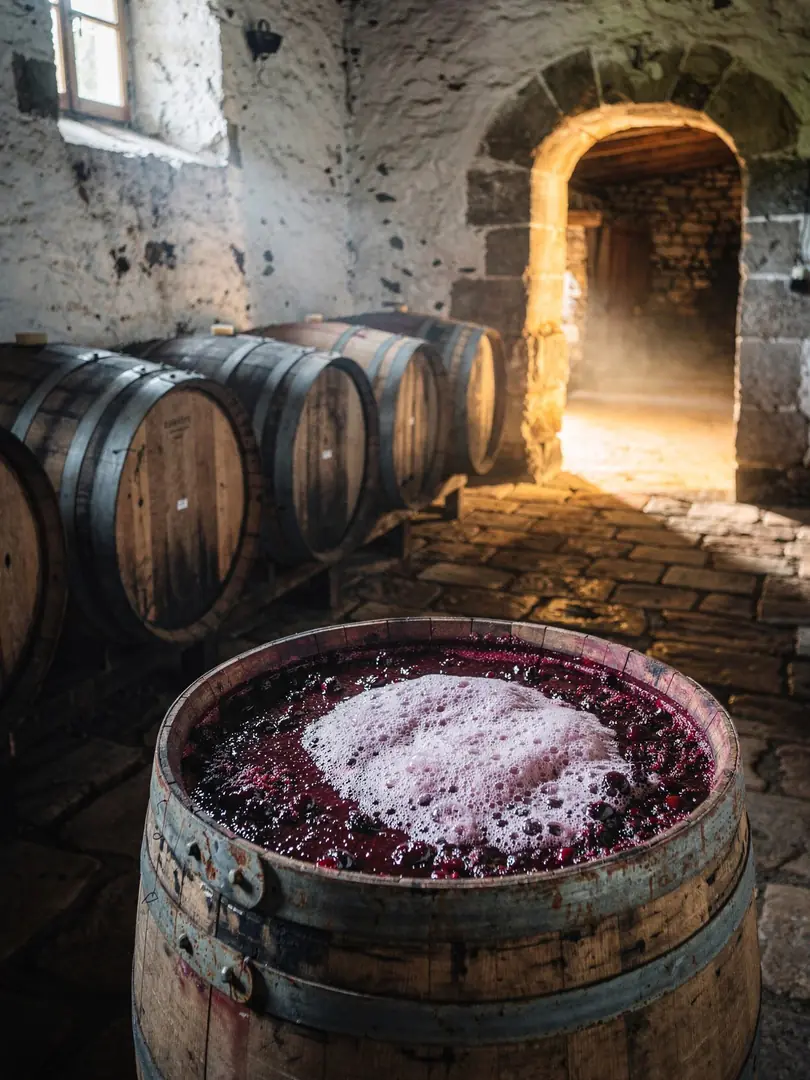
What happens in the barrels of Fougerolles begins almost immediately after harvest: the sweet guignes start fermenting on their own. This trait is said to be what first led farmers to turn their cherries into brandy. Fermentation happens with the stones still in, with no heating and no added yeast, sugar or other agents.
Beforehand, the barrels are carefully washed. In the past, cherries went into oak barrels on the day of harvest, sorted by early, standard and late varieties. Today they're brought to the fruit cooperative, founded in 1995 and uniting 60 growers, or a portion is kept back in the barrel for the grower's own distillery.
The first, turbulent phase runs without oxygen, and foam rises from the barrels. After that things calm down, and a crust can form on the fruit mass. Fermentation is done after about five to eight weeks, the barrels are sealed airtight, and the mash waits for the distiller.
The stones stay whole throughout. Crushed pits release hydrocyanic acid, which can form ethyl carbamate in light, considered a health risk. The subtle bitter-almond note in kirsch is meant to come from the intact stone alone. EU rules set a maximum of 7 grams of hydrocyanic acid per hectoliter of pure alcohol for stone-fruit brandies.
With raspberries, whose sugar content barely supports fermentation, the distinction between fruit brandy and fruit spirit comes into play. A fruit brandy is made from fermented fruit. A fruit spirit is made from unfermented fruit steeped in neutral alcohol and then distilled; it may contain no more than 10 grams of sugar per liter, compared with 18 grams for a brandy.
For Marc d'Alsace Gewurztraminer, the mash is already sitting at the winery: the pomace ferments and rests after the harvest until January, when distillation takes place. Under EU law, a marc brandy consists exclusively of fermented grape pomace.