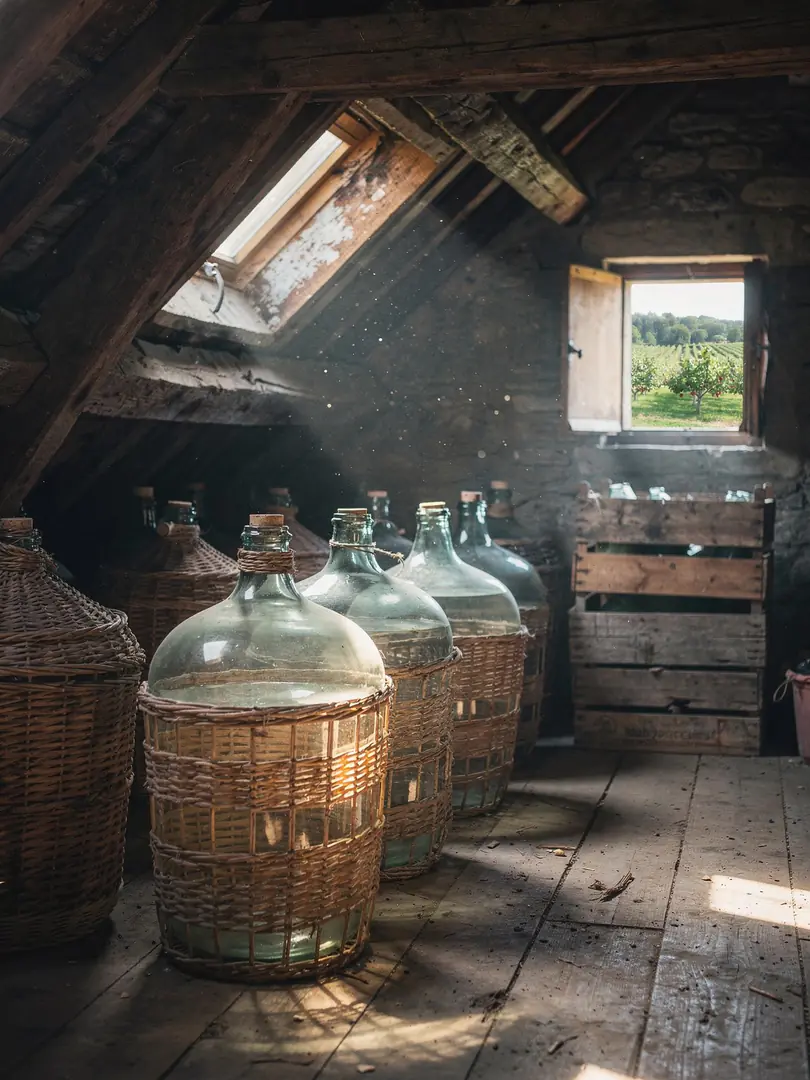
Demijohns Under the Roof
Maturation & Storage
Not an oak barrel but a glass demijohn under the roof: that's how Kirsch de Fougerolles matures at the bouilleurs de cru. The bonbonnes are wrapped in wicker, which protects the glass when carried and keeps out the light. The wickerwork itself is a craft particular to the area.
The demijohns stand "sous grenier," under the roof of the house, where the temperature swings over the year from around minus 5 to plus 35 degrees Celsius. For the first six months they're sealed only with a cloth, so that volatile ethers can escape. This loss is known as la part des anges, the angels' share. After that, the demijohns are sealed tight.
According to the inventory map's description, warmth softens the brandy's sharp edges while cold concentrates its aromas. Three to six years pass before it's sold. Wood isn't needed: the brandy stays colorless and keeps all its fruit aromas, while Cognac, Armagnac and Calvados draw both flavor and color from the barrel.
The distillateurs, by contrast, mostly store their brandies in enameled tanks or stainless steel. This too is common practice for fruit brandies: neutral containers don't alter the flavor.
EU law doesn't prescribe fixed aging periods for fruit brandies. For Marc d'Alsace Gewurztraminer, though, the specifications require: no wood, and a minimum of three months' rest before sale. Fermentation, distillation and storage must all take place within the départements of Haut-Rhin and Bas-Rhin; for Mirabelle de Lorraine, maturation too must happen within the region. With Mirabelle de Lorraine, age can bring a faint amber tint; added color, however, would be forbidden, since the brandy is classed as a white spirit.