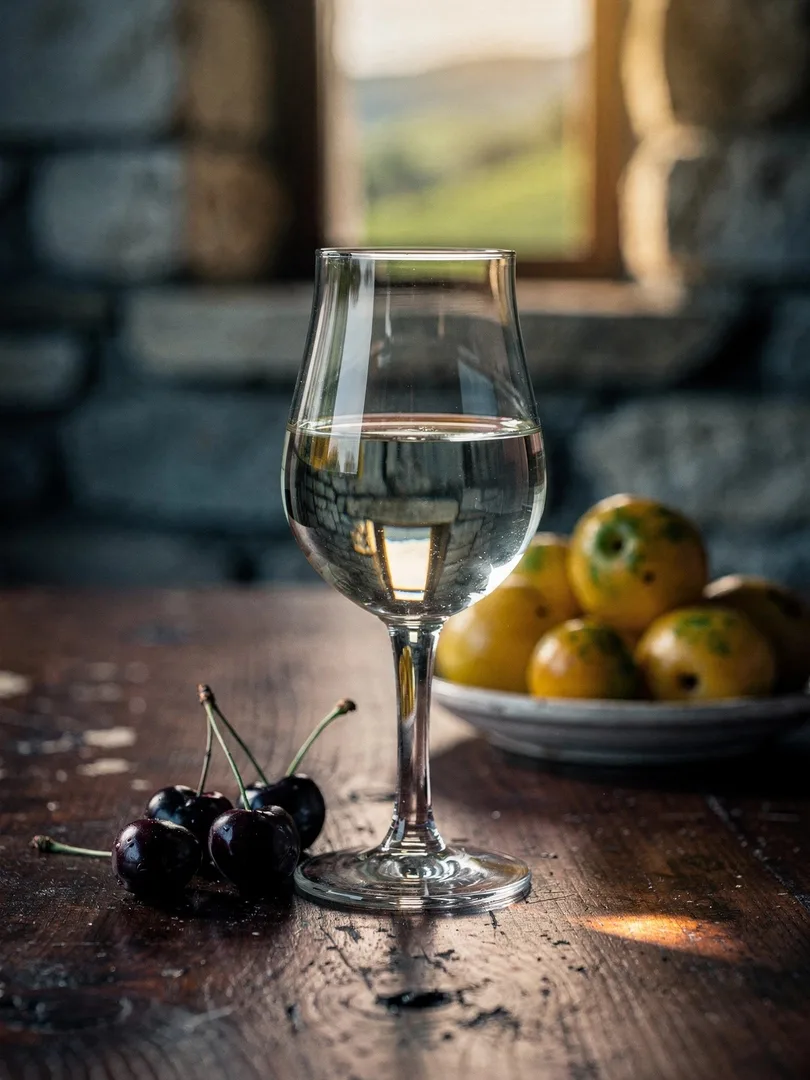
White, Clear, Fruity
Brandy Style
Three names carry the style of this region most distinctly: Kirsch d'Alsace, Kirsch de Fougerolles and Mirabelle de Lorraine. All three are white brandies with a minimum of 45 percent ABV, and all three draw their aroma exclusively from the fruit.
Kirsch d'Alsace is clear and brilliant. Its nose and palate should evoke cherry with a note of stone fruit. It's made from guignes and merises grown within the Alsatian region; the brandy is meant to carry the aroma of very ripe, unblemished fruit.
Kirsch de Fougerolles comes from eleven communes in the Haute-Saône and the Vosges, including Plombières-les-Bains and Val d'Ajol, from sandstone plateaus at 300 to 500 meters with abundant springs. It stands apart above all for its process: a blend of many local varieties, a single distillation pass, and years spent in a glass demijohn in the attic. The inventory map describes two styles: a rougher brandy meant for pastry chefs, and a fruitier one meant for sipping after a meal.
Mirabelle de Lorraine is likewise colorless, though it can take on a faint amber hue with age. It has a fruity aroma without ethereal notes, and on the palate it's soft, with no hard edges and no excess acidity, clearly recalling the fruit.
Alongside these stand Marc d'Alsace Gewurztraminer, a pomace brandy with floral and fruity notes, and Quetsch d'Alsace, made from damson plums. There's also Mirabelle d'Alsace and Framboise d'Alsace, made from raspberries. Across the Rhine, in the Black Forest, cherry brandy is called Schwarzwälder Kirschwasser. It too has been protected since 1989. The tradition is related, but the distillers and the varieties are not the same.
Kirsch d'AlsaceFruit brandy · Guignes and merises
- Alcohol
- 45–50 % vol
- Maturity
- 0–3 Years
Clear and brilliant, cherry with a stone-fruit note, dry, unsweetened.