Twice through the still
Distillation
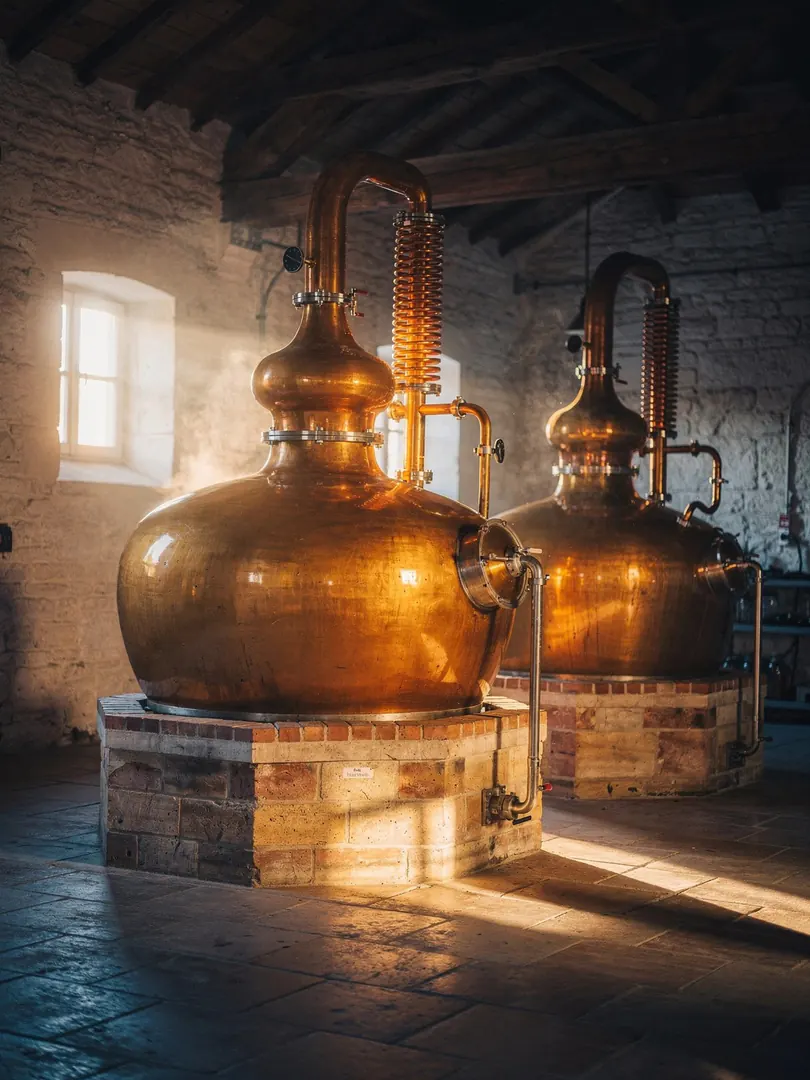
Twice, never three times: that's how often the wine passes through the still for a Cognac, and this holds true in the Grande Champagne too. How is Cognac distilled? In a copper Charentais pot still, set over an open flame and holding no more than 30 hectoliters. There's no column still here as in Armagnac; the law permits only this pot still and only double distillation.
In the first run, the wine is heated, and alcohol and aromatic compounds rise before the water does. The result is a still-cloudy, mild distillate the distillers call brouillis. It has little of the later Cognac about it, but everything that will define it is already present.
The second run is called the bonne chauffe, the good heat, and it demands experience. The distiller divides the distillate into fractions. The heads, with their solvent-like compounds, are cut away, as are the fusel-laden tails; only the heart, the middle cut, becomes Cognac. Heads and tails may be added back into the next distillation run. In the end, the distillate may not exceed 72.4 percent alcohol.
Exactly where the cut falls isn't decided by a thermometer alone, and it shapes the style of a house. Some grower-distillers in the Grande Champagne distill the wine together with its lees in small stills. Daniel Bouju describes a 16.5-hectoliter still for his estate, aiming to draw as much aroma as possible into the distillate.
Copper is no accident, since it binds sulfur compounds that would otherwise give the brandy an unpleasant smell. According to the industry body, almost 3,000 such stills operate across the region. The result is a colorless, fiery, yet already remarkably layered spirit that only gains its color and true name in the cask.