Base wine without sulfur
Mash & Fermentation
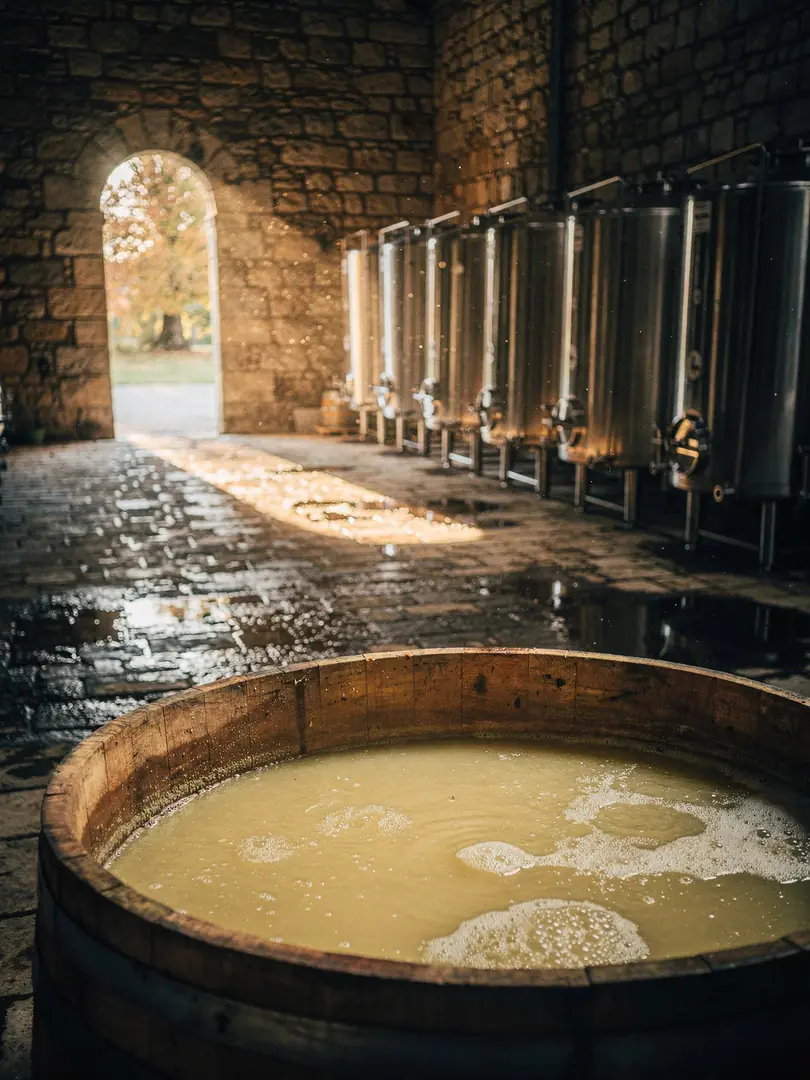
In autumn, the chais, the wine cellars of the Grande Champagne, fill with cloudy grape juice. Unlike fruit brandy, Cognac has no mash in that sense, but rather a base wine that growers vinify much like a white wine. The juice runs from the press into tanks, yeast converts the sugar into alcohol, and after a few weeks you have a wine that's hardly enjoyable to drink.
That's intentional. What kind of wine is distilled into Cognac? One that is as plain as possible and without the addition of sulfur, which would otherwise preserve the wine. The wine isn't meant for long storage but for the still soon after. It's lean, acidic and low in alcohol, and this acidity is the foundation for the fine structure later praised in the glass.
On the finished wine, the fine lees settle, a soft, cloudy sediment of dead yeast cells. Some grower-distillers distill the wine together with these lees, believing it gives the distillate more body and depth. Others rack off the clear wine beforehand and get a leaner, lighter brandy. This choice is part of an estate's style and can later be tasted in the glass.
Time is of the essence in this region. The Cognac distilling calendar sets 31 March after the harvest as the deadline, by which every drop of wine must be distilled. Winters in the Charente are therefore distilling season, and in the farm buildings of the Grande Champagne the still runs almost nonstop for weeks on end, while outside the vines rest.
At Frapin, which states that its estate farms exclusively within the Grande Champagne, and at smaller operations like Daniel Bouju's, Cognac therefore begins in the tank, not in the cask. Everything that the wood later adds builds on this unassuming wine. It is the raw material that reveals whether the vintage was good.