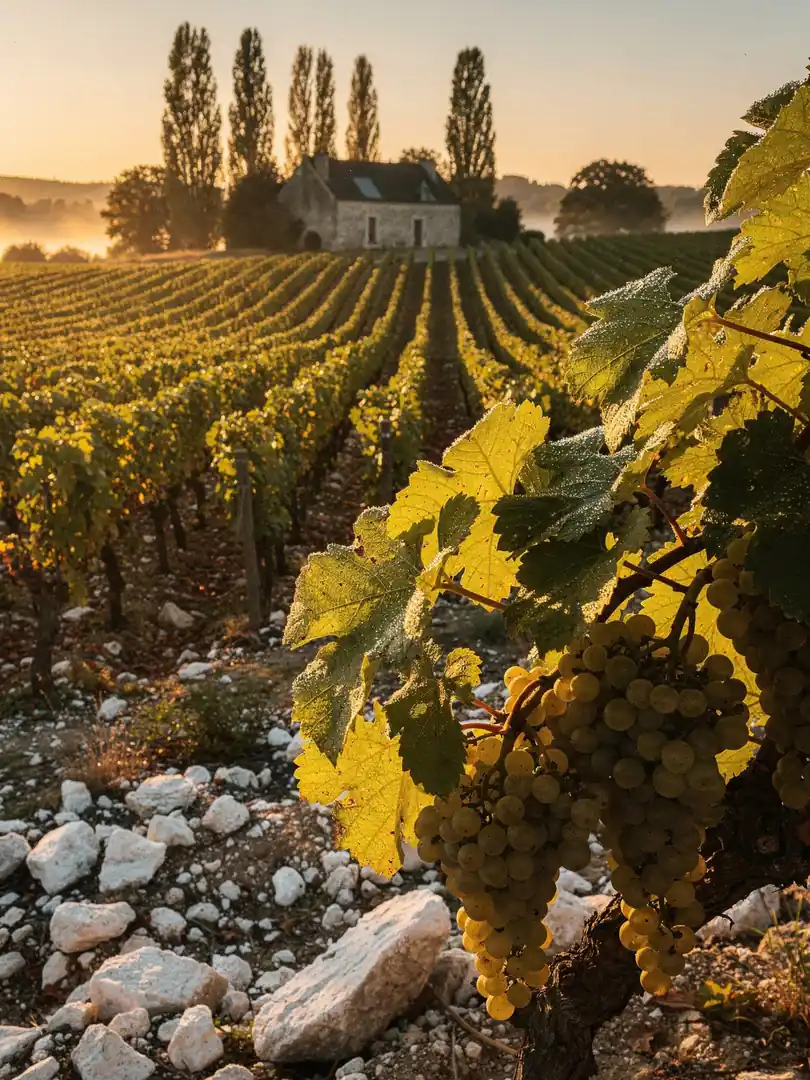
Ugni on chalk
Fruit & Raw Material
Which grape goes into Cognac? Almost exclusively Ugni blanc, accounting for more than 98 percent of the vineyard area across the whole region. In Italy, the same variety is called Trebbiano toscano. Colombard, Folle blanche, Montils, Sémillon and up to ten percent Folignan are also permitted, but on the hills of the Grande Champagne you'll mostly see rows of the same variety, as far as the eye can see.
As a table wine, Ugni blanc would be a disappointment: thin, acidic, low in alcohol. For the distiller, that's exactly the advantage. Many liters of wine yield little brandy in the still, and the acidity remains intact as backbone, whereas a heavy, high-alcohol wine would make the brandy clumsy.
On the chalk, the vine grows in restrained fashion. The soft limestone stores moisture and releases it slowly to the roots during dry summers, so the grapes ripen late and retain their acidity. Such wines are widely held to produce brandies with a floral scent and a touch of apricot, which only reveal what's inside them after years in the cask.
Around 13,000 hectares lie within the Grande Champagne, considerably less than a fifth of the region's total vineyard area of 87,648 hectares. The average estate farms 20 hectares. Frapin states that its estate farms exclusively within the Grande Champagne, naming Ugni blanc as its main variety. Daniel Bouju reports 30 hectares, planted almost entirely with this grape.
Harvest takes place in autumn. The grapes go straight to the press without delay, since fermentation needs to start soon, and the wine must be distilled by the end of March. Anyone driving through the area in autumn sees rows of vines on pale soil, limestone in walls and house fronts, and in between the farmyards of the grower-distillers, where presses and tanks stand ready.