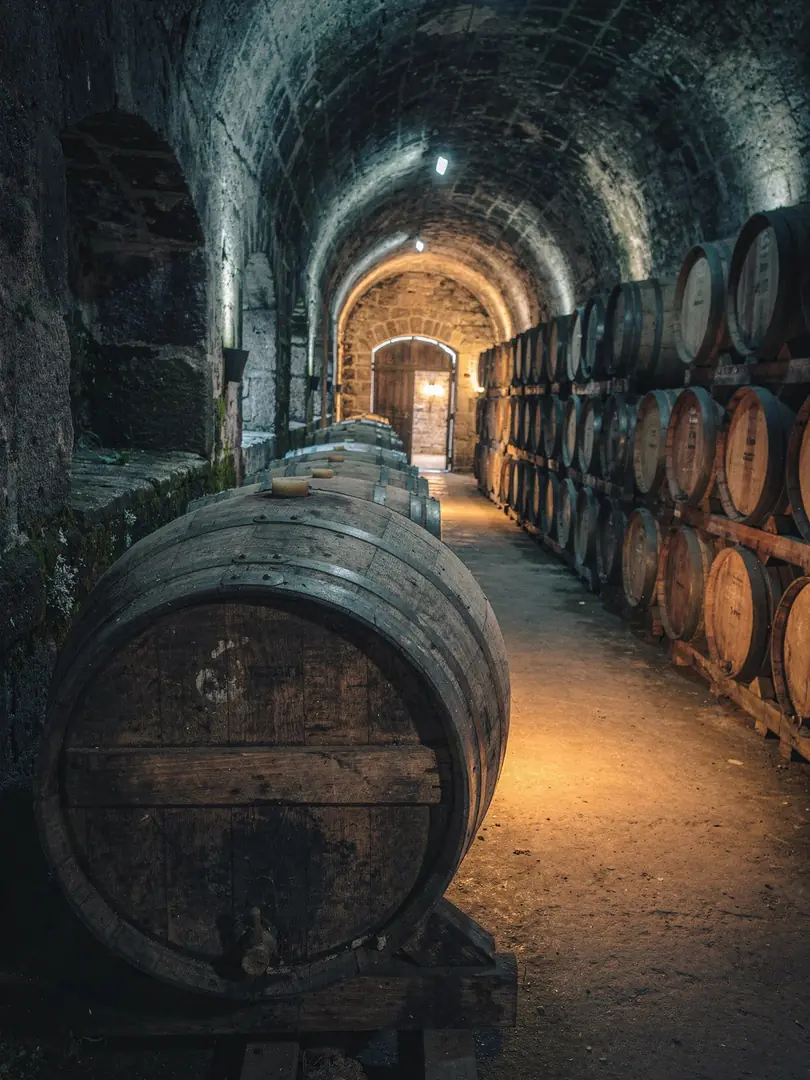
Oak and Patience
Aging & Maturation
How long must Calvados Pays d'Auge age? The specifications require at least two years in oak casks, counted from the day the spirit enters the cask. Before that, the fresh distillate is crystal clear and sharp; it's the cask that turns it into Calvados.
Many houses use casks of varying ages. Boulard describes how a spirit moves over the years through older and newer casks, and through drier and damper corners of its cellars in Coquainvilliers. New wood brings vanilla and toasty notes, while old wood mainly lets air reach the spirit.
Two things happen during this time. The spirit absorbs color, tannin, and vanilla from the wood, while oxygen seeps in through the pores, smoothing out the sharp edges. At the same time, part of the spirit evaporates through the wood, known in French as "la part des anges," the angels' share.
Labels show grades like Fine, Vieux, Vieille Réserve, VSOP, XO, or Hors d'âge. The higher the grade, the longer the spirit rested in cask. The exact number of years for each grade is set by the Calvados producers' trade association; the law itself only requires the two-year minimum. For blends, EU spirits regulations count the age of the youngest component.
Sugar and color adjustments are allowed only within narrow limits. Caramel coloring, oak chip infusion, and added sugar combined may account for at most four percent by volume of obscuration, meaning a small share of the color and sweetness. In the end, the spirit is diluted with water to drinking strength, a minimum of 40 percent alcohol.
Houses that age their brandies longer sometimes release single vintages. According to the house, Christian Drouin carries vintage-dated bottlings and very old spirits in its range, with aging periods that go well beyond the minimum requirement.