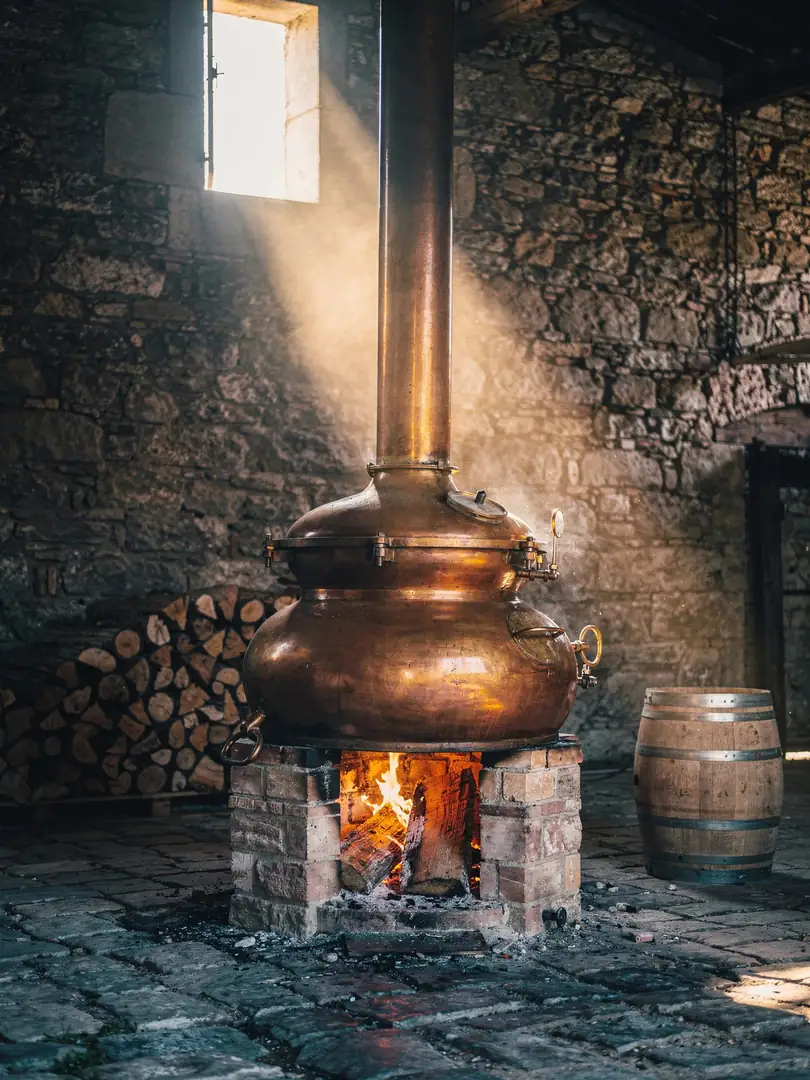
Column and Pot Still
Distilling
In Auch in 1814, a man named Tuilière filed a patent for a still that, unlike the classic pot still, runs without pause. Wine flows in continuously, steam rises through the plates of a column, and the finished spirit flows out at the end. From this idea, Gascony developed its own distilling tradition.
Is Armagnac double-distilled like Cognac? Generally not. Cognac may only be distilled twice in the Charentais pot still. For Armagnac, single continuous distillation in the alambic armagnacais is the standard method: a copper apparatus with a column, open flame, and a spirit of 52 to 72.4% ABV, yielding at most 40 hectoliters of pure alcohol per day.
Alongside this, double distillation in a pot still is permitted as an alternative method, yielding 65 to 72.4% ABV. Here the distiller first boils the wine into a weak raw spirit, then distills it a second time. The heads, which smell sharp and solvent-like, and the tails, which are heavy and fusel-laden, are cut away; only the heart goes into the brandy.
Janneau in Condom is considered one of the houses that uses both methods and then blends the resulting spirits. The house cites double pot-still distillation—which it says it has practiced again since 1972—as a distinguishing feature; most other Ténarèze producers tend to favor the column still.
In France, licensed distillers do the work, often traveling operations that move from farm to farm. In Germany, distilling without official permission would be illegal. And the column still is neither cheaper nor simpler: it demands that the distiller keep temperature and flow in balance for hours on end.