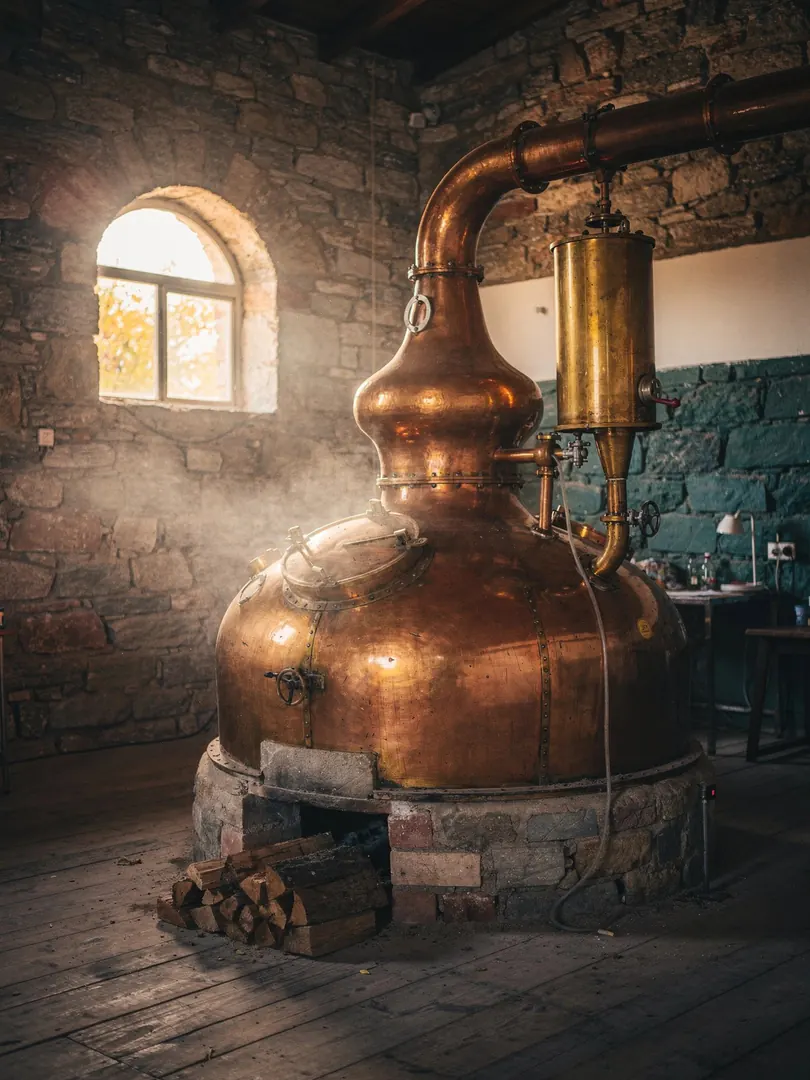
Copper in Autumn
Distillation
How does pomace become Tsipouro? Through distillation in a copper still, traditionally called a Kazani in Greece, which belongs to autumn in Tyrnavos as much as in Macedonia. The still is heated, the alcohol rises as vapor, cools in the condenser, and drips as distillate into a collection vessel.
Pomace is thick and sticky, which is why its own rules apply. The EU requires that the first distillation take place in the presence of the pomace, either with steam or with added water. Copper serves a practical purpose here: it binds sulfur compounds that would otherwise give the spirit an unpleasant smell. The steam bath protects the pomace from scorching at the bottom of the still and holds the aromas of the skins in the distillate.
The distiller separates the distillate into three parts. First comes the heads, which smell sharply of solvent, then the heart carries the desired aroma, and the tails taste oily and are cut away again. Where the heart ends is a matter of the distiller's skill. The heads only partially reduce methanol, which is why maximum limits apply.
Depending on the house, distillation happens once or twice. The EU only permits each distillation below 86% ABV, so the aroma of the pomace remains in the spirit and isn't lost as it would be with neutral alcohol. Bottlings typically range from 40 to 45% ABV, with the regulation requiring a minimum of 37.5% ABV.
Anyone buying Tsipouro with anise gets a product to which the house has added anise before the bottle is filled. Anise-free bottles carry a corresponding note on the label. Distilling itself traditionally falls in autumn and early winter, when the pomace is fresh and the stills become free after harvest.