Anise or Plain
Spirit Style
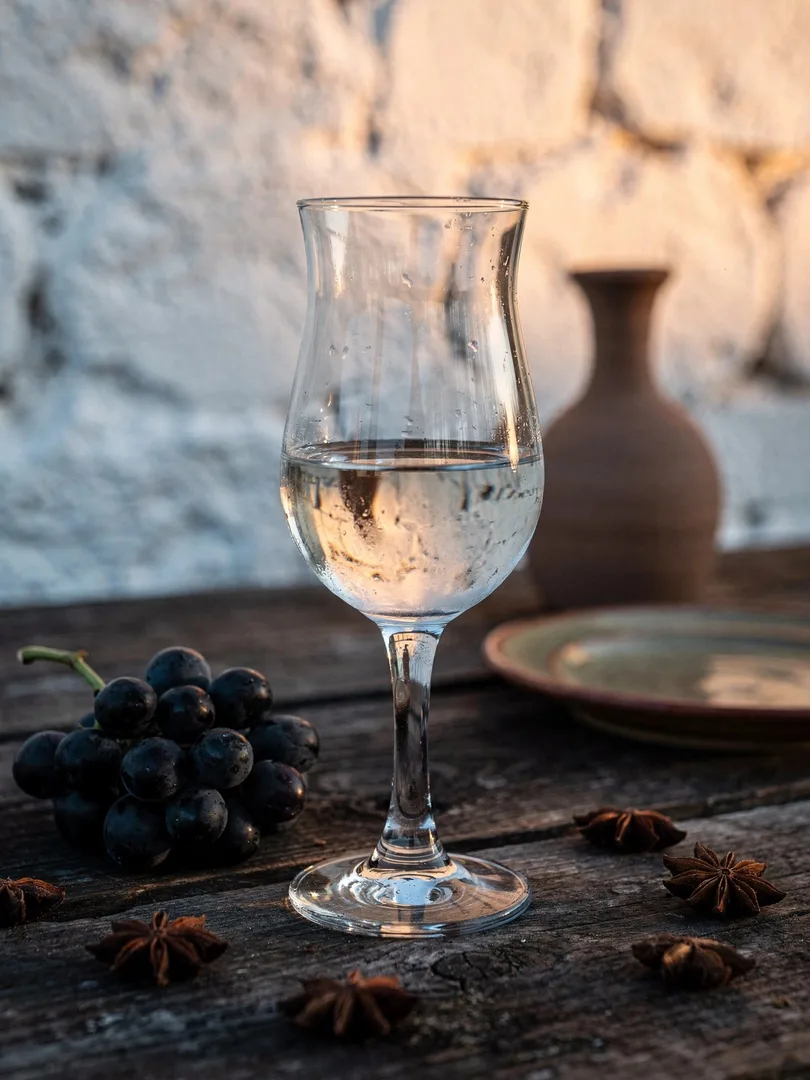
Tsipouro with or without anise: what's the difference? Both are pomace brandies, but one variant remains pure pomace while the other has anise added. Plain, Tsipouro tastes of grape, blossom, and stone fruit; with anise, the aroma tips toward licorice and fennel. Anise-free bottles carry a note on the label.
What distinguishes Tsipouro with anise from Ouzo? Ouzo is its own anise spirit with its own regulations, while in Tsipouro the pomace forms the backbone and anise is an addition. Something similar applies to Rakı from Turkey, an anise spirit based on grape distillate. Crete's Tsikoudia, by contrast, remains anise-free and belongs to a different region.
The three protected names differ mainly by their territory. Tsipouro of Tyrnavos stands for the city on the Thessalian plain, Tsipouro of Thessaly for the whole region, and Tsipouro of Macedonia for the north. Each name has its own specification, and when buying it's worth checking three things: the protected name, whether anise is included, and the grape variety, if stated.
How much alcohol does Tsipouro contain? Usually 40 to 45% ABV, with the EU permitting pomace brandy from 37.5% ABV upward. Metaxa stands apart as a counterpoint: amber-colored, rounded out with muscat wine, rose petals, and herbs, neither Tsipouro nor brandy in the EU's legal sense.
The grape also shapes the style. Muscat pomace usually gives floral notes reminiscent of rose and grape, while Xinomavro pomace brings more spice and tannin. The spirit's style also follows the table: in Greece, Tsipouro mostly accompanies food rather than being poured after it, unlike a Cognac or a Grappa served as a digestif.
Tsipouro of TyrnavosPomace brandy · Grape pomace, mainly Muscat
- Alcohol
- 40–45 % vol
- Maturity
- 0–1 Years
Clear, floral and grape tones, dry; with or without anise.