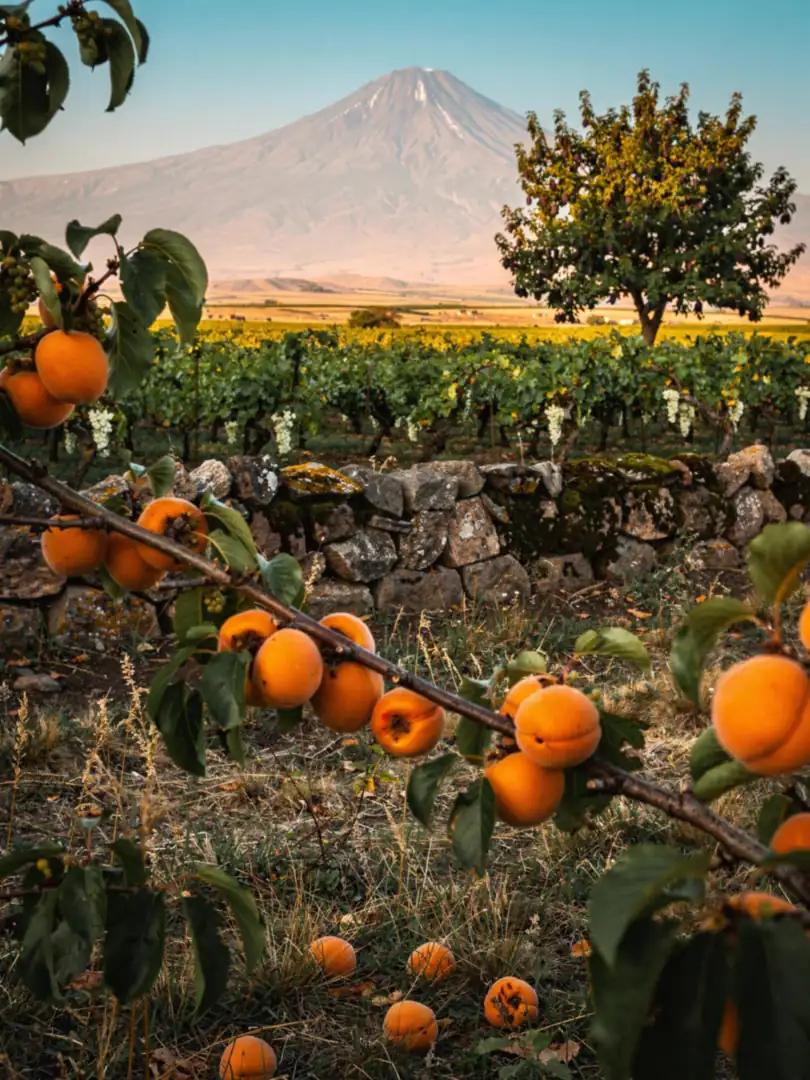
Grapes and Apricots
Fruit & Raw Material
Armenian brandy begins with white grapes from the Ararat Plain, the hot, dry basin surrounding Yerevan. According to the producers, native varieties are used, including Voskehat and Kangun. The name Voskehat roughly means "golden grain"; it is an old white variety of the country. The plain takes its name from Mount Ararat, visible behind Yerevan on clear days, even though it now lies on Turkish territory.
Why white varieties specifically? A brandy needs a wine that is lean and acid-driven with little inherent flavor of its own, since color and spice come later from the barrel. Heat makes grapes sweet, and picking them early enough still preserves the acidity that keeps the spirit fresh.
The second key fruit is known even longer than any brandy: the apricot. Its botanical name, Prunus armeniaca, points to the country, since it was long believed to originate there. In the Ararat Plain, the fruit ripens in high summer, well before the grapes, and whatever isn't eaten fresh or dried goes into the fermentation vessel.
Then there's the mulberry. The tree, called Tuti in Armenian, stands by courtyard walls and field edges, and its fruit is so sugar-rich that it ferments easily. Ripe mulberries are dark and soft, stain the fingers, and are hardly transportable, so they are usually processed where they grow. Fresh apricots likewise keep only briefly, though dried ones last the whole winter. The mulberry spirit, Tuti-Oghi, is considered the classic Oghi of the country.
Oghi is usually made from fruit grown on the producer's own land: alongside apricots and mulberries, plums, pears, and figs are also used. The quantities are small, the variety often unknown, and that's precisely why every homestead's version tastes a little different.