Copper Still, Twice
Distillation
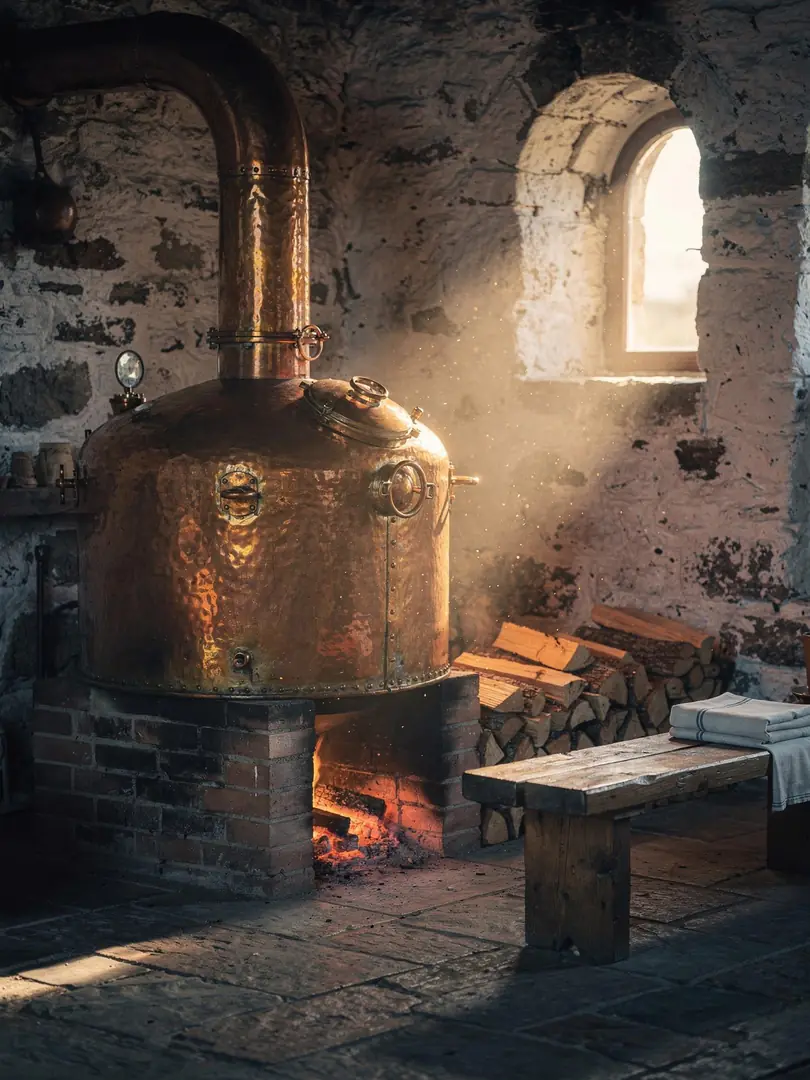
How is Chacha distilled from pomace? In the traditional method, the fermented mash goes into a copper pot still set over an open wood fire. The lid, as commonly described, is sealed with a paste of ash or flour so no vapor escapes at the seams. The vapor rises through a pipe into a cooling unit, where it condenses back into liquid.
The pomace stays in the still throughout, as EU rules also require for pomace brandy: the first distillation must take place with the pomace present. Unlike wine, which can be distilled as a clear liquid, the solid pomace can stick and scorch at the bottom of the pot, so it's heated carefully.
Distillation is usually done twice. The first run yields a weak, cloudy spirit; the second run purifies and strengthens it. In the process, the distiller separates the spirit into three cuts: the heads, with the most volatile, often sharp-smelling compounds; the hearts, which go into the bottle as Chacha; and the tails, with heavy, oily flavors. Cutting off the heads only partially lowers the methanol content, which is why the EU sets a maximum limit for pomace brandy.
This farmhouse spirit is a piece of Georgian home culture. In Germany, by contrast, private distilling without a license is prohibited; only licensed small-scale distilleries and distilling by raw-material owners at such a facility are legal.
With Georgian Brandy, the starting material is wine rather than pomace. Under EU law, the wine distillate must stay below 86% ABV so the wine's aroma is preserved. The house of Sarajishvili says it shows its facilities on tours in Tbilisi. Afterward, the distillate rests in wood, and only there is it decided whether the sharp wine spirit becomes a smooth Brandy.