Pears and Dirndl
Region & History
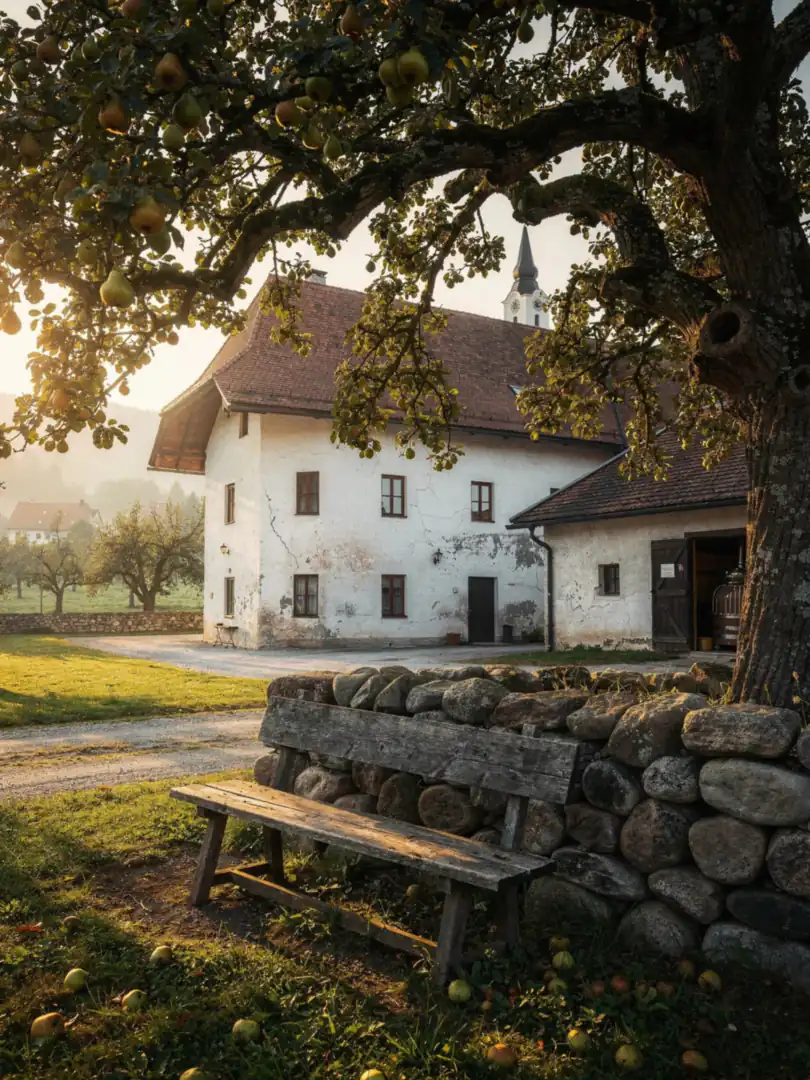
Ask anyone in Lower Austria about pear brandy and you'll end up in the Mostviertel, south of the Danube between the Enns and the Wienerwald. According to the region, this is home to the largest contiguous area of perry pear orchards in Central Europe, and the Moststraße runs right through the middle of it.
The pears here are older than any brandy. Botanists consider the area between the Hausruck and the Traisen the birthplace of many Austrian perry pear varieties — an estimated 400-plus exist in Austria alone. Originally they were pressed into Most (perry), and in 2011 the EU granted protected geographical status to "Mostviertler Birnmost." That protection covers the perry itself, not any brandy made from it.
Distilling has long happened on the side, right on the farms. In the Pielachtal, the distilling of cornel cherries is documented as far back as the reign of Maria Theresa. Today, the Original Pielachtaler Dirndlbrand is listed in Austria's register of traditional foods and comes from six municipalities: Hofstetten-Grünau, Rabenstein, Kirchberg an der Pielach, Loich, Schwarzenbach, and Frankenfels. Where France defines the origin of Cognac and Armagnac through strictly delimited areas, here it's simply an entry in a register.
Legally, distilling in the Mostviertel rests on the shoulders of small producers. Abfindungsbrenner (flat-rate distillers) register their distilling with the customs office and pay a reduced tax rate on limited quantities — up to 100 liters of pure alcohol (l A) per year at the lower rate, plus another 100 l A at a higher rate. On top of that there's tax-free home distilling: 15 l A for the farmer and spouse, 3 l A each for family members and employees, capped at a total of 27 l A. Illicit distilling remains banned here too, of course.
The elderberry's cousin, the wild service tree (Elsbeere), grows at the edge of the region. The Elsbeerreich stretches from the eastern Weinviertel to the western Wienerwald, and at the point where it meets the Mostviertel, farms around Michelbach have banded together. Elsbeerenbrand is likewise listed by Lower Austria as a traditional food.