Pear, Dirndl, Elsbeere
Fruit & Raw Material
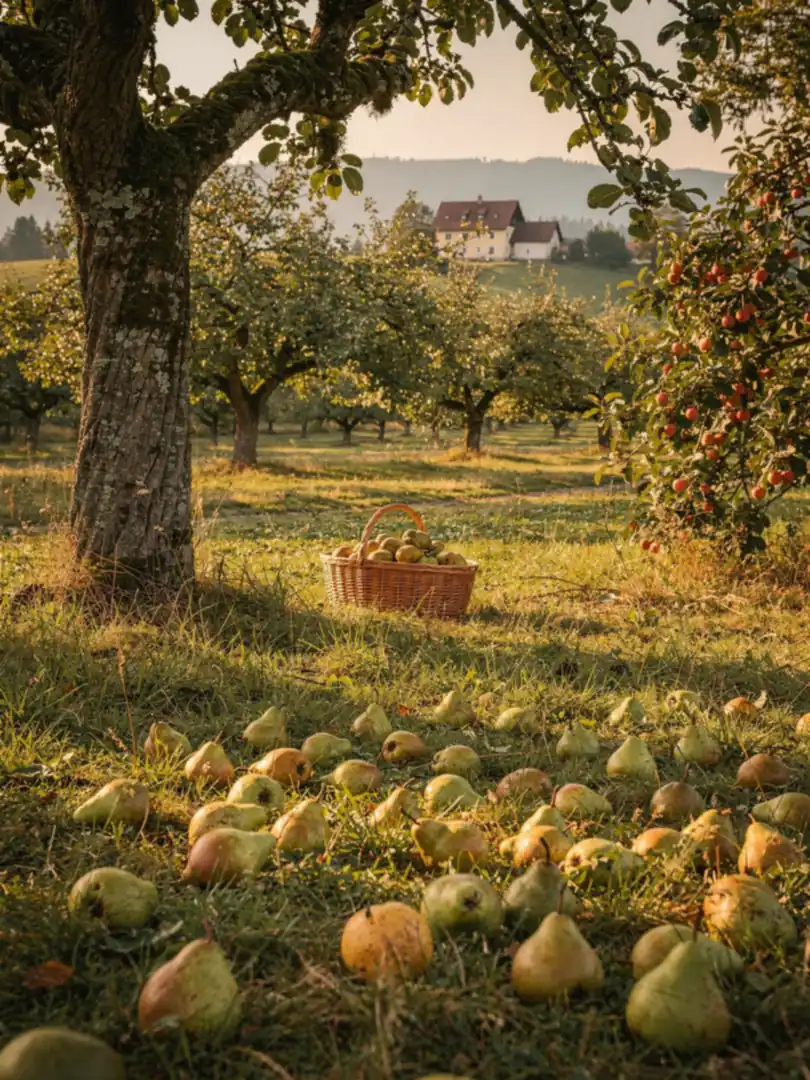
When the pear blossoms open in spring, you can see along the Moststraße just how many standard, full-size trees grow here: several hundred thousand gnarled trees shape the landscape, according to the region. Their fruit is small, hard, and tart — barely edible raw, but perfectly suited to perry and brandy.
Four names come up again and again: Dorschbirne, Speckbirne, Knollbirne, and Stieglbirne. The Dorschbirne is considered a traditional perry pear with a distinctive flavor. The Speckbirne is said to originate in Carinthia and has been known throughout Austria since 1888; it's pressed, dried, and distilled.
The cornel cherry grows throughout the Pielachtal, where it's simply called Dirndl — a large shrub or small tree that can reach five to twelve meters in height. From mid-August the fruit ripens, turning coral-red to almost black depending on the variety, and it's rich in tannin. Because the region markets it so consistently, the upper Pielachtal is now known as the Dirndltal.
Harvesting calls for patience. Ripe fruit falls on its own into nets spread beneath the trees; ripening stretches over roughly six weeks, with picking every three to four days. Only fully ripe Dirndl deliver real aroma, so the small quantities are often frozen and thawed together at the end.
Rarer still is the wild service berry (Elsbeere), a wild tree familiar to the Elsbeerreich. Around Michelbach, 32 producers have joined forces to preserve it. According to the region, it takes about 25,000 berries to make a single liter of Elsbeerenbrand. Perry pears also live on in Normandy: Calvados Domfrontais requires at least 30 percent perry pear content.