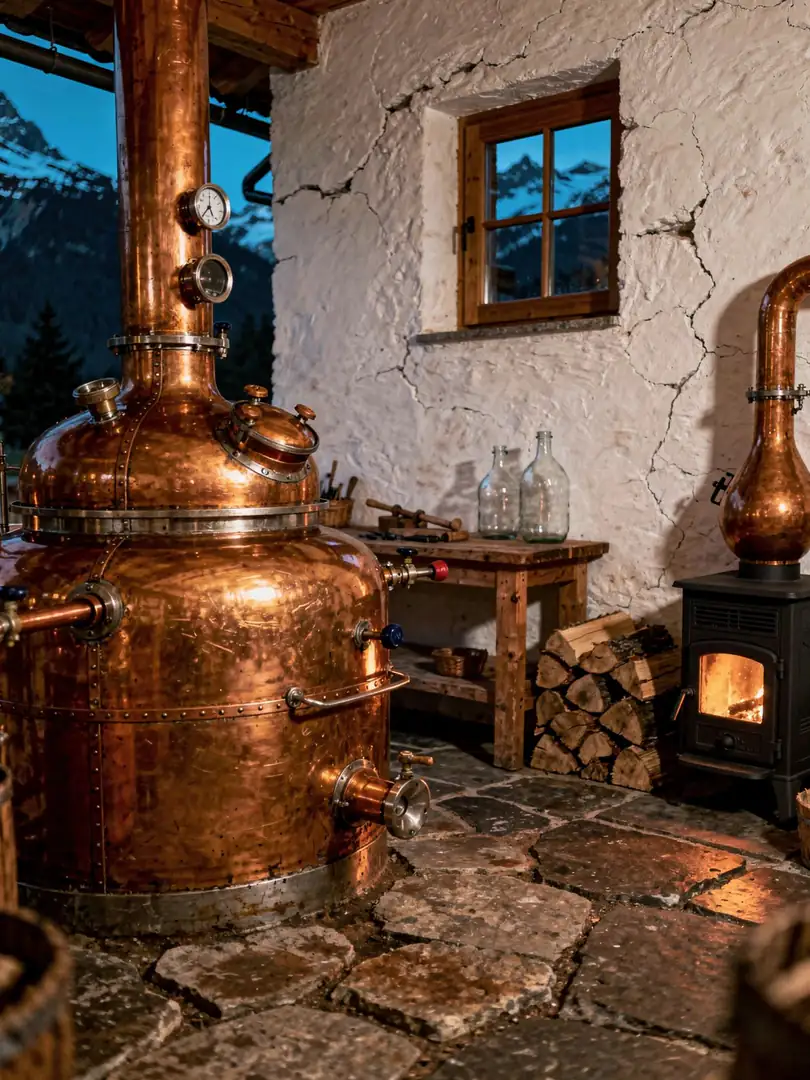
Still and Column
Distilling
In Tyrol, farmers and master distillers do their distilling in winter. The mash goes into a copper still, is heated, and since alcohol evaporates before water, a vapor rises first that carries much of the alcohol and aroma. A condenser turns it back into liquid.
Those who double-distill work in two stages. The first pass, the raw spirit, is cloudy and weak; the second, the fine spirit, sharpens the result. Wildschönauer Krautinger is distilled twice, and Rochelt likewise describes its brandies as double-distilled. An alternative is a still fitted with a rectifying column, which concentrates the alcohol in a single pass.
The distiller divides the distillate into three parts. The heads come first and smell of solvent, the heart carries the aroma, and the tails taste of wet cardboard and are cut away. Whether the cut succeeds depends on the distiller's nose and palate—this is what separates a brandy with character from one with flaws.
Methanol is present in every fruit brandy because it comes from the pectin in the fruit, which is why maximum limits exist. For most fruit brandies these stand at 1,000 to 1,200 grams per hectoliter of pure alcohol; for rowanberry, up to 1,350 is allowed. These brandies are safe when produced legally and cleanly.
Important for readers in Germany: owning a still and distilling schnapps there requires a permit. Tyrol's home-distilling rules apply to Austrian farmers, not to hobbyist distillers.