Saint-Martin
Food & Tradition
In mid-November, about two weeks after All Saints' Day, the Ajoie celebrates Saint-Martin, a feast of roughly ten courses entirely devoted to pork. The tradition is listed among Switzerland's living traditions by the Federal Office of Culture. Fittingly, the specifications also state that Damassine may not be sold before Saint Martin's Day.
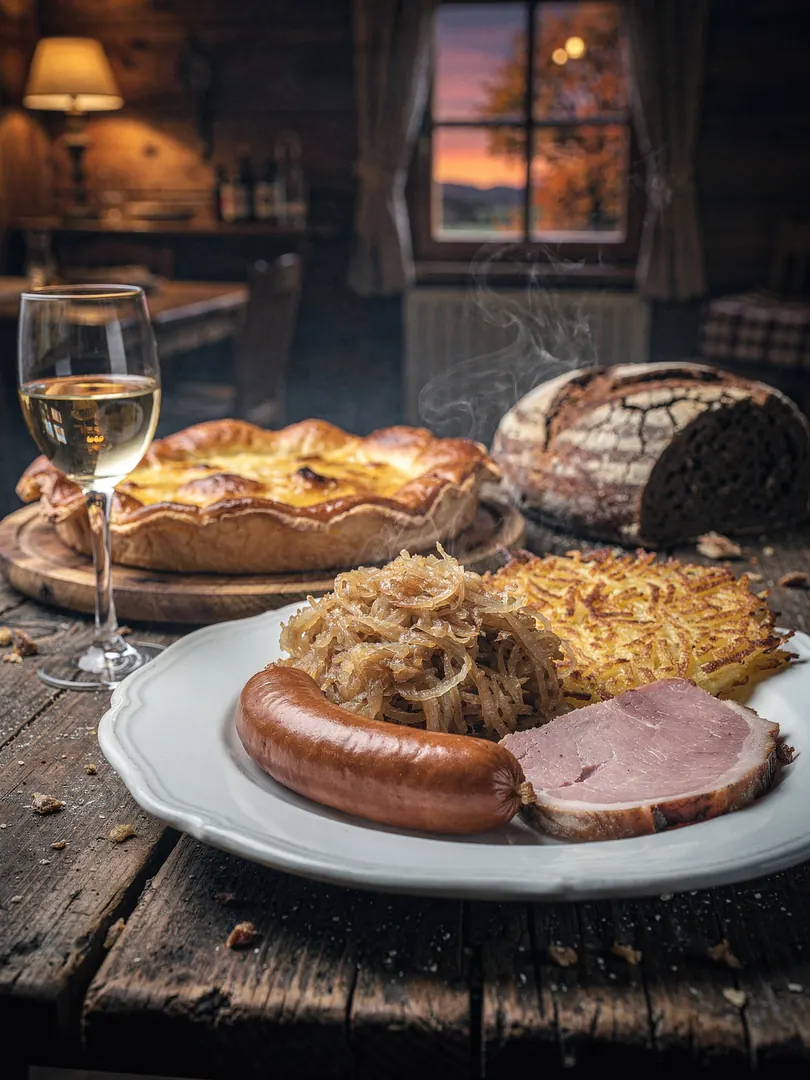
The table brings bouillon, headcheese, blood sausage and other sausages, roast pork with rösti, sauerkraut, ham and bacon. At the end comes Totché, a salty cream tart. Midway through the meal, tradition calls for a "coup de milieu" — a small glass of Damassine AOP or another fruit brandy.
Whether that little glass in the middle of the meal actually aids digestion is an old belief. In truth, nothing speeds up, since alcohol tends to slow gastric emptying rather than hasten it. The relief felt after a glass of Damassine comes from the pause at the table. Especially during Saint-Martin, with its roughly ten courses, that sip midway through is more of a breather than a remedy.
Also part of the meal is Saucisse d'Ajoie, a sausage with protected geographical indication from the district of Porrentruy. Made predominantly from pork, it has a lightly salty flavor of smoke and caraway and is often served with sauerkraut. The name is said to trace back to butchers of the 1920s, who used it to set their sausage apart from others.
Even without a festive occasion, Damassine remains, in Porrentruy and across Jura, a brandy for the end of a meal — a small glass after a hearty dinner, sipped slowly, never poured as an invitation for more.