Still and Presence
Distillation
Can you distill spirits in Switzerland? Farmers who process only their own homegrown grapes may work as home distillers with their own equipment, under the rules of the Federal Office for Customs and Border Security. Those without equipment have their pomace distilled by a contract distiller. In Germany, every distillation run requires official permission; without it, distilling is prohibited.
The basic rule for pomace is set out in EU law: it is distilled either directly with steam or after the addition of water, and the first distillation must take place in the presence of the pomace itself. This distinguishes grappa from brandy, which is made from wine. Every distillation run ends below 86 percent alcohol by volume, so that the aroma stays in the spirit.
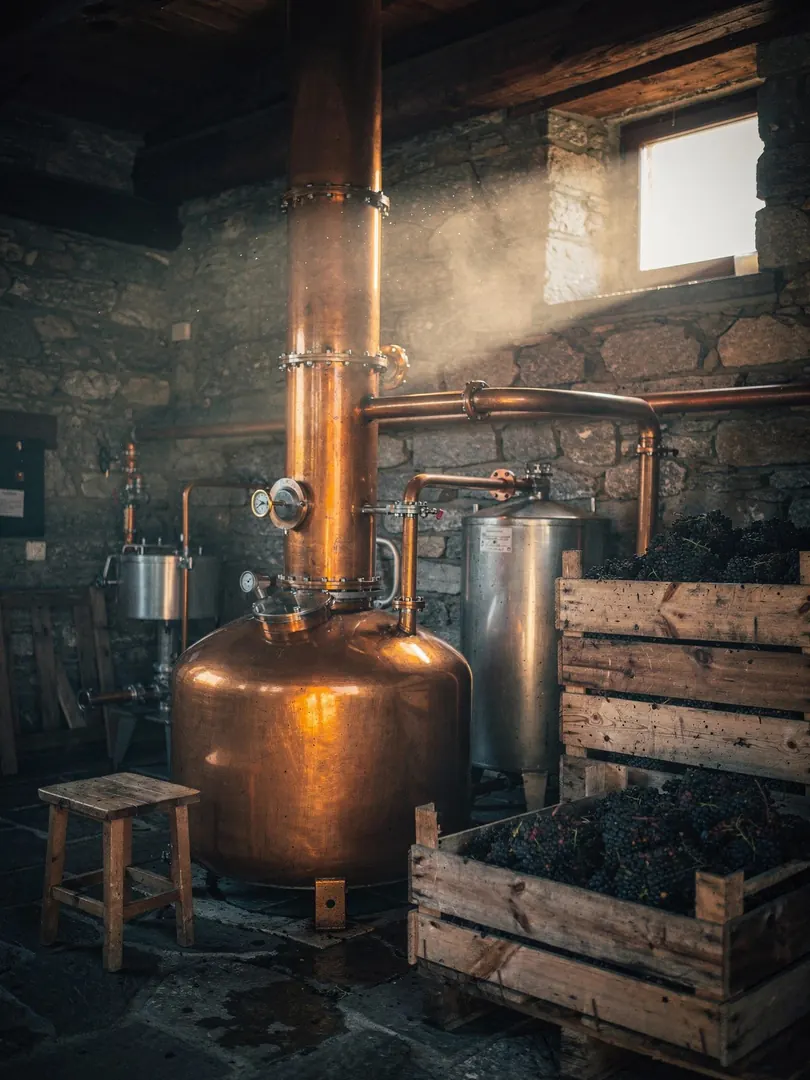
The still is usually made of copper. As it heats up, the heads rise first, containing volatile and harsh compounds that are separated out. Next comes the heart, the middle run that fills the bottle. Finally comes the tails, with heavy, oily components. Exactly where the distiller makes the cut determines the character.
With pomace brandy, cutting is a matter of smell and taste, since the mix of skin aromas and seed oils is tricky. Separation reduces methanol only partially, since it comes from the pectin and is present in every mash. That's why EU law sets a maximum limit, rather than relying solely on the distiller's experience.
The mobile stills that once traveled from cellar to cellar have largely disappeared. Today the equipment is mostly installed permanently in distilleries and wineries, in Ticino just as in Misox, Puschlav, and Bergell. The finished distillate is reduced to drinking strength with water, usually to 40 to 45 percent for sale.