Luizet and Williams
Fruit & Raw Material
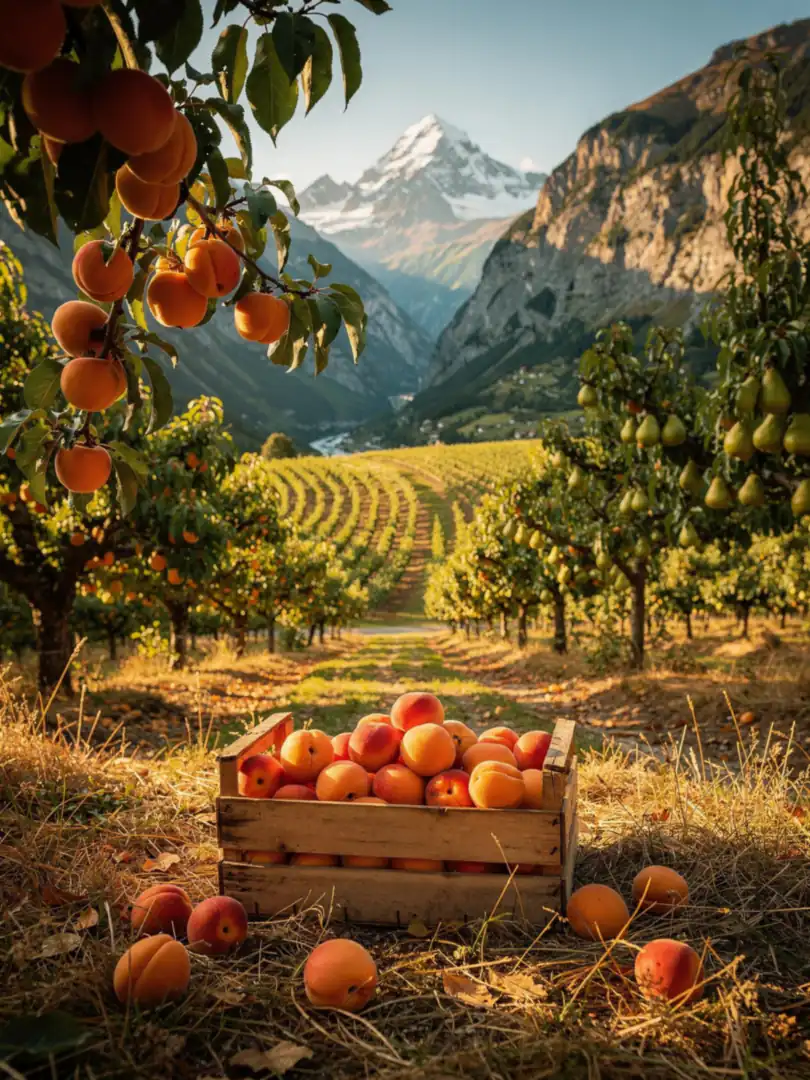
Between Sierre and Martigny, the orchards of the Rhône Valley are dominated by one fruit above all: the apricot. It grows across roughly 700 hectares in Valais, and according to industry figures, the vast majority of the Swiss apricot harvest comes from here. The trees stand in the shelter of high mountains, where rainfall is comparatively low and the sun lingers long on the slopes.
For Abricotine AOP, one variety matters above all: Luizet. At least 90 percent of the processed fruit must be Luizet, with at most 10 percent allowed from other Valais varieties, calculated per distiller, cellar and year. The specifications demand a pronounced Luizet character in the finished brandy.
For the pear brandy, only one variety goes into the mash: the Williams, known in Germany as Williams Christ. EU law enforces the same strictness: a brandy may only be labelled 'Williams' if it is made exclusively from this variety. In Valais, the AOP demands the same rule all the way from tree to bottle.
Why these two fruits in particular? The Williams pear has a strong, unmistakable aroma that survives distillation, while the Luizet apricot brings fragrance and acidity. Both thrive in the valley's dry, warm climate. The fruit is harvested fully ripe, since whatever aroma hasn't developed on the tree won't amount to much in the still later on.
Stone fruit brings one particular complication: apricot kernels contain amygdalin, which can release hydrogen cyanide. For this reason, an EU maximum of seven grams per hectolitre of pure alcohol applies to stone fruit brandies, and the kernels are never crushed.