Within Two Days
Mash & Fermentation
How do cherries become Kirschwasser? First they must ferment, and quickly: the production rules require the fruit to be mashed no later than 48 hours after harvest. Mashing means the cherries are crushed and placed in a vessel, where their sugar ferments into alcohol.
The pits are kept as intact as possible during this process. Crushed pits release hydrocyanic acid, which can later form ethyl carbamate when exposed to light — a compound no one wants in the finished spirit. A subtle stone note is desired; too much of it is a flaw.
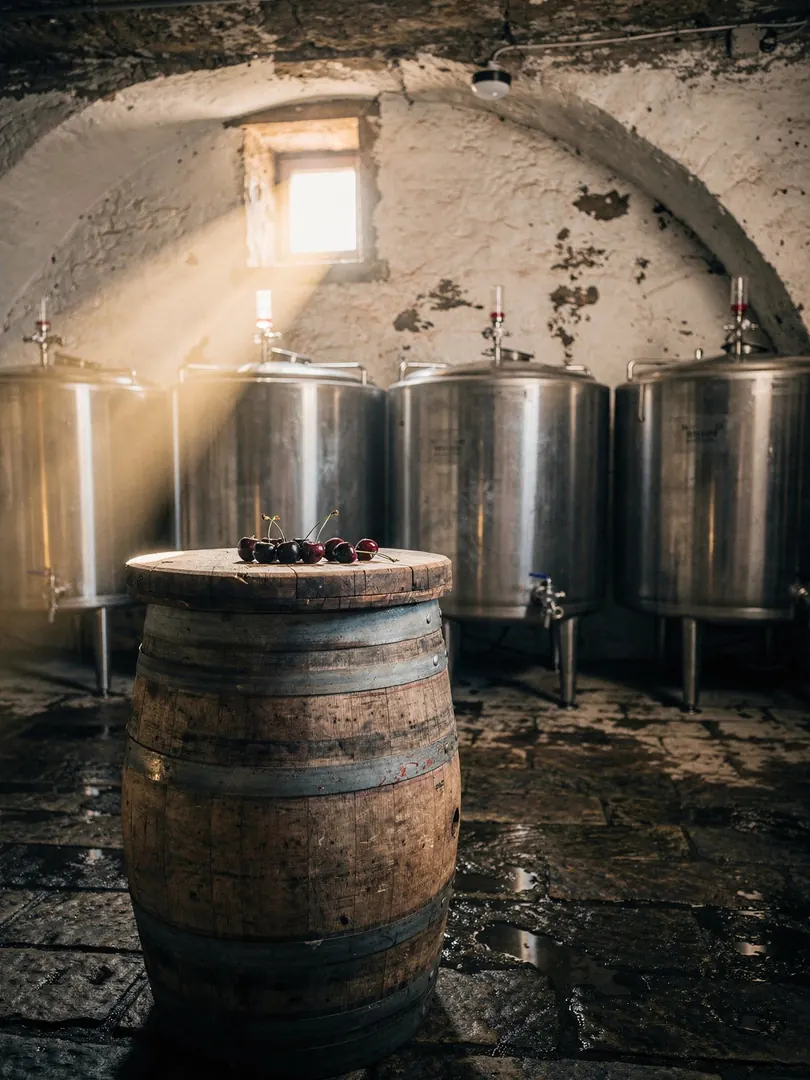
Fermentation takes place in an airtight vessel under a fermentation lock, a valve that lets carbon dioxide out while keeping oxygen from getting in. The production rules permit cultured yeast without genetic modification, as well as enzymes, and the temperature should ideally not exceed 23 degrees Celsius. If the mash is acidified, only phosphoric or lactic acid may be used.
How long fermentation takes depends on the variety, ripeness, and weather, usually a few weeks. After that, the producer has time, but not unlimited time: the mash must be distilled by May 31 of the following year. Until then, it sits tightly sealed in a barrel or tank.
On the farms around Lake Zug, in Menzingen or on the Rigi, this cycle repeats every summer. The harvest is brief, and then barrels and tanks fill with a thick mass of flesh, skin, and pits. During fermentation, carbon dioxide rises, the mash foams, and the smell of cherries fills the air. Only once it has settled down is it clear how much alcohol it actually contains.