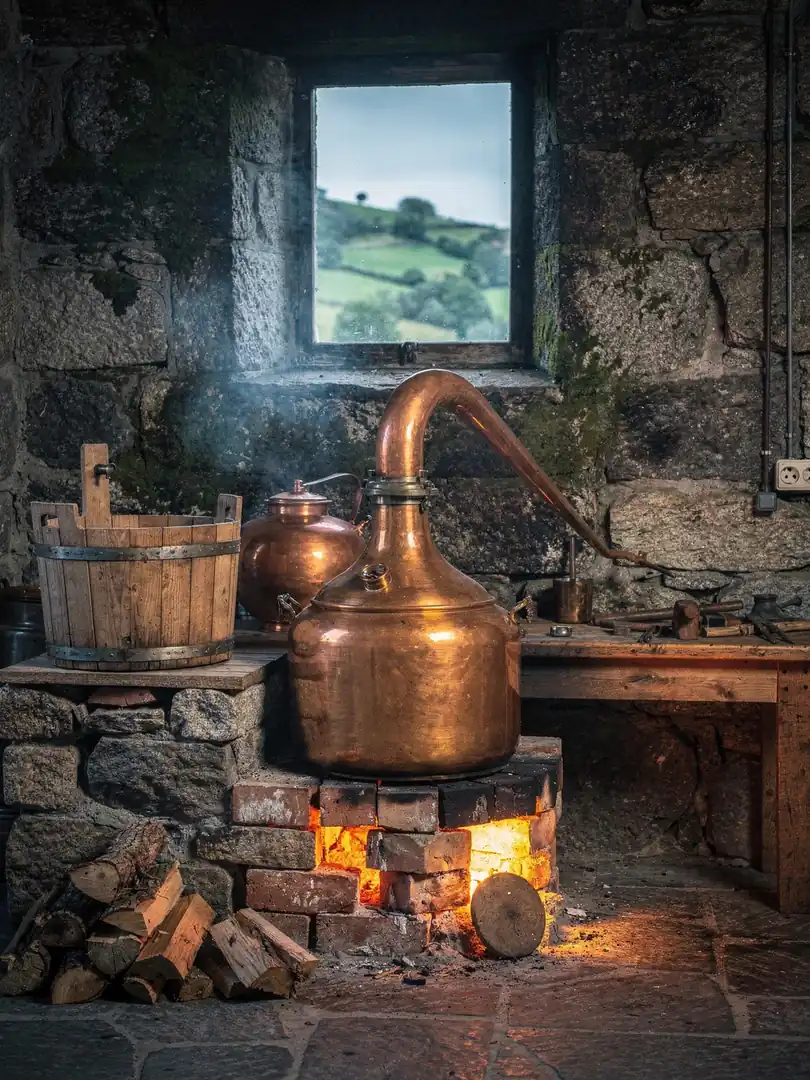
Alquitara and Fire
Distillation
Next to the copper still stands the poteiro, the distiller of Orujo de Galicia, watching the fire. He smells and tastes the distillate again and again as it drips from the condenser.
How does fermented pomace become Orujo? It goes into the still, called Alquitara or pota in Galicia. The word Alquitara comes from Arabic; pota refers to the lower vessel, made of copper or clay, where everything is heated. Per the product specification, heating is done over an open flame or with steam, and the Spirits Regulation requires that the first distillation take place with the pomace present. Each distillation stays below 86% ABV, so that the character of the raw material remains detectable.
The fire controls the process. First comes the heads, the most volatile, sharp-smelling fraction, which is cut away. Then follows the heart, the part that will go into the bottle, and finally the tails, with heavier, often fusel-like aromas. Where the cuts fall is decided by the poteiro's nose and palate. In the traditional method, the fire is lowered after the first drops appear, so the brandy flows slowly.
One run, called a potada, takes about five hours according to one producer. Cutting away the heads only partially reduces methanol, since it's distributed throughout the run. In Germany, distilling without a license is illegal, and Orujo comes only from licensed operations.
Aguardiente de sidra is also distilled from a fermented product, but its rules specify different numbers. The distillate may leave the still at no more than 72% ABV and is then brought down to drinking strength, with a minimum of 37.5% ABV required for sale.