Stone and Root
Mash & Fermentation
Apricots go into the mash ripe and soft. Anyone who has ever halved them by hand knows the smooth pit at the center. Whether distillers in the Vinschgau remove the pits or let them ferment along with the fruit is up to each producer; the EU spirits regulation permits either approach.
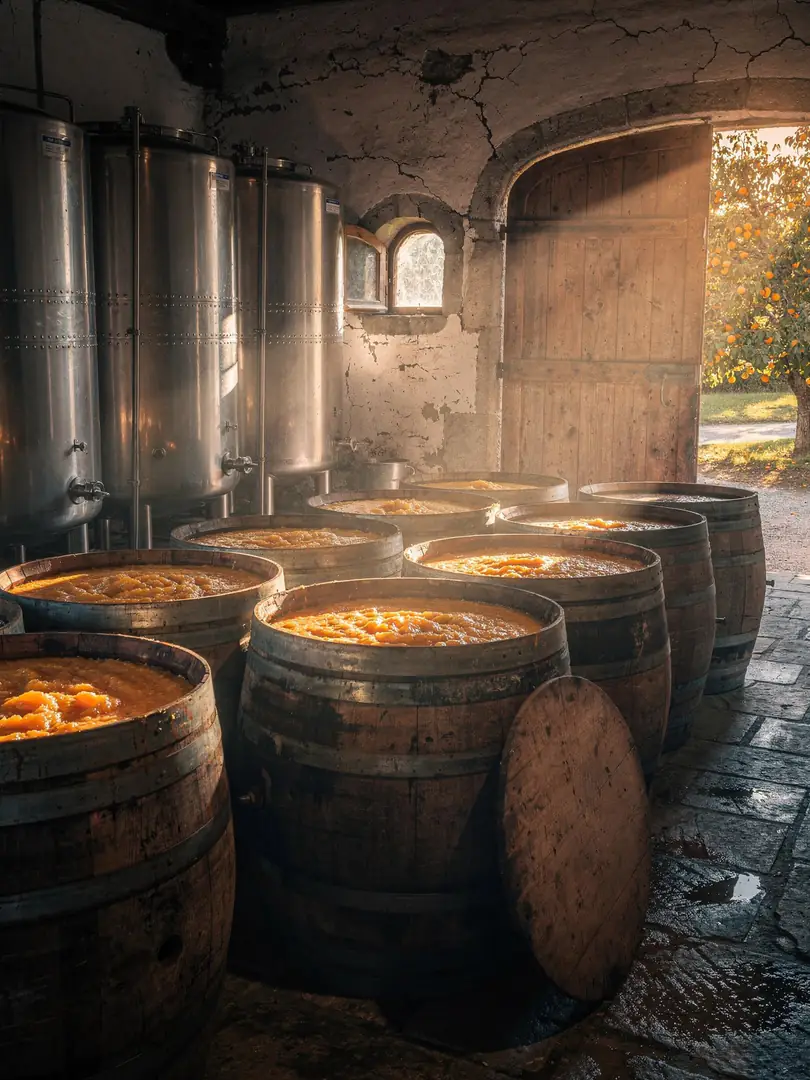
Then the yeast takes over. It converts the fruit sugar into alcohol, and in fruit brandy no added sugar or outside alcohol is permitted. The mash sits in wooden vats or stainless steel tanks, kept cool and tightly sealed so that no oxygen reaches the fruit and no acetic acid develops. The same principle of fermented mash underlies pomace brandy too, only there it's grape skins and seeds that ferment.
With apricot and plum, the pit brings a delicate almond note into play. Südtiroler Zwetschgeler's specification explicitly describes it with subtle almond tones. Too much of this is a flaw: crushed pits release hydrocyanic acid, which can turn into ethyl carbamate under light exposure, a substance that has no place in the brandy.
How long fermentation takes depends on the fruit, the warmth and the yeast; for stone fruit it's often a matter of several weeks. Only once the sugar is used up is the mash ready for distilling, and the distiller smells and tastes it to judge whether fermentation was clean. A spoiled mash yields no good brandy, not even in the finest copper still.
Gentian mash is a special case. The roots are harvested in autumn, cut into small pieces and placed in vats, where they ferment. Here the sugar sits not in fruit flesh but in the root itself, and fermentation proceeds slowly. The mash smells earthy and bitter long before the first drop is distilled.