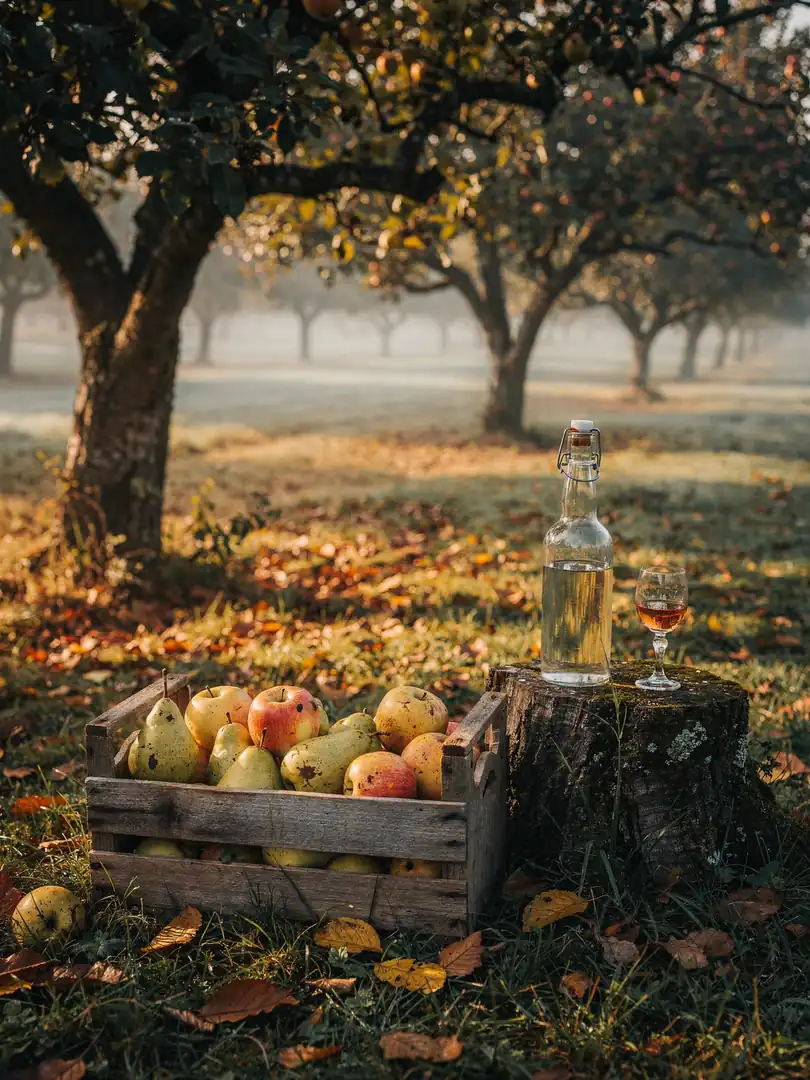
Apple and Pear
What Is an Obstler? Apple, Pear, and the 85-Percent Rule
An Obstler is a fruit brandy whose mash consists of at least 85 percent apples, pears, or both. Up to 15 percent may be other fruits or berries. A pure apple-and-pear brandy is possible, then, but not mandatory.
The Obstler Rule: At Least 85 Percent Apples and Pears
Obstler is one of the few blended brandies for which the Spirit Drinks Regulation reserves its own name. As a general rule, a brandy made from several fruits is simply called fruit brandy, with the fruits listed in descending order of quantity. For apples and pears, the law makes an exception. If at least 85 percent of the mash comes from these two pome fruits, the brandy may be called Obstler.
How that 85 percent is split is left open. An Obstler can consist of almost entirely apples, or mostly pears, and mixing different varieties is explicitly permitted. The remainder, at most 15 percent, may come from other fruits or berries. Otherwise, the usual fruit brandy rules apply: fermented fruit, at least 37.5 percent alcohol, no outside alcohol, no flavoring, maximum 18 grams of sugar per liter.
A common assumption holds that an Obstler must be 100 percent apple and pear. The law doesn't actually demand this. Many distillers stick to it anyway, since a pure pome fruit brandy tastes cleaner. Anyone who wants certainty should ask the producer or check the back label.
Why Apples and Pears Specifically?
Pome fruit grows abundantly across the Alpine region and the hilly landscapes of southern Germany, especially on traditional orchard meadows with old standard trees. Many of these fruits are too tart, too small, or too blemished to sell as table fruit. In the mash, such cosmetic flaws matter little, as long as the fruit is ripe and sound. The Obstler was therefore long the farmhouse brandy, made from whatever the orchard produced each autumn.
In terms of flavor, the apple contributes freshness and acidity, the pear fullness and a softer aroma. A well-made Obstler shows both, without either fruit overpowering the other. Because cider apples and perry pears are often tarter than table fruit, classic Obstlers tend to taste rustic rather than perfumed. Rotten or moldy fruit, on the other hand, leaves off-flavors that no amount of distilling can remove.
Südtiroler, Franconian, and East Tyrolean Obstler
Two fruit brandies have been protected as geographical indications in the EU since 1989: Südtiroler Obstler and Fränkischer Obstler. These names may only be used for brandies that come from the respective area and meet its rules. Since 2019, Pregler, also called Osttiroler Pregler, has also been protected. It is a fruit brandy made from apples and pears from the Lienz district, sourced from plantations, meadow orchards and individual trees. The raw material, distillation and production must all take place there.
A protected Bodensee-Obstler, by contrast, does not exist. A joint application from Germany, Austria and Switzerland was filed in 2019, but it is listed as withdrawn in the EU register. Bodensee-Obstler on the market is therefore a producer's indication of origin, not a protected designation with its own rules.
Obstler, Apfelbrand, Calvados: three paths to the apple
Anyone who distills only apples is not making an Obstler but an Apfelbrand (apple brandy). It also falls under Category 9 and carries the fruit in its name. South Tyrol, for example, is home to the protected single-variety brandies Südtiroler Golden Delicious and Südtiroler Gravensteiner. Much the same applies to Birnenbrand (pear brandy), with one special feature: only a pear brandy made exclusively from the Williams variety may be called Williams.
Calvados takes a different path. It isn't distilled from fruit mash but from already-fermented apple and pear wine, cidre and poiré. Legally, this is its own category: brandy from apple or pear wine. Many tasters describe cidre brandies as rounder and more wine-like, while mash-based brandies come across as fresher in fruit character.
The fruits also differ when it comes to methanol. For apple and pear brandies, the regulation allows up to 1,200 grams of methanol per hectoliter of pure alcohol, and 1,350 for Williams pears. These upper limits exist because methanol comes from the fruit's pectin, a substance found in cell walls. Every fruit brandy therefore contains some, even a cleanly distilled one.