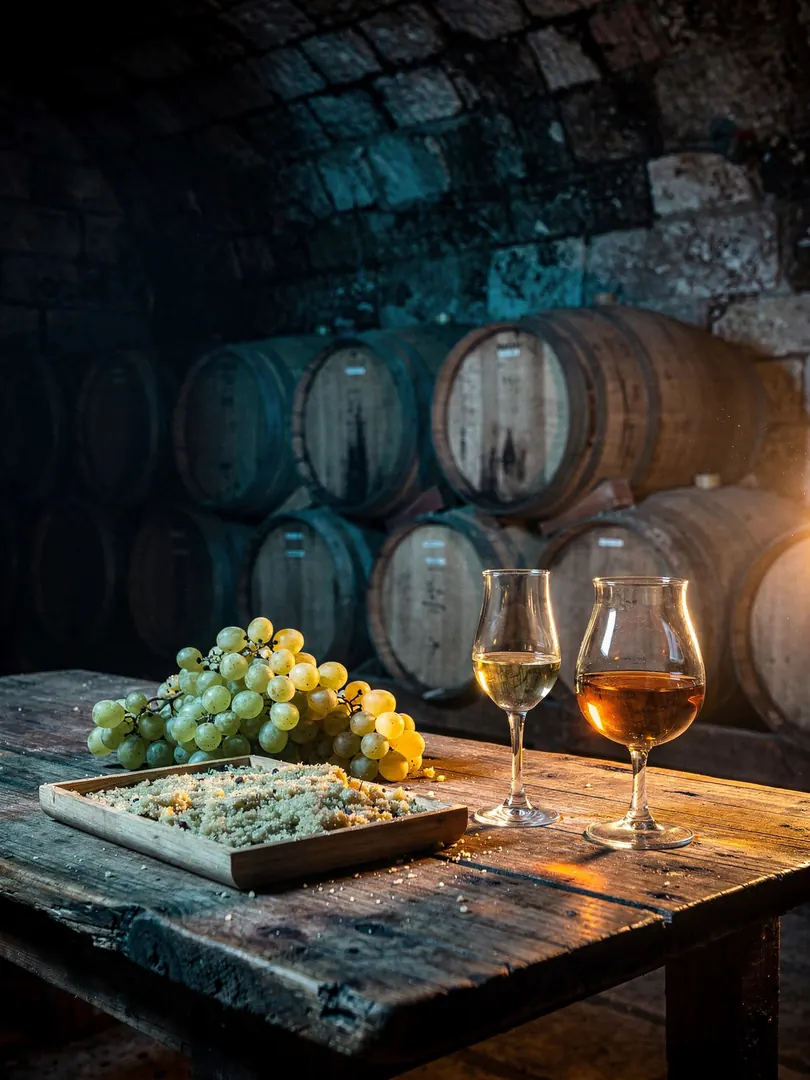
The Grape Family
From Grapes: Weinbrand, Pomace Brandy, and Branntwein at a Glance
Several brandy types legally originate from grapes: Branntwein from wine, Weinbrand or Brandy from oak-aged Branntwein, pomace brandy from fermented skins and seeds, and lees brandy from the sediment. Cognac, Grappa, and Pisco are designations of origin within this family.
Branntwein: The Distillate from Wine
It starts with wine, usually a high-acid, rather light white wine. When distilled, it becomes Branntwein under EU law, category 4, known in French as eau-de-vie de vin. It requires at least 37.5 percent alcohol, with no aging required. Added alcohol and flavoring are prohibited, though caramel coloring may be used to adjust the color.
Surprising to many: Cognac and Armagnac are listed in the EU register as geographical indications within this category—in other words, as Branntwein. Their own rules, however, are significantly stricter than the EU minimum. Cognac, for instance, must be double-distilled in a Charentais still and aged at least two years in oak. Every Cognac therefore also meets the minimum rules for Weinbrand, but not every Weinbrand is Cognac.
Weinbrand and Brandy: Branntwein with Oak Aging
Weinbrand and Brandy are legally the same thing, category 5. The base is Branntwein that must age in oak: at least one year in containers of 1,000 liters or more, or at least six months in smaller casks. The minimum alcohol content, at 36 percent, is actually lower than that of Branntwein. Up to 35 grams of sugar per liter are permitted.
The German word Weinbrand is younger than it sounds. It was coined by Hugo Asbach and registered as a trademark on November 11, 1907. Since 1923 it has been a generic term in German wine law, after the Treaty of Versailles reserved the name Cognac for France. Protected Weinbrands in the EU include Deutscher Weinbrand, Pfälzer Weinbrand, Wachauer Weinbrand, and Brandy de Jerez.
Brandy de Jerez shows just how differently Weinbrand can age. It matures in a solera system, in casks that previously held Sherry, continually topped up with younger brandies across multiple cask tiers. Its classifications—Solera, Reserva, and Gran Reserva—are therefore based on average age. For other brandies, by contrast, any age statement must always refer to the youngest component.
Pomace Brandy: Grappa, Marc, and Their Relatives
Pomace is what remains after pressing grapes: skins, seeds, and sometimes stems. Fermented and distilled, this becomes pomace brandy, category 6. The first distillation must take place with the pomace present, either directly with steam or after adding water. A minimum of 37.5 percent alcohol is required, and aging is optional.
Pomace brandy goes by a different name in every country. In Italy it's called Grappa, in France Marc, in Spain Orujo, in Portugal Bagaceira, in Greece Tsipouro or Tsikoudia, in Cyprus Zivania, in Hungary Törkölypálinka, and in Georgia Chacha. All follow the same basic principle. They have little in common with Weinbrand, since they're made from the residues of winemaking rather than from the wine itself.
The name Grappa is reserved for Italy within the EU. Switzerland, too, has secured its own names through its agricultural agreement with the EU, such as Grappa del Ticino. A pomace brandy from Germany or Austria is therefore called Tresterbrand, Trester, or Treber, even if it's made in a very similar way. The law allows pomace brandy up to 1,000 grams of methanol per hectoliter of pure alcohol, compared to just 200 for Branntwein, since skins carry more pectin than wine.
Lees Brandy, Currant Brandy, and Pisco: The Edges of the Family
After fermentation, a sediment settles in the cask—the lees, or wine lees. This too can be distilled. Lees brandy, category 12, requires at least 38 percent alcohol and is often described as yeasty and winey. Rarely encountered is currant brandy, made from dried berries of the Black Corinth or Muscat of Alexandria varieties.
Pisco doesn't fit neatly into this scheme. Peruvian Pisco is distilled from freshly fermented grape must, without added water and without wood aging, and has been listed in the EU register since 2009 under the fruit spirit category. The Croatian grape brandy Hrvatska loza is also classified there. Chile likewise claims the name Pisco, with its own rules that permit wood aging and the addition of water.
One question is enough for orientation: What was distilled? Wine yields Branntwein and, after oak aging, Weinbrand; pomace yields pomace brandy; lees yield lees brandy. Everything else—from terroir to age classification—is governed by designations of origin. Their details have their own chapters elsewhere in this brandy journey, from Cognac and Armagnac to Grappa and Marc.