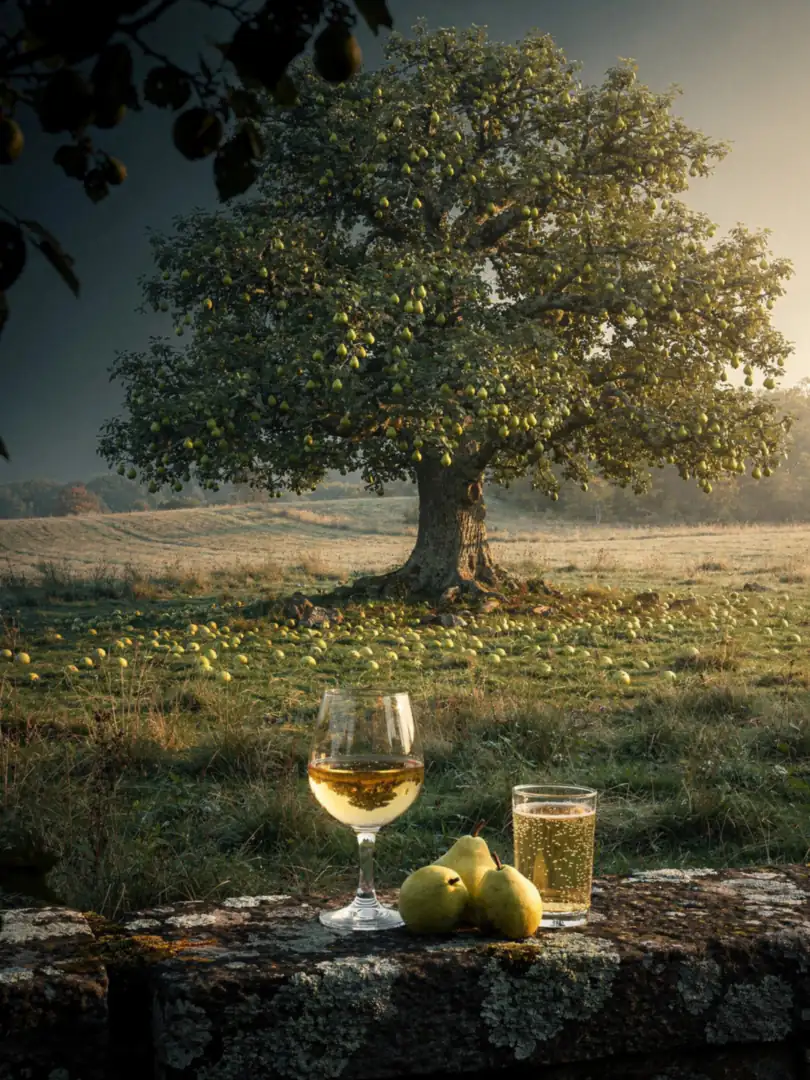
Perry pears and Williams pears
Poiré and pear brandy: the pear in Normandy and beyond
Pear brandy comes in two basic forms: as a brandy distilled from perry, as in Normandy, and as a fruit brandy made from fermented pear mash, as in the Alpine region. Calvados Domfrontais contains at least 30% perry pears, while a Williams brandy is made exclusively from pears of the Williams variety.
Poiré: Normandy's pear wine
In southern Normandy stand mighty pear trees, often taller than the farmhouses beside them, lasting for generations. Their fruit is small, hard, and so astringent that almost no one eats it raw. For Poiré, the fermented pear wine, they're ideal. The best-known variety is called Plant de Blanc, contributing acidity, freshness, and a delicate, floral scent. Poiré is pressed like cider and fermented slowly, but tastes more delicate, often with notes of white peach and white blossom.
As a drink, this pear wine has its own protected designation, Poiré Domfront. For distillers, it's primarily a raw material. Besides sugar, perry pears contain plenty of tannins, which lend structure during distillation and in cask. Because pears spoil faster than apples and their juice ferments more unpredictably, working with them is considered more demanding. That explains why pure brandies distilled from Poiré are far rarer than those from cider.
Pear brandy from Poiré: Domfrontais and Eau-de-vie de poiré
The pear features in several Norman brandies. In simple Calvados, Poiré may be blended in without a fixed proportion; in Pays d'Auge, up to 30% is allowed. In Calvados Domfrontais, the ratio flips: here at least 30% perry pears are mandatory, distillation takes place only in a column still, and the brandy matures at least three years in oak. Many Domfrontais contain considerably more pear, giving them a brighter, more floral character than Calvados from the north.
A brandy made entirely from pears bears the name "Eau-de-vie de poiré de Normandie," protected in the EU register since 1989. Legally, like Calvados, it falls under category 10, "brandy from perry." It's a rarity and shows most clearly what a brandy made from perry tastes like: less sweet and fruity than a Williams, but drier, with notes of pear skin, hay, and blossom. It shares its homeland with Calvados, but isn't allowed to carry the name.
Pear brandy from mash: Williams, Hirschbirne, Hohenlohe
In German-speaking countries, pears usually ferment whole in the mash and are then distilled into fruit brandy under category 9. The best known is Williams, which may only carry that name if made exclusively from pears of that variety. For Williams, the maximum methanol level is 1,350 grams per hectoliter of pure alcohol, versus 1,200 for other pears. In Valais, "Eau-de-vie de poire du Valais" is a protected designation of origin for Williams brandy.
There are also brandies from old perry and wild pear varieties. In Styria, Steirischer Hirschbirnenbrand is listed in the register of traditional foods; in Baden-Württemberg, Hohenloher Birnenbrand holds protected geographical status. Hungary protects a wild-pear brandy under the name Vasi vadkörte pálinka. In Austria's Mostviertel region, perry pears such as the Speckbirne shape the landscape. Its protected Birnmost, however, is a still pear must, not a brandy.
How do pear brandies differ in taste?
A Williams made from mash smells like the ripe fruit itself—juicy, sweet, and almost perfumed. Brandies from perry pears are more austere, with notes of skin, spice, and sometimes a faintly earthy tone. A brandy distilled from Poiré is the most restrained of all: dry, delicate, floral, and often with a light acidity. Add oak, as with Domfrontais, and vanilla, honey, and nut notes join in, pushing the fruit further back.
When comparing, it's worth paying attention to the name on the label. If it says Williams or Birnenbrand, mash was the raw material. If it says Calvados Domfrontais or Eau-de-vie de poiré, perry went into the still. The differences resemble those between apple brandy and Calvados: mash brings intense fruit, while the detour through wine brings finesse and a winey note. Both paths lead to distinctive brandies, and neither is superior to the other.