Trade Along the Charente
Where Does the Word Brandy Come From? The Dutch and Cognac
The word brandy comes from the Dutch “brandewijn,” meaning burnt wine. Dutch merchants bought wine along the French Atlantic coast, had it distilled, and in doing so made the distillate from the Charente famous—the very spirit that would later become Cognac.
Brandewijn, Branntwein, Brandy: A Word Travels
The three words are siblings. Brandewijn, Branntwein, and brandy all describe the same thing: wine burned, or distilled, through heat. In English, the Dutch word wore down to “brandy.” Today it stands worldwide for distillates made from wine and, with a qualifier, from other fruits too, as in American “apple brandy.” That such a widespread word comes from Dutch reveals who dominated the brandy trade for so long.
Under German law today, brandy is a synonym for Weinbrand. EU Category 5 is called “Brandy or Weinbrand” and requires at least 36% ABV and aging in oak. The older term Branntwein, by contrast, denotes in Category 4 a wine distillate for which no aging is prescribed. A single word used by seafaring traders has thus split into two legal terms with different rules.
Why Did the Merchants Distill the Wine?
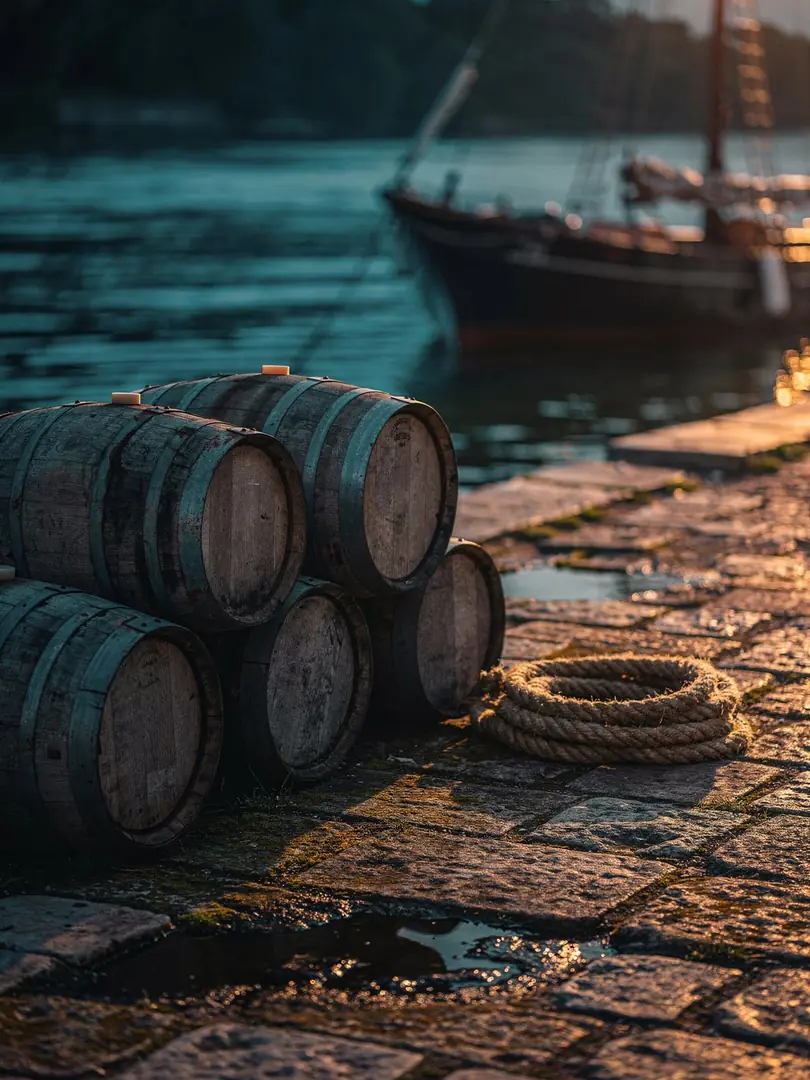
The Charente flows into the Atlantic, and its ports were easy to reach for the wine trade. Dutch ships collected wine there for northern Europe. On long sea voyages wine spoiled easily, and every barrel took up cargo space. A distillate kept better and needed far less space for the same amount of alcohol. For merchants who thought in terms of barrels and hold space, that was a strong argument.
According to the Cognac trade association BNIC, the Dutch therefore began distilling the region's wine and called the result "brandewijn." Later, it apparently became cheaper to distil on the spot to ship less volume, which is how the first stills came to the Charente. Tradition has it that the spirit was meant to be diluted with water again at its destination. Whether that was actually done everywhere is not documented.
A similar trading logic appears with Port wine. There, the fermenting wine is fortified with brandy, stopping fermentation and leaving sweetness in the wine. It's often said this was invented so the wine would survive the sea voyage to England. Whether that was the only reason remains open. What is certain is that distillate and maritime trade were closely linked during this era, on the Charente just as on the Douro.
Double-distilled: how a trade good became Cognac
From the 17th century onward, the common account holds that double distillation became established in the region. The wine is first distilled into a weak raw spirit, the "brouillis," and then distilled a second time into the "bonne chauffe." Distillation takes place in the Charentais still, a copper pot still over an open flame. This method remains mandatory for Cognac to this day; a column still is not permitted, and distillation must be completed by March 31 following the harvest.
The great trading houses whose names are still known today emerged in the 18th century. Jean Martell founded his house in 1715, Rémy Martin followed in 1724, Hine and Delamain in 1763, and Richard Hennessy, an Irishman, in 1765. The spirit from the Charente thus became an export good with its own brands. It's often said that the merchants discovered the value of cask aging because the spirit mellowed in wood while waiting for ships. This is documented as anecdote, not as a dated fact.
Traces of the Dutch: Armagnac and Jerez
In Armagnac too, Dutch merchants were important buyers in the 17th and 18th centuries, according to the appellation's specifications. In Andalusia, the wine distillate from which Brandy de Jerez is made is still called "holandas" today. The name recalls the merchants from the north. This brandy is aged in the solera system in casks that previously held Sherry, and its age classifications are based on average age.
What remains of this history? The name Cognac is now strictly protected: the area has been delimited since 1909, and the appellation has existed since 1936. Grape varieties are prescribed, as is double distillation, a minimum of two years in oak, and a minimum of 40% ABV for sale. Every Cognac thus meets the minimum rules for brandy, but not every brandy is a Cognac. The word brandy, on the other hand, belongs to anyone who distils wine and ages it in oak.