Rights from above
Distilling rights as privilege: Oberkirch 1726 and the Krautinger
Distilling was long a privilege granted by the authorities. In 1726, the Bishop of Strasbourg permitted farmers around Oberkirch in the Black Forest to distil surplus fruit. In the Tyrolean Wildschönau, the right to produce Krautinger dates back to the time of Maria Theresa.
Why was distilling a privilege?
Whoever distils turns fruit, wine, or beets into a valuable and readily tradeable good. For territorial rulers, this meant two things: a source of taxes and an activity they wanted to keep an eye on. That's why distilling was tied to permits in many areas, permits belonging to specific places, farms, or individuals. Such rights help explain why distilling culture is dense in some valleys today and nearly absent in others.
These privileges said little about technique or taste. They regulated who was allowed to distil, which raw material, and sometimes how much. These same three questions still determine distilling rights today, even though the reasoning has changed. In the past it was about rule and taxes; today it's about tax law, food safety, and preserving traditional orchards.
Oberkirch 1726: distilling rights for farmers in the Renchtal
Oberkirch lies in the Renchtal at the western edge of the Black Forest, in the Ortenau region. In 1726, the Bishop of Strasbourg, Armand Gaston de Rohan, granted the local farmers the right to distil surplus fruit. At the time, the area fell under the secular rule of the Bishop of Strasbourg. In 2026 this distilling right thus marked its 300th anniversary; a cuvée created for the occasion is called "Heimatkirsch 1726."
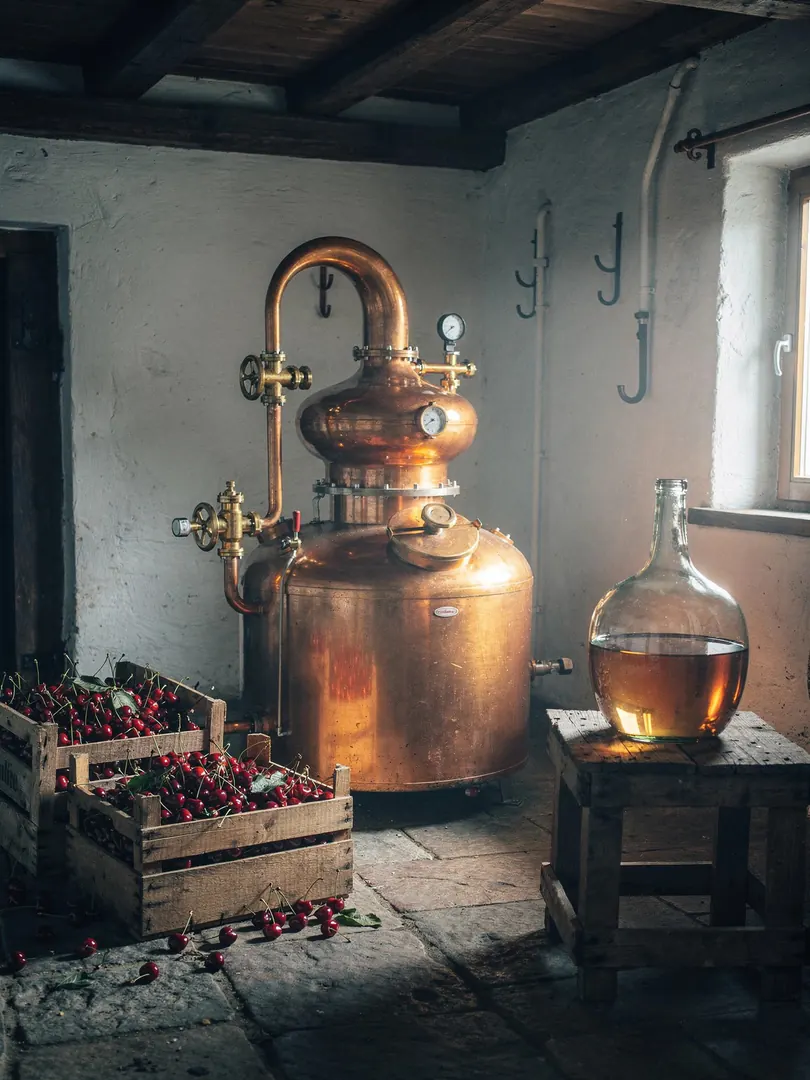
The consequences shape the valley to this day. According to Schwarzwald-Tourismus, there are around 700 home and farm distilleries around Oberkirch, and the region advertises itself as having the highest density of small distilleries in Europe. That's a marketing claim, not official statistics. What is certain is that cherries and other fruit from the traditional orchards there have been turned into spirits in small distilleries for generations, and that old cherry varieties bred for distilling are being replanted.
The Krautinger: a beet spirit with a special right
A particularly distinctive privilege has survived in the Wildschönau in Tyrol. There, Krautinger may be distilled, a spirit made from stubble turnips, white autumn turnips that grow in the fields after the grain harvest. The distilling right dates back to the reign of Maria Theresa, 1740 to 1780, and originally applied to 51 farms, exclusively in this valley. In 1942, when Austria was part of the German Reich, it was confirmed by Berlin.
Austria's Ministry of Agriculture lists Wildschönauer Krautinger in its register of traditional foods and describes its flavor as highly distinctive. Without the old special right, this spirit probably wouldn't exist in its current form. The example shows how a privilege can bind a product to a place long before there was anything like a designation of origin in the modern sense.
In Austria, there is also frequent mention of a "Maria Theresa distilling right" for farmers, allowing quantities of up to 400 liters. This figure is not reliably documented. What is documented, however, is today's tax-free home distilling: a farmer and their spouse may together produce 15 liters of pure alcohol tax-free, or up to 27 liters including family members; in Tyrol and Vorarlberg, higher limits apply, up to a maximum of 50 liters of alcohol.
What became of the old distilling rights?
In Germany, the distilling right of an Abfindungsbrennerei (flat-rate distillery) was tied to the farm until the end of 2017 and passed to the successor along with the property. Since January 1, 2018, there has no longer been a distilling right in the old sense, only a personal permit. Farm successors must reapply for it within three months. The term lives on nonetheless, for instance in the "300-liter distilling right," a colloquial way of referring to the permitted 300 liters of pure alcohol per year.
Across the Atlantic too, a date shows how early states began registering distilleries: Laird & Company in New Jersey holds US Treasury License No. 1, dated 1780, and is considered the oldest licensed distillery in the United States. The basic principle has remained the same everywhere: distilling is permitted as long as the state knows about it and collects taxes. Anyone who distils without a permit in Germany violates the Alcohol Tax Act, even for the smallest quantities.