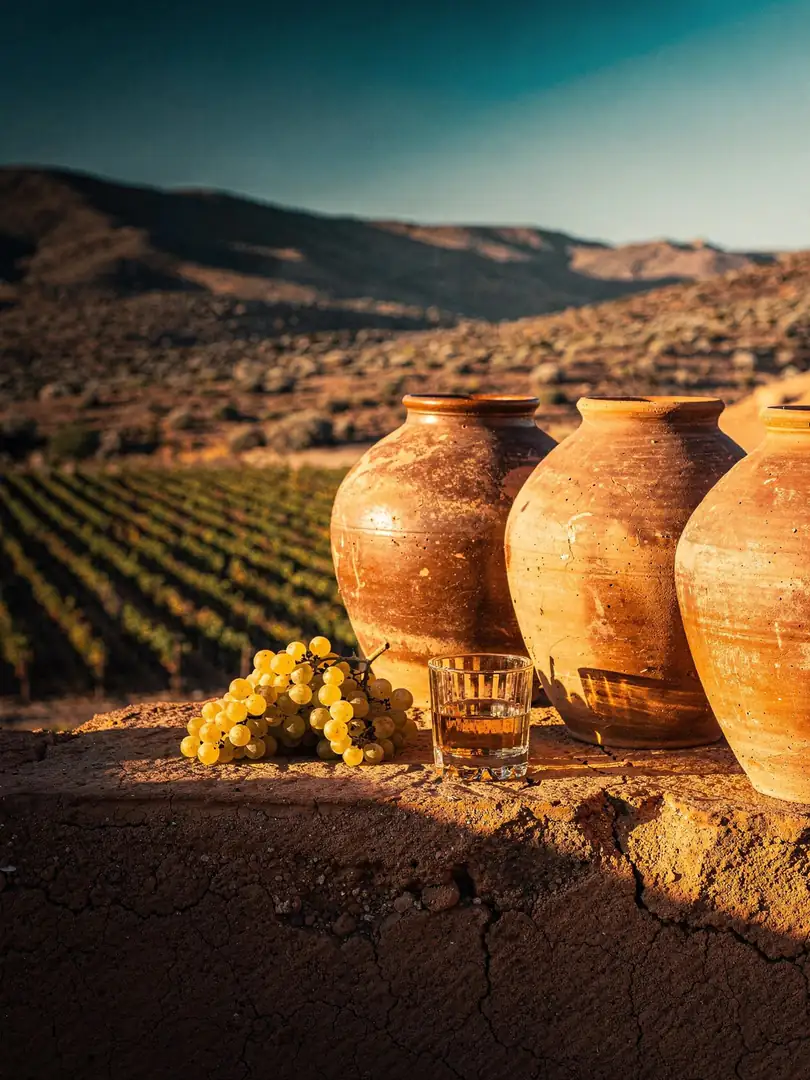
One name, two countries
Pisco: Does the Name Belong to Peru or Chile?
Pisco is a grape brandy from South America claimed by both Peru and Chile as a designation of origin. Peru points to the port of Pisco on its southern coast, while Chile points to its own distilling tradition. Many markets allow both, provided the origin is stated on the label.
Where does the name Pisco come from?
The Spanish brought grapevines to the west coast of South America in the 16th century, and it wasn't long before the wine was also being distilled into brandy. On the southern coast of present-day Peru lies the town of Pisco, named after the valley in which it sits. During the colonial era, its port was an important hub for the distillate, which is said to have taken its name from there. Sailors carried it from there to other ports.
Peru bases its claim on this origin. Chile points out that grape brandy has long been produced under this same name in its northern valleys as well. Who is historically correct remains a political dispute to this day. What matters more for understanding what's in the glass is that the two countries have established different rules.
Chronicle of a naming dispute
Chile created the first legal protection: in 1931, Chilean Pisco received a designation of origin. In 1936, the village of La Unión in the Elqui Valley was renamed Pisco Elqui, which in Peru is seen as a sign of Chile's claim to the name. Peru protected Pisco as a designation of origin in 1991. These three dates come from trade and travel media and have not been officially verified here.
Within the EU, Peruvian Pisco has been registered as a geographical indication since July 27, 2009. Chilean Pisco has no separate entry in the EU register; it is instead governed by special rules under the trade agreement between the EU and Chile. In many countries, both sit side by side on the shelf, labeled, for instance, "Pisco – Perú" or "Pisco chileno."
It's notable where the EU register classifies Peruvian Pisco: under Category 9, among fruit spirits, rather than among wine distillates like Cognac or Armagnac. This makes little difference to buyers, but it shows how awkwardly a New World spirit fits into European categories. The register does not rule on who the name rightfully belongs to; it simply records what was applied for and registered.
Difference between Peruvian and Chilean Pisco
The differences go beyond politics. Under the Peruvian standard NTP 211.001, Pisco is made only from freshly fermented must of specific grape varieties, the "uvas pisqueras," and only in five regions: Lima, Ica, Arequipa, Moquegua, and Tacna. It is distilled in a single pass straight to drinking strength, according to available sources without any dilution with water, and rests for at least three months in glass, stainless steel, or clay — never in wood. Permitted strength ranges from 38 to 48% ABV.
Chile allows more latitude. Its designation of origin covers the regions of Atacama and Coquimbo. Water may be used to reduce strength, and wood aging is permitted, which is why some classes take on color from the barrel. According to industry sources, alcohol content ranges from 30 to 50% ABV. A Chilean and a Peruvian Pisco can therefore differ considerably, even though both are distilled from grapes.
Whether wood is used or not is more than a technical question. A spirit without barrel aging shows unfiltered what the grape and fermentation contribute; a spirit aged in wood gains color, tannins, and notes of vanilla or toasting. The Peruvian rule favors the former, while the Chilean rule allows for both.
Pisco, Singani, Grappa: what sets them apart
Pisco is distilled from fermented grape must, not from pomace. This places it closer to wine distillate than to Grappa, which is made from the pressed grape remains. Because Peruvian Pisco is not aged in wood, it lacks the vanilla and oak notes of a brandy; the grape takes center stage, often with a floral aroma in the case of aromatic varieties.
In neighboring Bolivia, there is another grape brandy with its own designation of origin: Singani. It is distilled from Muscat of Alexandria, grown on vineyards at elevations of at least 1,600 meters, centered around Tarija. Singani is not a Pisco, even though the two are often mentioned in the same breath. Outside South America, many people know Pisco chiefly from the Pisco Sour, a cocktail made with Pisco, lime, sugar, and egg white.