Crisis and New Beginnings
Phylloxera and Spirits: Cognac 1875, Wachau 1890
Phylloxera, an insect accidentally introduced from North America that attacks vine roots, reached the Charente around 1875. By about 1893, the region's vineyard area had shrunk from 280,000 to 40,600 hectares. The crisis transformed grape varieties, spirits, and even fruit-growing landscapes like the Wachau.
What Does Phylloxera Do to Vines?
The damage begins invisibly underground. Phylloxera, a tiny insect, feeds on the roots of the grapevine. On European vines, this causes growths and wounds through which rot can enter; the roots die off, and the vine perishes within a few years. American wild vines, by contrast, are more resistant, having evolved alongside the pest in their native habitat.
In the 19th century, the louse arrived in Europe with plant material from America and spread from vineyard to vineyard. In the end, grafting became the solution: European scion wood is grafted onto American rootstocks, which can withstand phylloxera. The grape remains European, but the root is American. This is how most vines in Europe still grow today.
For fruit brandies, phylloxera posed no direct problem, since it only attacks grapevines. Cherries, plums, apples, and pears were unaffected. For this very reason, fruit could take the place of wine wherever viticulture collapsed. For Cognac, Armagnac, and all other wine-based spirits, however, the raw material was missing until the vineyards were replanted with grafted vines, a process that took years.
Cognac After Phylloxera: From Folle Blanche to Ugni Blanc
For Cognac, phylloxera marked a profound turning point. According to the appellation's specifications, it reached the Charente around 1875; by about 1893, only 40,600 of the original 280,000 hectares of vines remained. Without wine, the raw material for the spirit was missing for years. The stills stood idle not because no one wanted to distill, but because there was nothing left to distill.
The rebuilding also brought a change in grape variety. Before phylloxera, Folle Blanche was the region's most important grape. According to industry sources, it is prone to rot because its berries grow in tight clusters, and it proved harder to graft onto American rootstocks. Ugni Blanc, known in Italy as Trebbiano Toscano, coped better with these conditions.
Today, Ugni Blanc covers over 98% of the 87,648 hectares of Cognac vineyards, according to the industry association's 2026 figures. The variety produces a high-acid, low-alcohol wine that yields little as a drinking wine but is well suited to distilling. The fact that Cognac is now almost a single-variety spirit has its roots in the phylloxera crisis.
Armagnac: A Grape Variety Born of Necessity
In Armagnac too, growers searched for vines that could cope with the new conditions. In 1898, François Baco bred Baco Blanc, also known as Baco 22A. It is a hybrid, a cross between a European vine and American vine species. Such crosses were meant to be more resistant to pests and diseases without entirely losing the character of the wine.
In many wine regions, hybrid grape varieties are not permitted for quality wine. In Armagnac, however, Baco blanc is one of the ten permitted grape varieties of the appellation, while in Cognac it's absent from the list. This small rule shows just how differently the two neighbors responded to the same crisis.
Wachau: Apricots Where Vines Were Lost
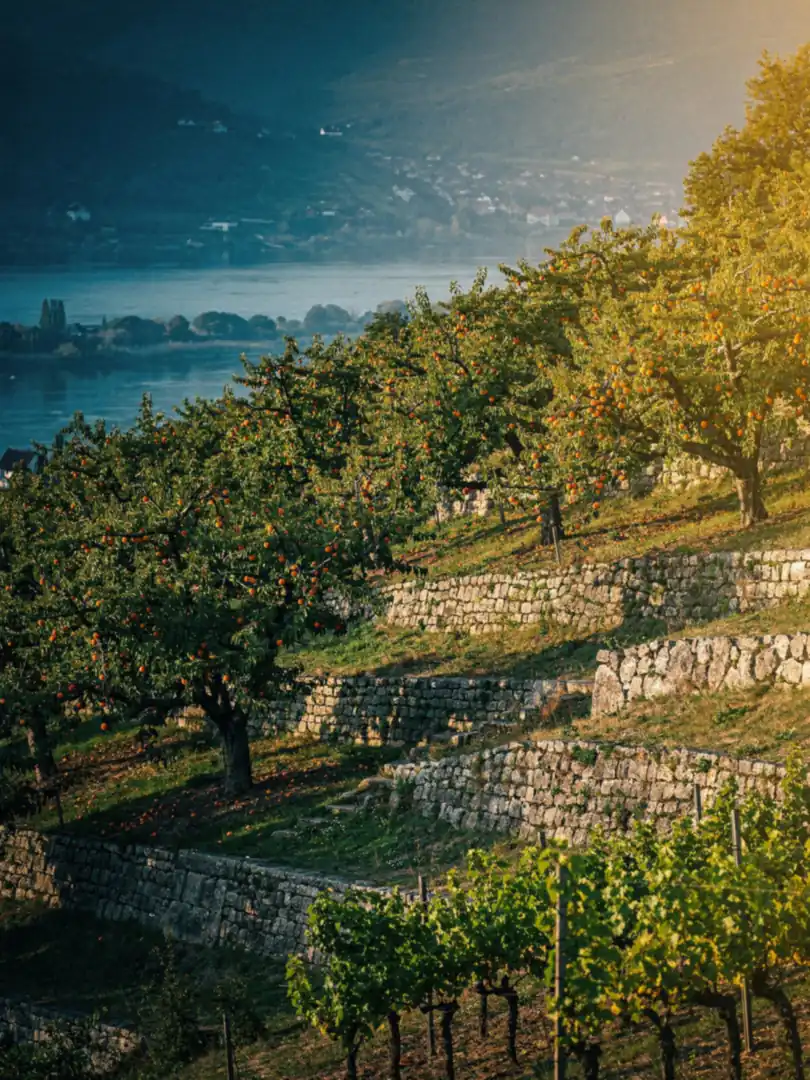
Phylloxera struck Austria too. In the Wachau, the Danube valley between Melk and Krems, apricot trees have been documented since 1509. Around 1890, following the damage caused by phylloxera, cultivation expanded significantly. Where vines were lost, farmers turned to Marillen, as apricots are known in Austria. A crisis in viticulture thus gave rise to an orchard landscape now famous well beyond the valley.
This development produced one of Austria's best-known geographical indications for brandy. "Wachauer Marillenbrand" has been protected as a geographical indication since Austria joined the EU in 1995. It comes from 21 municipalities, is distilled only in simple pot stills and never continuously, and must have a minimum ABV of 38%. The fruit itself has been registered as "Wachauer Marille" with protected designation of origin since 1996. Brand and fruit are therefore two separate protections, and "Wachauer Marillenlikör" is yet another thing entirely: a liqueur, not a brandy.