The 19th Century
Column and Potato: How Distilling Became an Industry
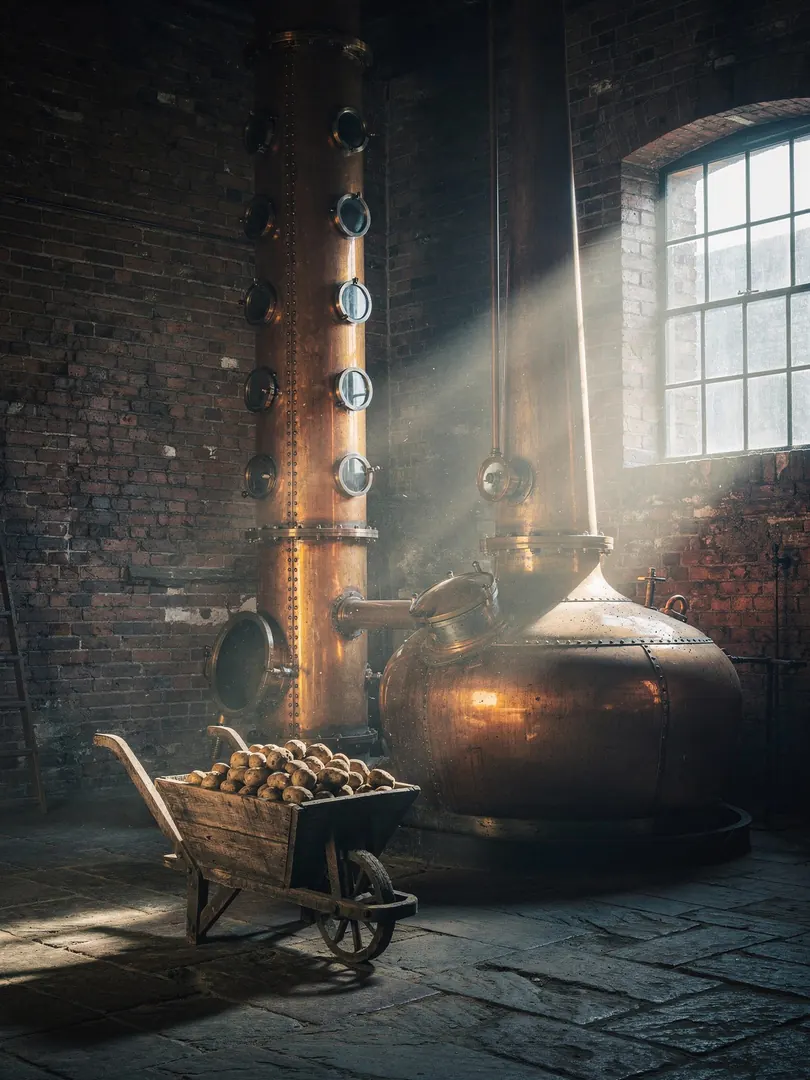
In the 19th century, distilling became an industry: new apparatuses with columns worked without pause and delivered stronger alcohol than the old pot still. In Prussia, this turned potato spirit into a mass product; in Ireland, the Coffey column emerged.
Pot Still or Column: What Changed
For centuries, distilling was done in pot stills. A still is filled, heated, and emptied again after each run; experts call this discontinuous, meaning it's interrupted. Anyone wanting a stronger, cleaner spirit would distill a second time. That cost time, labor, and firewood, and the quantity remained limited.
The column works differently. In a tall tower with plates, the fermented raw material continuously flows downward while steam rises from below. On each plate, part of the liquid evaporates and condenses again, almost as if it were being distilled many times in succession. This produces a significantly stronger distillate in a single pass, and the apparatus can run without interruption. This was the prerequisite for distilleries on a factory scale.
Armagnac 1814: The Column in Southwest France
An early example comes from Gascony. The Armagnac appellation's specifications cite a 1814 patent by Tuilière in Auch, the main town of the Gers, for a still that worked continuously. Today, the "alambic armagnacais" is the region's primary method: a column with plates, heated over an open flame and operated in a single pass. Every distilling operation must have at least one such apparatus.
Notably, Armagnac doesn't use its column for mass production. The distillate leaves it at 52 to 72.4% ABV, far below the strength of neutral alcohol, retaining much of the wine's aroma. In 2012, 95% of the base wine ran through such columns. Many winegrowers still have their distilling done today by traveling distillers, who move from farm to farm with their equipment.
Pistorius 1817: Potato Spirit from Prussia
In Prussia, the new technology had different consequences. On March 21, 1817, Johann Heinrich Leberecht Pistorius received a patent for a still that could extract alcohol at 60 to 80 percent from potato mash. Potatoes were cheap and available in large quantities. According to regional historical sources, this turned Berlin into a center of the brandy trade; by 1831, the Province of Brandenburg is said to have had over 1,400 potato distilleries.
Potatoes require an intermediate step, however. They contain starch but almost no sugar, and yeast can only ferment sugar into alcohol. So the starch must first be broken down and, traditionally with the help of malt, converted into sugar. With fruit, this step is unnecessary, because the ripe fruit brings its own sugar. This is also one reason why potato distilleries grew into factories while fruit distilleries often remained small operations.
Many of these distilleries were located on large estates. The mash residue, known as draff or spent wash, served as animal feed, while the alcohol was sold. This link between agriculture and distilling shaped the industry in northern and eastern Germany for a long time. It also explains why the monopoly administration later took over the alcohol from agricultural potato and grain distilleries, until September 30, 2013. The details of the spirits monopoly are covered in the themed journey on distilling rights.
Coffey 1830 and the Boundary with Fruit Brandy
In 1830, the Irishman Aeneas Coffey patented a column still after stepping down from his post as Inspector General of the Irish Excise Board. His design became the model for many large distilleries, especially for grain whisky made from cereals. Earlier designs from France and Germany, including that of Pistorius, are considered precursors. So here too, there is no single inventor of the column still.
For fruit brandies, the powerful column never became standard. The reason lies in the goal: the more intensely a column separates, the more aroma is left behind, until almost neutral alcohol results in the end. EU regulation therefore requires that for fruit brandy, pomace brandy, and wine-based spirits, every distillation must stay below 86% ABV. The "Wachauer Marillenbrand" bans continuous distillation entirely, while Zuger Kirsch mandates the use of a Hafen still. Today, fruit distilleries commonly use a pot still fitted with a reinforcing column, a hybrid form combining both worlds.