The Pear in the Glass
How Does the Pear Get into the Bottle? The Riddle of the Williams
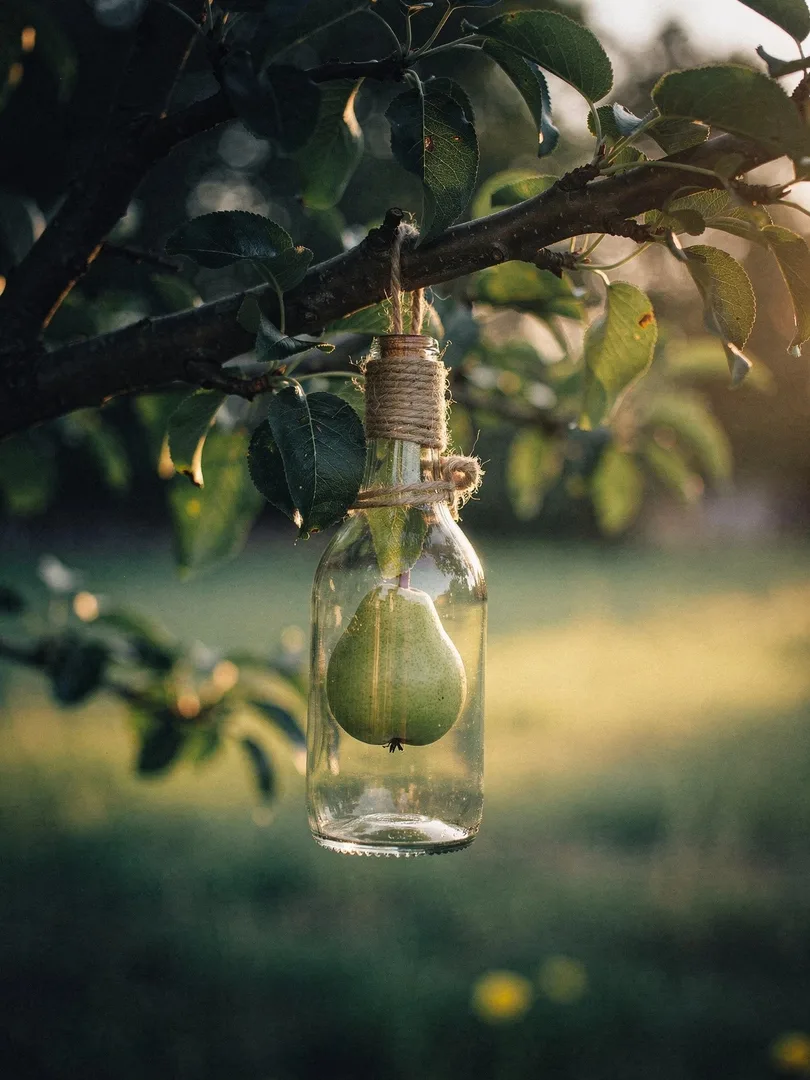
The pear doesn't pass through the neck of the bottle—it grows inside it. In spring, fruit growers slip empty bottles over young fruit buds still on the tree. The pear then ripens inside, is harvested bottle and all, and later the bottle is filled with pear brandy.
Pear in the Bottle: A Riddle with Many Wrong Answers
Few bottles draw as many stares in a distillery shop as this one: a whole, full-grown pear, far wider than the neck of the bottle, resting in clear brandy. Imagination tends to fill in the blanks. Some say the bottle is blown around the fruit, others that the base is cut off and glued back on. Others believe the pear is dried, pushed inside, and then swells back up in the alcohol.
None of these theories hold up. A glassblower could never shape a bottle around a piece of fruit without cooking it, and a glued seam would be instantly visible in clear glass. A dried pear, meanwhile, would never regain its smooth, plump shape. The real answer is older and simpler. It mainly takes patience and a pear tree—and it has nothing to do with distilling, but everything to do with fruit growing.
How Does the Pear Grow Inside the Bottle?
In spring, once the blossoms have faded and the first small fruits appear, growers carefully guide a young fruit bud into an empty bottle. The bottle is then fastened to the branch so its weight doesn't snap the twig. All summer long, the pear grows inside the glass, sheltered from wind and birds, but still bathed in sunlight.
This is painstaking handwork, and it doesn't succeed with every fruit. Confined to the bottle, a pear may grow misshapen, stay small, or drop too early. Once ripe, the stem is cut and the bottle, fruit and all, is taken down from the tree. It's then cleaned and filled with brandy. How many bottles end up with a perfect pear in the end depends on the year, the tree, and the grower's experience.
It's precisely this effort that gives the bottle its charm. Behind every one lies a full gardening year, from blossom to harvest. So it takes at least a year before the pear ever reaches a shop shelf.
Which Brandy Belongs with the Pear in the Bottle?
Most often, the bottle contains a Williams pear brandy. That makes sense, since the Williams Christ variety has a particularly intense, juicy aroma. Under EU law, only a pear brandy made exclusively from this variety may be labeled Williams. So a bottle bearing the word Williams guarantees a single-varietal brandy.
The pear itself is mainly a showpiece. The flavor comes from the brandy poured around it. The same rules apply to it as to any other fruit brandy: at least 37.5% ABV, no added alcohol, no flavoring, no coloring. The maximum methanol limit for Williams brandy, at 1,350 grams per hectoliter of pure alcohol, is slightly higher than for other pears, simply because the variety naturally contains more of it.
Pear Brandy, Pear Liqueur, Williamine: What's Really in the Bottle?
Not every bottle with a pear inside contains pear brandy. Sometimes the fruit sits in a pear liqueur, which is noticeably sweeter and lower in alcohol, or in a spirit flavored with pear. The difference lies in the label, not in the fruit floating inside. Pear brandy or Williams pear brandy means: distilled from fermented pears, with no added alcohol.
In Valais, Williams brandy even has its own protected designation of origin: Eau-de-vie de poire du Valais AOP, registered on December 21, 2001. Williamine, by contrast, is the brand name of a single producer from Martigny—not a category, and not a designation of origin. Pear-in-the-bottle spirits are offered by distilleries in several countries. They're part of fruit-growing tradition, and a reminder that behind many a riddle lies simply a summer's worth of patience.