Alcohol content and quality
More proof, better spirit? What alcohol content actually reveals
More alcohol doesn't make a spirit better. Alcohol content says something about style and legal framework, not about quality. Fruit brandy requires at least 37.5% ABV, brandy 36% ABV. Many master distillers bottle at 40 to 45% ABV, because alcohol at that level carries the aromas well.
Strong equals authentic? Where the belief comes from
At the local pub, a potent homemade spirit is often considered more honest than the bottle from the store. The logic goes: it burns, so it must be real. Behind this lies the experience that cheap spirits are sometimes bottled right at the legal minimum. From this comes the mistaken converse conclusion: the higher the proof, the better the spirit.
In fact, the percentage on the label measures only one thing: how much alcohol is in the liquid. The figure % vol stands for alcohol by volume. A spirit at 40% vol is therefore four-tenths alcohol, with the rest being mostly water. This number says nothing about the fruit, the fermentation, the distillation, or the care taken in making it.
Minimum alcohol: what the law requires for spirits
The EU Spirit Drinks Regulation sets a minimum alcohol content for each category. Fruit brandy, fruit spirit, pomace brandy, and brandy require at least 37.5% vol. Brandy or grape brandy need only 36% vol, while yeast brandy and Jerusalem artichoke spirit require 38% vol. Rules of origin often go further: Cognac, Armagnac, and Calvados must reach at least 40% vol before coming to market, Wachauer Marillenbrand at least 38% vol, and Zuger Kirsch at least 40% vol.
If a drink falls below these thresholds, it may not carry the corresponding name. A fruit-based drink with significantly less alcohol is therefore not a fruit brandy, but often a liqueur or a spirit without protected category status. The regulation sets no upper limit for most spirits. Peruvian Pisco is an exception with a defined range: 38 to 48% vol, distilled directly to drinking strength without the addition of water.
Why many spirits come in the bottle at 40 to 45 percent
Straight from the still, the heart of a fruit brandy comes out considerably stronger—Zuger Kirsch, for example, averages at least 68% vol. The spirit is then reduced to drinking strength with softened water. How far it's reduced is a matter of taste. Alcohol dissolves and carries aromatic compounds, which is why a spirit with a slightly higher percentage often feels fuller and more fragrant.
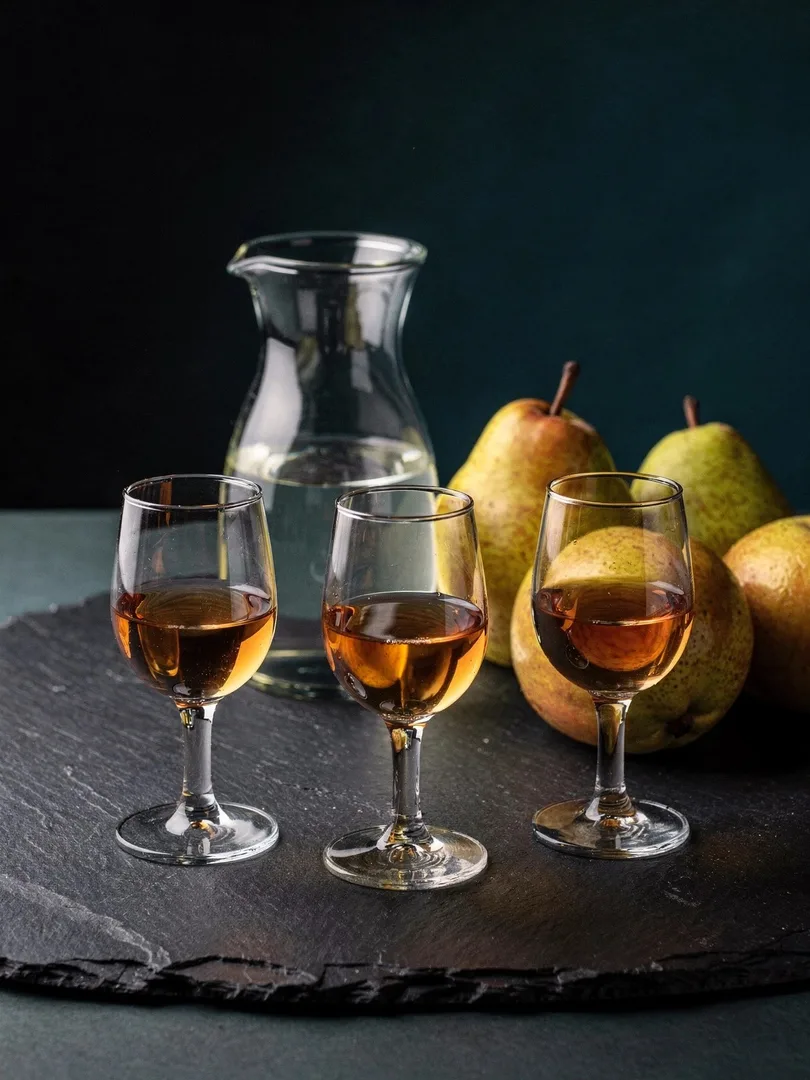
Too much alcohol, however, masks the fruit. It numbs the mucous membranes in the nose and mouth, and the delicate notes of a Williams pear vanish behind the heat. A skilled distiller searches, for each spirit, for the point where aroma and strength are in balance. This point can shift from fruit to fruit and from vintage to vintage—there's no fixed formula.
Cask strength and Esprit de Cognac: high proof for a reason
Some spirits are deliberately bottled at high strength. For barrel-aged spirits, there are cask-strength bottlings—meaning no dilution, just as they come from the barrel. These are aimed at connoisseurs who prefer to add their own drop of water. This has nothing to do with higher quality; it's simply a different style.
A special case shows just how little the percentage reveals about enjoyment: Esprit de Cognac is distilled a third time, reaching 80 to 85% vol, and is used exclusively in the production of sparkling wine. It is not meant for drinking. The number on the label, then, helps gauge the power of a spirit—but its quality is judged by nose and palate. One thing, however, always changes: with every sip of a stronger spirit, you take in more alcohol.