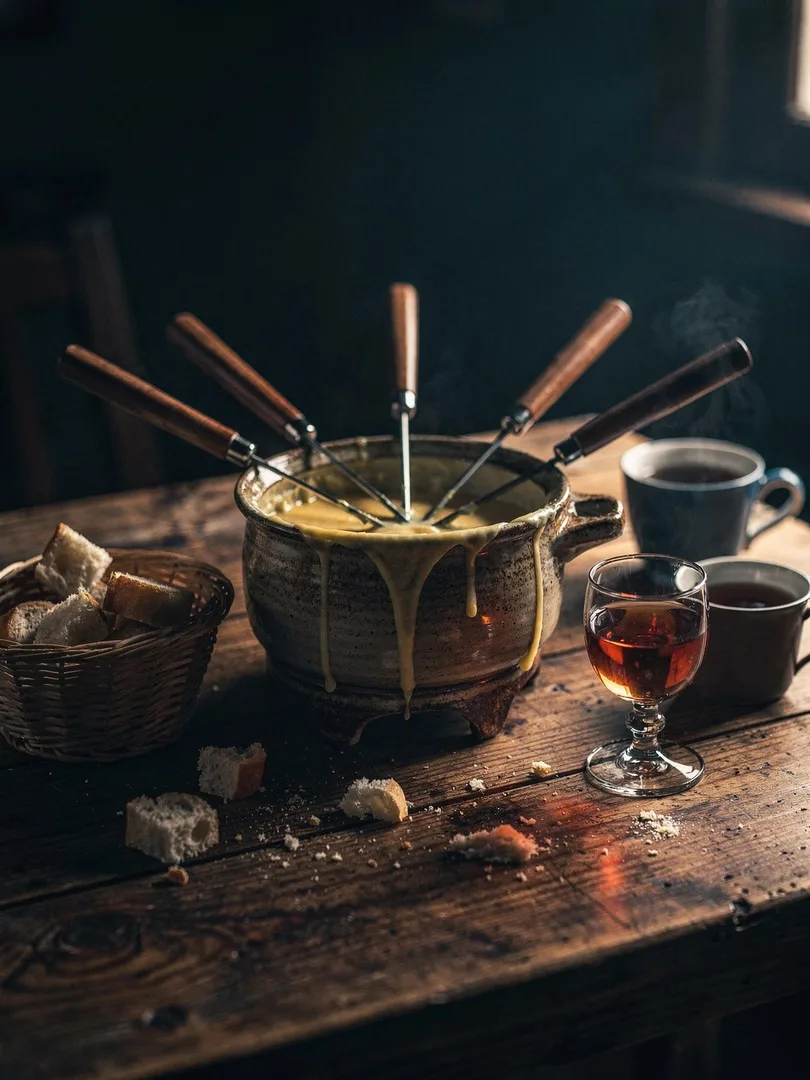
Digestif Put to the Test
Does Schnapps Help Digestion? What the Fondue Study Shows
No, a schnapps after eating does not speed up digestion. In a Zurich study (BMJ 2010), the stomach emptied significantly more slowly after cheese fondue with wine and kirsch than with tea and water. That pleasant feeling afterward is relaxation, not a faster stomach.
Digestif: Where Does the Belief Come From?
Pushing the plate aside after a rich meal and ordering a kirsch, fruit brandy, or Calvados: in many parts of Central Europe, that's simply part of the table culture. The brandy then carries a medical-sounding name, digestif. The French word literally means something meant to aid digestion. But a name alone proves no effect.
The belief has understandable roots. For a long time, brandies were considered medicine, and pharmacies and monasteries dispensed them as tonics. There's also a genuine experience behind it: after a glass, a full stomach often feels less heavy. Anyone who has felt that for decades takes the connection as proven. A research team in Zurich once put exactly this experience to a clean test, using the dish that traditionally comes with a kirsch in Switzerland.
The Zurich Fondue Study: What Happened in the Stomach
The team of gastroenterologists from the University of Zurich published the study in 2010 in the British Medical Journal, one of the leading medical journals. Twenty healthy adults ate the same cheese fondue on several occasions. They drank either white wine or black tea with it, followed by a small glass of kirsch or water. The order was randomized, and each participant went through several variations. Experts call this a randomized crossover study, because each participant also serves as their own comparison.
What was measured was gastric emptying, meaning how quickly food moves from the stomach into the intestine. To do this, the researchers added a labeled substance to the fondue that could later be detected in the breath. The result was clear: with tea and water, the stomach emptied significantly faster than with wine and kirsch. The more alcohol involved, the slower the process. The authors describe this as an inverse dose-response relationship.
Like any study, this one has limitations. Twenty participants is a small group, and only a single, very rich dish was tested. Still, the direction of the result matches what physiology has long described about alcohol and the stomach: larger amounts of alcohol slow gastric emptying rather than speeding it up. For the digestif, that's an inconvenient finding, since it's supposed to do the opposite.
Why Does the Stomach Feel Lighter After a Schnapps?
If the stomach works more slowly, why do so many people experience schnapps as a relief? The study itself offers an answer. Complaints like bloating or pressure didn't differ between the groups. So the alcohol didn't noticeably worsen how people felt, but it didn't measurably improve it either. Still, those who had eaten with wine and kirsch reported less appetite afterward.
That pleasant feeling has more to do with relaxation. Alcohol calms the nervous system, you lean back, the evening slows down. Add to that the aroma of a good kirschwasser, which feels fresh and clean after a heavy meal. That's a moment of pleasure, but not a stomach accelerator. Anyone genuinely seeking relief after a rich meal is, according to the measurements, better off with a cup of tea or a walk.
Fruit Brandy, Herbal Bitters, Trou Normand: Does This Apply to Every Digestif?
The study looked at kirsch, a classic fruit brandy distilled from fermented cherries. There's no reason to expect a different effect for plum brandy, Williams pear brandy, or brandy, since the key substance is the same in all of them: alcohol. Herbal bitters and amari differ through their bitter compounds. They're said to stimulate appetite, but they too contain alcohol, and that slows the stomach.
Even the trou normand from Normandy, a shot of Calvados served between courses, is a custom, not a digestive aid. Anyone who values the digestif as part of dining culture is welcome to keep enjoying it. The honest thing is simply to order it as a pleasure, not as medicine. Anyone looking for something aromatic without alcohol after a meal can now also find alcohol-free distillates based on herbs and fruit.