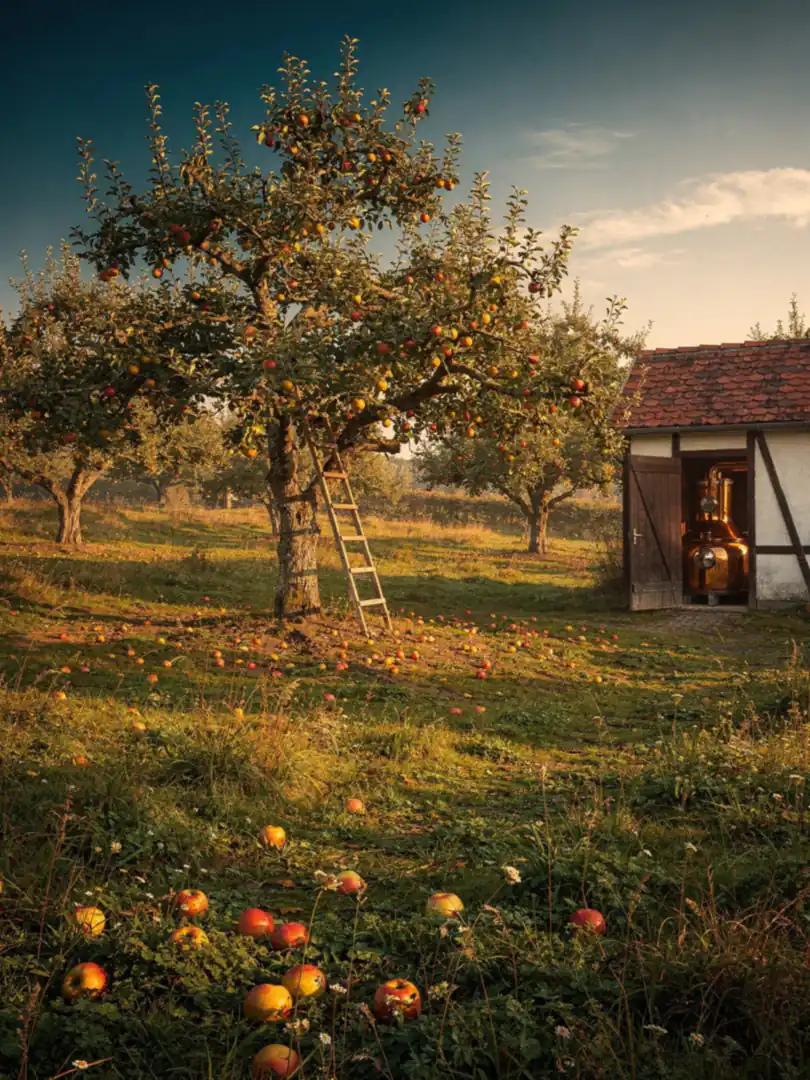
Standard Trees and Craftsmanship
Traditional Orchards and Distilleries: Why Old Trees Make Good Brandies
Traditional orchards (Streuobstwiesen) yield many characterful fruit brandies, because their tall, old trees carry aromatic, acid-rich varieties rarely found in commercial plantations. In turn, small distilleries keep these orchards alive by making use of the fruit.
What Is a Streuobstwiese?
A Streuobstwiese is a meadow or pasture scattered loosely with standard, full-sized fruit trees. "Standard" means the crown begins high enough that the ground beneath can be mown or grazed by livestock. Apples, pears, cherries and plums of various varieties and ages all grow on the same plot. Spraying and fertilizing are usually minimal, and harvesting is often done by hand or by shaking the trees.
In Germany, traditional orchard cultivation has been listed on the national inventory of intangible cultural heritage since March 2021. This recognizes a form of land use that has shaped landscape, food and tradition across generations. Traditional orchards are also considered especially species-rich habitats, providing a home for birds, insects and wild plants.
Why Do Old Varieties Make Good Brandies?
Commercial plantations favor a few table varieties that look attractive, store well and bear fruit evenly. For brandy, different qualities matter. Old orchard varieties are often small, acid-rich and aromatic, sometimes tannic, and they're harvested fully ripe. It's exactly this combination of acidity, aroma and ripeness that carries through into the mash and the distillate.
Examples can be found everywhere. Distilling cherries in the Black Forest and central Switzerland traditionally grow on standard trees; in Fraxern, Vorarlberg, there are around 2,200 of them. In the Mostviertel region, perry pears like Speckbirne or Dorschbirne shape the local fruit culture. East Tyrolean Pregler, protected since 2019, is distilled from apples and pears grown on plantations, traditional orchards and individual trees in the Lienz district. In Styria, apple brandies made from Maschanzker or Kronprinz Rudolf carry old variety names.
Small Distilleries as the Backbone of the Traditional Orchard
In Germany, many orchard owners don't distill their own fruit but instead supply it to a small distillery or have it distilled there. The typical setup is the Abfindungsbrennerei, an agricultural operation with a license permitting it to produce no more than 300 liters of pure alcohol per year. The alcohol produced there isn't measured directly but calculated as a flat rate from the quantity of raw material.
These operations are becoming fewer. In 2023, Germany still had 10,931 Abfindungsbrennereien in operation; figures from earlier years are only partly comparable due to a change in how the statistics are compiled. Around Oberkirch in the Renchtal valley, the region promotes itself as home to roughly 700 house and farm distilleries. Where such distilleries close, the fruit from the surrounding orchards also loses a buyer.
Tax Reduction and "Stoffbesitzer" Briefly Explained
Alcohol from Abfindungsbrennereien is taxed at a reduced rate in Germany. Lawmakers justify this by citing the preservation of traditional orchards. Anyone who owns their own fruit but no distilling equipment can have it distilled at an Abfindungsbrennerei as a so-called Stoffbesitzer (material owner): a maximum of 50 liters of pure alcohol per year, and one person per household.
Distilling without a license is illegal in Germany, even for personal use. The details of licensing, taxation and distilling equipment belong in a separate chapter on distilling rights. For the traditional orchard, one insight suffices: its fruit becomes brandy through legal channels, via licensed distilleries, and every bottle made from this fruit helps keep the trees standing.
How Do You Recognize a Brandy from a Traditional Orchard?
The EU spirit drinks regulation has no legal designation of its own for orchard brandy. Clues come instead from other details: old variety names, a precise origin, sometimes the name of the meadow or village. Such information comes from the producer and should be read as a description from the house, not as a verified seal.
In the glass, this origin often shows through as more acidity, more spice and a fruit character that feels less polished than brandy made from table fruit. That's not a rule, but it is a common observation. Anyone comparing brandies made from old varieties with those made from plantation fruit is best off tasting them side by side, in small amounts.