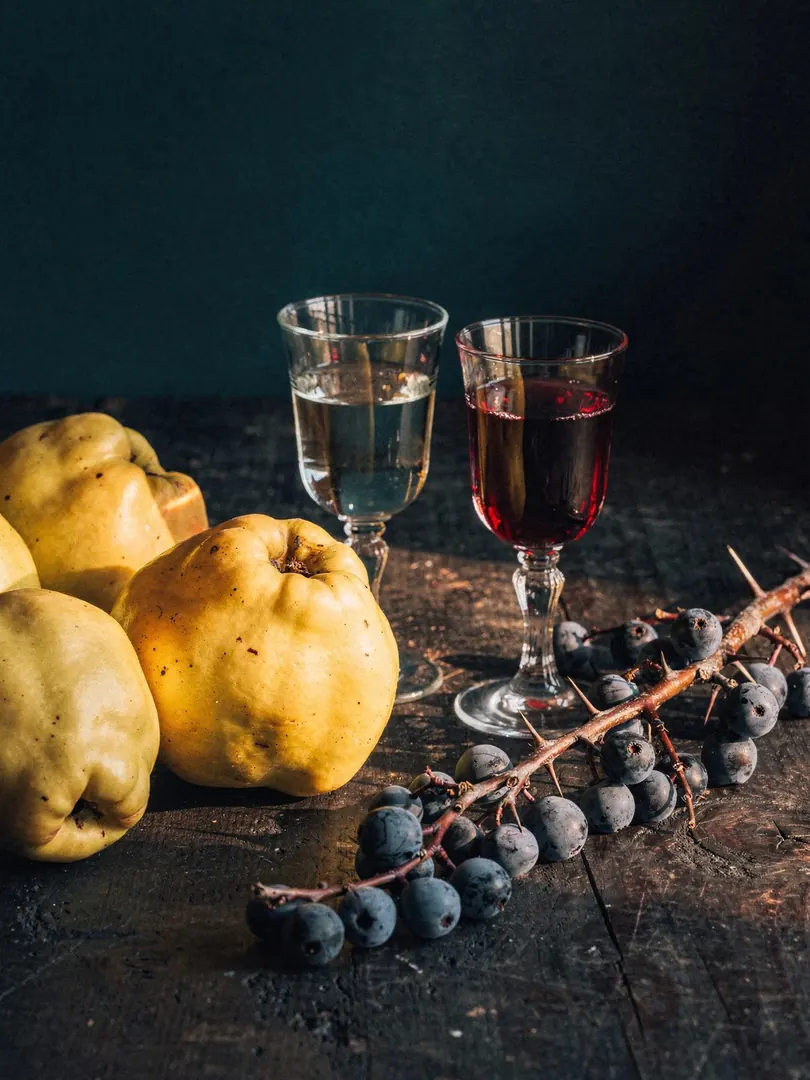
Two Fruits, Two Paths
Quince and Sloe: Brandy or Geist?
Quince is usually made into a brandy, meaning fermented and then distilled, since it brings enough sugar and plenty of aroma along with it. The low-sugar sloe, on the other hand, often appears as sloe geist or as a brandy "obtained by maceration." The label reveals which path was taken.
Brandy or Geist: The Difference in Two Sentences
A brandy is made from fermented fruit, while a Geist is made from unfermented fruit that is steeped in neutral alcohol and then distilled. In between sits the brandy "obtained by maceration and distillation," in which fruit is steeped using no more than 20 liters of alcohol per 100 kilograms of fruit. All three must have at least 37.5 percent alcohol by volume. A Geist may be rounded off with no more than 10 grams of sugar per liter, a brandy with no more than 18 grams.
Which path makes sense depends on the fruit. Fruit high in sugar ferments well and supplies enough alcohol of its own. Fruit low in sugar releases its aroma more readily into finished alcohol. There's no judgment of quality in this. A carefully made Geist can be finer than a mediocre brandy, and vice versa.
Quince Brandy: Why the Quince Is Fermented
Raw quince is hard, tart and barely edible, yet when ripe it smells so strong it can perfume an entire room. It contains enough sugar to ferment, but yields its juice only grudgingly. Its brandy shows notes of pear, citrus and honey, sometimes rose as well. Because the fruit is hard, ripens late and must be carefully chopped, quince brandy is considered demanding among distillers.
For quince brandy, Regulation (EU) 2019/787 allows up to 1,350 grams of methanol per hectoliter of pure alcohol, the same limit as for Williams pear or rowanberry. The reason is the high pectin content, the same quality that makes quince jelly so firm. In Hungary, two quince brandies are protected as geographical indications: Nagykunsági birspálinka since 2016 and Madarasi birspálinka since 2019.
Sloe Geist: The Bitter Wild Plum in a Glass
The sloe grows on thorny hedges and bears small, blue-black fruits. Raw, they pucker the mouth because they're rich in tannins. Traditionally they're harvested after the first frosts, once they've mellowed somewhat. Even so, sugar and juice remain scarce, which is exactly what makes the sloe a textbook case for a Geist.
Sloe Geist is made by steeping the unfermented fruit in neutral alcohol before distilling it. The resulting distillate often carries a pronounced almond and marzipan note from the pits, combined with a fine, tart fruitiness. There's also sloe brandy "obtained by maceration and distillation." Here, the designation must appear on the front of the label, in the same typeface, size and color as the name of the product.
Sloe Brandy from Fermented Fruit: It Does Exist
Fermentation isn't entirely ruled out for the sloe. In Hungary, Sárréti kökénypálinka has been protected as a geographical indication since 2019, a sloe brandy made from fermented fruit under the strict Pálinka rules, meaning no added sugar, no flavorings and no foreign alcohol. It requires a great deal of fruit and a great deal of patience. But it shows that the distinction between brandy and Geist hinges on the fruit and the effort involved, not on any prohibition.
Because the sloe also has a pit, the stone fruit rules apply to its brandy. The hydrocyanic acid limit of 7 grams per hectoliter of pure alcohol must be observed, and the pits must not be crushed during mashing. The finished brandy also needs to be stored away from light, since hydrocyanic acid can turn into ethyl carbamate under light exposure.
Pacharán, Sloe Gin, Sloe Liqueur: Not Brandies
Many sloe-based drinks aren't brandies at all. Spanish Pacharán navarro is a spirit flavored with sloes and legally its own category. Sloe gin is made by steeping sloes in gin; it's sweetened and weaker than a brandy. Sloe liqueur is likewise sweetened. These drinks are usually reddish, since the fruit's color remains in them, whereas sloe Geist and sloe brandy, being distillates, are clear.
Color is therefore a useful first clue, but it doesn't replace checking the legal designation. The same applies to quince: quince brandy is clear, while quince liqueur is usually golden-yellow and sweet. Anyone looking for a brandy should look on the label for the word Brand (brandy) or Geist.