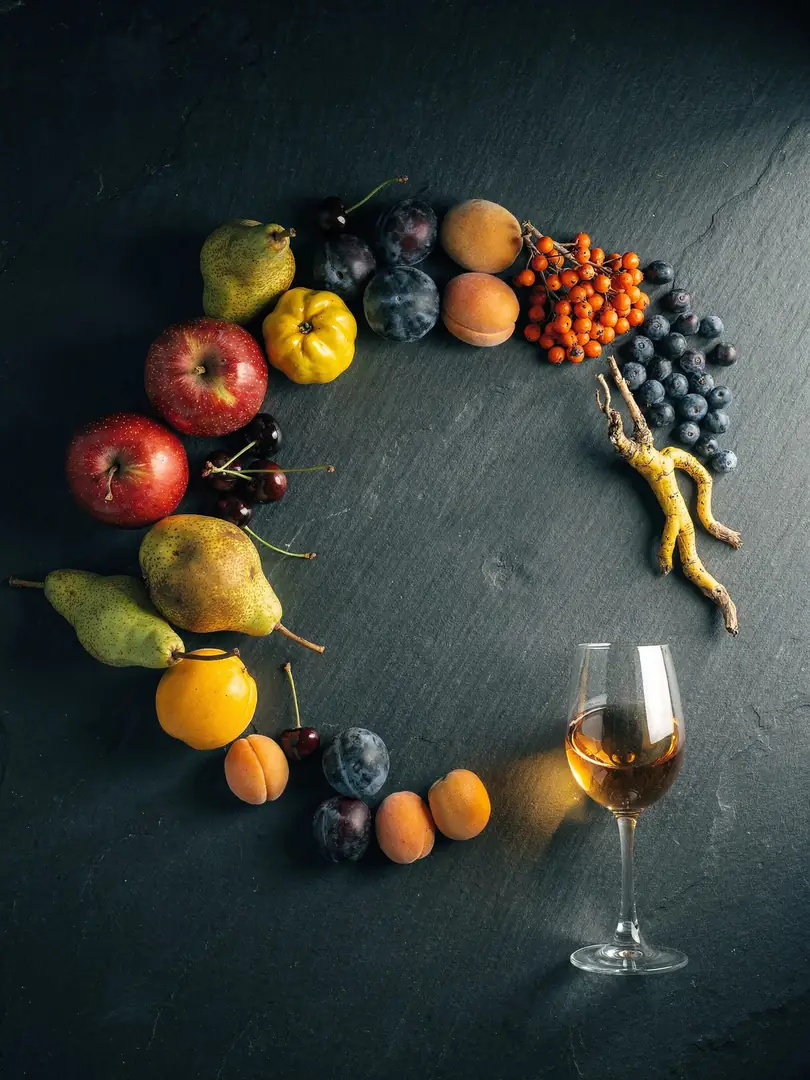
Pome, Stone, Berry
Which fruits are used to make fruit brandy?
Fruit brandy comes from almost any fleshy fruit with enough sugar to ferment: pome fruits like apple, pear and quince, stone fruits like cherry, plum and apricot, berries and wild fruits. Roots like gentian yield their own distillates, but never a fruit brandy.
What the law understands by fruit brandy
The dividing line is drawn by the European Spirit Drinks Regulation (EU) 2019/787. Fruit brandy sits there as Category 9. It arises exclusively from alcoholic fermentation and distillation of fresh, fleshy fruit, its must, berries or vegetables, with or without stones. No foreign alcohol may be added, no flavorings either, and coloring is forbidden. In the glass, the finished brandy holds at least 37.5 percent alcohol. It may be sweetened with no more than 18 grams per liter, enough to round it off, but never enough to make it a liqueur.
The word fleshy is the real filter. A fruit must bring along juice and sugar, since only then can yeast turn it into alcohol. From this mash, the fermented fruit pulp, distillation follows. The regulation even names the banana explicitly. Whether a brandy is called Kirschbrand or Kirschwasser makes no difference. The ending "-wasser" is an approved alternative name for the same fruit brandy and reveals nothing about quality or production.
Pome fruit: apple, pear and quince
Apples and pears are the workhorses of the distilleries. They grow almost anywhere with cold winters, bear abundantly, and ferment reliably. If at least 85 percent of the mash comes from apples, pears, or both, the brandy may be called Obstler; up to 15 percent of other fruits is then allowed. Single-variety brandies, by contrast, carry the name of the fruit or even the variety, such as Williams or Golden Delicious.
Pome fruit has a practical advantage: it brings no large stones that could release hydrocyanic acid during mashing. The quince belongs botanically to the same family but is hard, tart and barely edible raw. In the brandy, though, it shows an aroma somewhere between pear, citrus and honey that hardly any other fruit achieves. That is why distillers consider it demanding but rewarding.
Stone fruit: cherry, plum, apricot and mirabelle
Stone fruit yields the best-known single-variety brandies of the Alpine countries: Kirschwasser, plum brandy, apricot brandy and mirabelle brandy. Its hallmark sits in the pit. A fine note of marzipan or bitter almond is part of the profile in many of these brandies. It comes from amygdalin, a compound inside the stones from which hydrocyanic acid can form.
That is why the regulation sets a maximum of 7 grams of hydrocyanic acid per hectoliter of pure alcohol for stone fruit brandies. Distilleries leave the stones largely intact during mashing, since crushed pits release too much of it. Under the influence of light, hydrocyanic acid in the finished brandy can form ethyl carbamate, a suspected carcinogen. A subtle stone-fruit note is craftsmanship; an overpowering one is a flaw.
Berries and wild fruits: when sugar is lacking
Raspberries, sloes or blackberries have intense aromas but little sugar. Fermented, they yield only small amounts of alcohol. For such fruits, the law recognizes two further paths. For a Geist, unfermented fruit is steeped in neutral alcohol and then distilled. For a brandy "obtained by maceration and distillation," the fruit is steeped in a limited amount of alcohol, essentially extracted for its aroma, and then distilled; this note must appear on the front of the label.
Wild fruits such as rowanberry, service tree berry or wild service berry are nonetheless still fermented in the classic way. They rank among the rarest and most labor-intensive brandies of all. Their methanol limit stands at 1,350 grams per hectoliter of pure alcohol, at the upper end of the scale. Methanol, incidentally, forms from the pectin in cell walls, already during mashing, not from faulty distillation. Most fruits are capped at 1,000 grams; apple, apricot, plum or mirabelle at 1,200 grams.
Roots and tubers: brandies, but not fruit brandies
Gentian roots, Jerusalem artichoke tubers or beets can also be fermented and distilled. Their brandies are deeply rooted in the Alps, but legally they belong to their own categories. Gentian forms Category 18 and may even be produced with added ethyl alcohol. Jerusalem artichoke is Category 14 and requires at least 38 percent. Neither counts as fruit brandy under the regulation.
Anyone asking about the raw material thus gets three answers. Fruits with enough sugar become fruit brandy, low-sugar berries often become Geist, roots land in their own categories. A blend of several fruits is simply called fruit brandy, with the fruits listed on the label in descending order of quantity. In the end, it is less the paragraphs than ripeness, variety and care in the still house that decide which bottle wins you over.