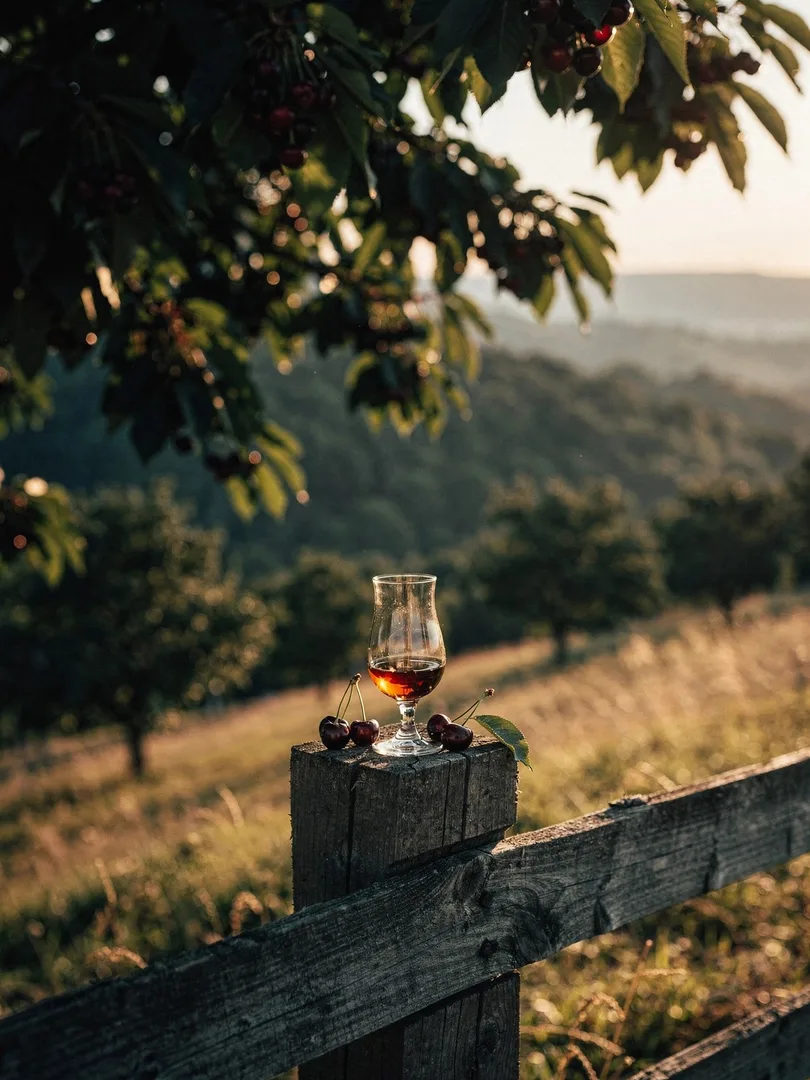
Distilling cherries instead of table fruit
Kirschwasser: varieties, origin and flavor
Kirschwasser is a fruit brandy made from fermented sweet cherries and is legally identical to Kirschbrand. Good Kirschwasser comes from small, aromatic distilling cherries grown on tall trees, for instance in the Black Forest, Alsace, Franconia, South Tyrol, central Switzerland or Vorarlberg.
What is Kirschwasser, and why is it called "water"?
It pours into the glass clear as water, which is where the name comes from. The ending "-wasser" is an old term for fruit brandies that European law still permits today as an alternative. Kirschwasser and Kirschbrand are therefore the same product, a fruit brandy under Category 9 of Regulation (EU) 2019/787. As a short form, "Kirsch" is also permitted, but only for brandy made from sweet cherries, botanically Prunus avium.
Sour cherries, called Weichseln in Austria, yield their own brandies with a tarter, more acid-driven profile. In Hungary, such a brandy from Újfehértó is protected as Újfehértói meggypálinka. A cherry liqueur, by contrast, is clearly sweetened and usually weaker. Maraschino too, made from the Dalmatian Marasca sour cherry, is a liqueur and not a Kirschwasser, even though both look clear.
Distilling cherries: small, dark and aromatic
Not every cherry suits Kirschwasser. Distilleries rely on distilling cherries, small-fruited, aromatic varieties that would barely find demand as table fruit. They traditionally grow on standard trees, meaning large, freestanding trees, and are harvested fully ripe. In the Black Forest, distillers and fruit growers around Oberkirch are once again deliberately cultivating old varieties such as Meisenbühler Schlapper, Schwarze Schüttler or Rencher Wegkirsche.
Switzerland regulates the matter most precisely. The specification lists approved varieties for Zuger Kirsch and Rigi Kirsch AOP, including Basler Langstieler, Frühe Schwyzerkirsche, Notiker and Wölflisteiner. Other varieties from the region may make up at most ten percent, while surplus table cherries are excluded entirely. The cherries must be mashed within 48 hours of harvest, and distillation takes place only in the classic pot still.
Where does Kirschwasser come from? Black Forest, Zug, Alsace, Fraxern
Kirschwasser has no inventor and no single homeland. Cherry brandies have been at home throughout the Upper Rhine and Alpine regions for centuries. Still, some dates are documented. In 1726, the Bishop of Strasbourg, Armand Gaston de Rohan, granted farmers around Oberkirch the right to distill surplus fruit. In Zug, Johann Baptist Etter began distilling his own cherries from 1823, and in Fraxern in Vorarlberg, cherries are already documented as early as 1574.
Fraxern is a mountain village roughly 1,000 meters above the Rhine Valley. Around 15 cherry varieties grow there on some 2,200 standard trees, and distillation takes place in December, done twice over. In local dialect, the brandy is called Kriasiwasser. Such places show just how closely Kirschwasser is tied to landscapes where old trees still stand on slopes and along pathways.
Protected Kirschwasser origins in the EU and Switzerland
In the EU, geographical indications apply to Schwarzwälder Kirschwasser and Fränkisches Kirschwasser, both protected since 1989. Also protected are Kirsch d'Alsace, Kirsch de Fougerolles from the Vosges, Südtiroler Kirsch, as well as Kirsch Friulano and Kirsch Trentino from northern Italy. A geographical indication means that a brandy owes its characteristics substantially to its origin and is made according to a fixed specification.
Switzerland maintains its own register. Since 2013, Zuger Kirsch and Rigi Kirsch have been registered there as AOP, a protected designation of origin. The region covers the entire canton of Zug as well as municipalities in Schwyz and Lucerne around the Rigi. A bottle carries either one name or the other, never both at once.
What does good Kirschwasser taste like?
A well-made Kirschwasser smells of dark, ripe cherry, often with a hint of almond or marzipan from the stone. On the palate it is dry, since it holds hardly any sugar, yet still fruity. The stone-fruit note is welcome as long as it stays in the background. If it turns loud and bitter, too much pit was likely involved, and the risk of hydrocyanic acid and ethyl carbamate rises as well.
Most Kirschwasser is colorless and rests in glass demijohns or stainless steel tanks to preserve the fruit aroma. Zuger Kirsch, for instance, must mature at least six months and reaches the market at a minimum of 40 percent. Wood-aged cherry brandies also exist; they turn golden and rounder but give up some of the fresh fruit character. Quality shows in both cases through clarity and a long, clean finish.