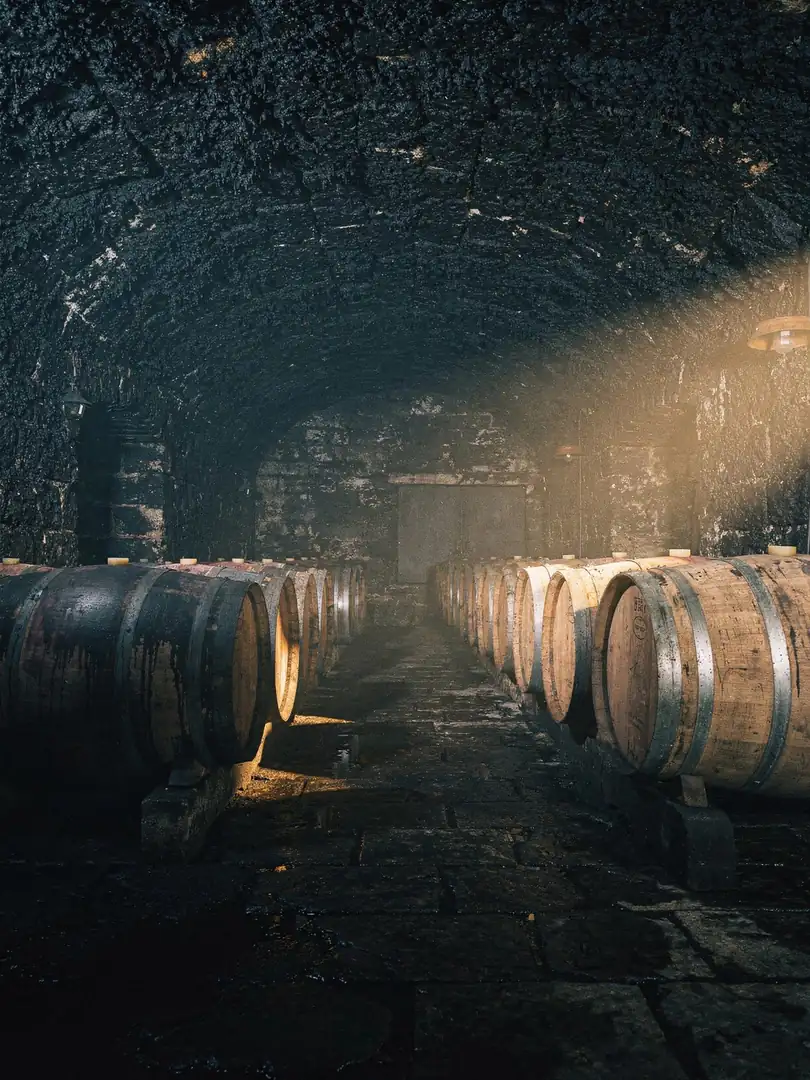
The angels' portion
The Angels' Share: what evaporates from the cask
The Angels' Share, called "part des anges" in French, is the portion of a spirit that evaporates through the wood during cask maturation. In the Cognac region, according to the industry association, that amounts to around 41 million bottles a year. As the volume changes, so do the alcohol content and aroma.
What is the Angels' Share?
An oak cask is tight, but not completely sealed like a glass bottle. Water and alcohol slowly migrate into the staves, the curved wooden boards of the cask, and evaporate on the outer surface. Year after year, a little goes missing from the cask. Cellar masters say, with a wink, that the angels are having a drink too. The name is folklore, but the process is pure physics.
The scale of the loss is shown by figures from the Cognac region. According to the industry body BNIC, around 2.2 billion bottles of Cognac are currently aging in casks there, and every year a volume equivalent to roughly 41 million bottles evaporates. As a rough rule of thumb, Cognac houses often cite around two percent per year. The actual figure varies depending on the cellar, the cask, and the weather.
The same process affects every spirit that matures in wood, from Armagnac to Calvados to cask-aged fruit brandy. In a glass demijohn or stainless steel tank, by contrast, virtually nothing evaporates. There, there is no angels' share at all.
What evaporation depends on: cellar, climate, cask size
The air in the cellar is decisive. If it's humid, proportionally more alcohol escapes than water, the alcohol content in the cask drops, and the spirit grows milder over the years. In dry air, more water evaporates, the alcohol content stays higher and can even rise. Cognac houses exploit this difference by deliberately storing casks in humid or dry cellars.
Warmth matters too. In warm climates, the wood works harder, the spirit expands and contracts more, and evaporation increases. This is why the angels' share is noticeably larger for whisky matured in hot countries than in Scotland's cool warehouses.
Cask size works in the same direction as the wood effect. A small cask has more surface area relative to its volume and loses spirit faster. Large casks and cool, steady cellars keep the loss smaller, but they also let the spirit mature more slowly.
The black fungus on the warehouses
Anyone driving through the towns of the Cognac region will see a black coating on walls and roofs around the warehouses. It's a fungus called Baudoinia compniacensis, which feeds on the alcohol vapor in the air. It's named after the pharmacist Antonin Baudoin of Cognac, who described it in the 19th century.
The fungus is harmless to the spirit, but it's a visible sign of just how much alcohol escapes from the casks into the surrounding air. Similar coatings can be found in other places where large volumes of spirits are matured in wood, such as around whisky warehouses.
What the loss means for very old spirits
Over decades, the loss adds up. A cask that was full fifty years ago now holds only a fraction of its original contents, and what remains has lost alcohol strength too. This is one reason why very old spirits are rare. Part of what a house once distilled has simply gone up into the air.
As alcohol content drops, a very old spirit gradually approaches drinking strength on its own. Cognac must be sold at a minimum of 40% vol. Young distillates come off the still at up to 72.4% vol and are reduced with water; in the Cognac region, this is often done gradually using what's called "petites eaux," a mixture of water and Cognac, so the spirit isn't shocked all at once.
Eventually, additional wood only brings bitterness and dryness, while volume continues to shrink. At that point, cellar masters transfer the spirit into glass demijohns, as described in the section on maturation without wood. In glass, evaporation stops, and the angels' share for this spirit has been paid in full.
For enthusiasts, the angel's share explains why an old cask demands so much time and patience. It is the invisible price of any long cask maturation, whether for Cognac, Armagnac, Calvados, or brandy.