Raw Material and Regulation
What Is Pomace – and What Is Pomace Brandy?
Pomace is the solid residue left over from pressing grapes: skins, seeds, and often stems too. When this pomace is fermented and distilled, the result is pomace brandy with a minimum of 37.5% ABV. Grappa, Marc, and Orujo are all pomace brandies; wine brandy is not.
What Is Pomace? The Leftovers from the Wine Press
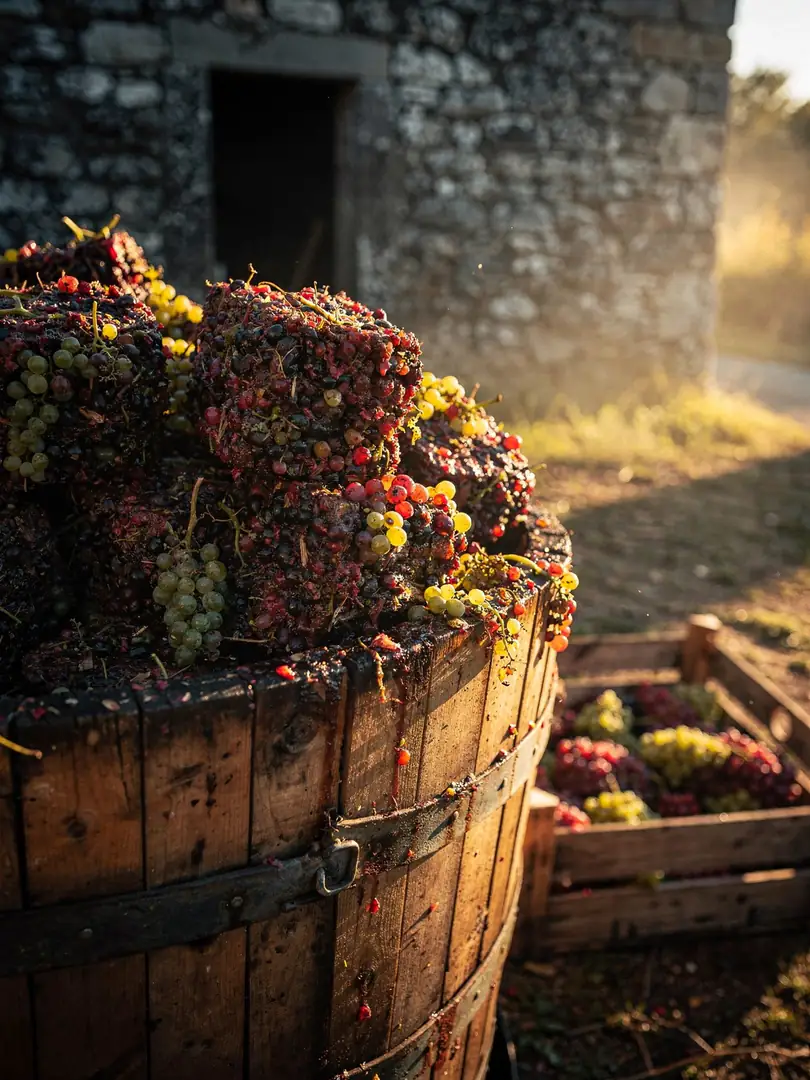
Every autumn, heaps of skins and seeds pile up next to the press at wineries. The juice has run off, and the wine begins its own life in the cellar. What remains is called pomace by winemakers in Germany, or Treber/Trebern in Austria and parts of southern Germany. Either way, it refers to the same thing: the solid parts of the grape left after pressing.
This residue is anything but worthless. The skins still hold many of the grape variety's aromatic compounds, traces of juice cling to them, and in the case of red wine, the pomace has already fermented alongside the must for weeks. In the past, it ended up as fertilizer in the vineyard or as feed in the barn. Distilling it was a way to coax one more round of alcohol and aroma out of the leftovers of the harvest. This thrifty practice is how Grappa, Marc, Orujo, and their relatives came into being.
One distinction matters from the start. White wine is usually pressed right after harvest, so its pomace is still sweet and unfermented. Red wine, by contrast, ferments on the skins so that color and tannin pass into the wine; its pomace therefore comes out of the press already fermented and containing alcohol. Both can be distilled, but the white pomace must first be fermented.
Pomace Brandy Under EU Law: What Category 6 Requires
Across Europe, Regulation (EU) 2019/787 on spirit drinks sets out what may be called pomace brandy. In its annex, it appears as Category 6 under the name "grape marc spirit or grape marc". The only permitted raw material is fermented grape pomace. It is distilled either directly with steam or after the addition of water, and the first distillation must take place in the presence of the pomace itself. Simply pressing out the juice and distilling only the liquid would not qualify as pomace brandy.
Distillation takes place at less than 86% ABV, so that the distillate retains the character of the raw material rather than becoming neutral alcohol. On the market, pomace brandy must have a minimum strength of 37.5% ABV. Foreign alcohol and flavoring substances are prohibited; caramel coloring may only be used to adjust the color. Sweetening is allowed up to a maximum of 20 grams of sugar per liter.
One special rule concerns the lees, the sediment of yeast and suspended particles that settles in the barrel after fermentation. For every 100 kilograms of pomace, a maximum of 25 kilograms of lees may be added, and the alcohol derived from these lees may make up no more than 35% of the total alcohol. This lees rule prevents a pomace brandy from secretly becoming a lees brandy.
Why Pomace Brandy Tastes Different from Wine
Set a young pomace brandy next to a young wine brandy, and the difference hits you immediately on the nose. Pomace brandy smells more robust, often of grape skin, hay, nuts, or blossoms, and with aromatic varieties like Muscat, distinctly of roses and grapes. The reason lies in the raw material: skins carry most of the grape's aromatic compounds, while the seeds contribute bitter, astringent notes.
Skins also contain a great deal of pectin, a cell-wall substance that produces methanol during fermentation. That's why EU law permits up to 1,000 grams of methanol per hectoliter of pure alcohol in pomace brandy, compared to just 200 for wine brandy. This doesn't make a properly made pomace brandy dangerous—the limits exist precisely to ensure safety. But the figure does show just how different the two raw materials are.
Pomace Brandy, Wine Brandy, Lees Brandy: The Neighbors
Grapes can yield several different spirits, and this is exactly where confusion often arises. Wine brandy and eau-de-vie are distilled from finished wine, meaning from liquid, not from skins. Grape spirit is made from whole fermented grapes, including juice and skin. Pomace brandy, on the other hand, uses only what remains after pressing.
Two further relatives have their own categories. Fruit pomace spirit (Category 7) is distilled from the pressed residue of other fruits, such as apples, and is then called apple pomace spirit; here the methanol limit is even higher, at 1,500 grams. Lees spirit (Category 12) is made from the lees, the wine sediment, and must have a minimum strength of 38% ABV. Grappa, Marc, Orujo, Bagaceira, Tsipouro, Zivania, Törkölypálinka, and Chacha, meanwhile, all belong to the same family: they are pomace brandies of different origins.