Slowly and neat
How should you drink fruit brandy?
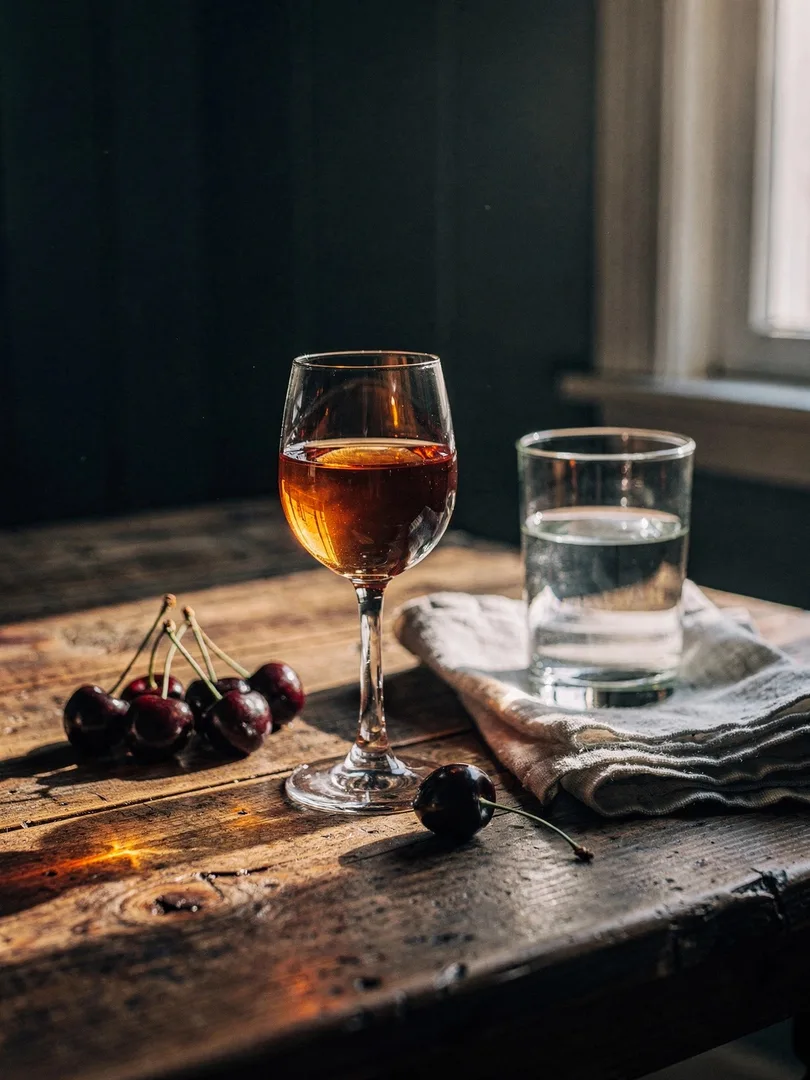
Fruit brandy is best enjoyed neat, in small amounts and slowly: from a tulip-shaped glass, slightly below room temperature, nosed first and then sipped in small mouthfuls. That way a kirsch or a Williams pear brandy shows its fruit instead of simply burning in your throat.
How should you drink fruit brandy? Slowly, not in one go
Knocking back a schnapps from an ice-cold shot glass is one of the most familiar images of tavern culture. For a good fruit brandy, it's the worst way to drink it. What the distiller spent months coaxing out is, above all, a fragrance: the almond note of a cherry, the juiciness of a Williams pear, the spiciness of a plum. Down it in one, and you'll barely notice any of that — mostly just the alcohol.
Tasters therefore do things differently. They pour little, often just two centilitres, and take several minutes over that small glass. The brandy stays neat, no ice, no soda. A glass of still water alongside helps neutralise the palate between samples. This has little to do with etiquette — it's simply the way that lets you taste the most of what's actually in the bottle.
Step by step: look, smell, taste, finish
It's worth starting with a look in the glass. A classic fruit brandy is colourless, since after distillation it rests in glass or stainless steel and never sees wood. A golden hue reveals wood ageing. Colouring is forbidden for fruit brandy; caramel colouring, meaning burnt sugar used to adjust colour, is only permitted if the brandy has had at least a year of contact with wood.
Next comes the nose. Hold the glass at a slight angle and sniff briefly, from a little distance, rather than burying your nose deep inside. The first impression is often alcohol. By the second and third sniff, the fruit begins to open up. Opening your mouth slightly while you smell takes some of the sharp edge off the alcohol.
The first sip should be small and allowed to sit on the tongue for a few seconds. It accustoms the palate to the strength, since fruit brandies run at a minimum of 37.5 percent alcohol, many at 40 percent or more. Only the second sip reveals how the brandy really tastes. After that, pay attention to the finish — how long and how clean the aroma lingers. A good brandy finishes on fruit; a weak one finishes on a burn in the throat.
Obstbrand, Obstgeist, Obstler: what to expect in each glass
Knowing what you're drinking sharpens the nose. Obstbrand (fruit brandy) is made from fermented fruit. The fruit is mashed, the resulting pulp ferments into a kind of fruit wine, and this is then distilled. An Obstbrand therefore tastes of ripe, sometimes almost cooked fruit, and with stone fruit carries a hint of almond from the pit. Kirschwasser, incidentally, is simply another permitted name for cherry brandy.
Obstgeist follows a different process. Unfermented fruit, raspberries for example, is steeped in neutral alcohol and then distilled. A raspberry Geist therefore often smells bright and fresh, like fruit straight off the bush, but feels lighter on the palate. The difference isn't a matter of quality, but it does set a different expectation for what's in the glass.
An Obstler, meanwhile, is a fruit brandy whose mash consists of at least 85 percent apples, pears, or both. It smells of pome fruit and is usually more straightforward than a single-variety Williams. Set an Obstler next to a kirschwasser and you'll quickly notice how different spirits can be that, in the local pub, all simply get called schnapps.
When and why: brandy as a companion, not a dare
Traditionally, a fruit brandy rounds off a meal. That it actually aids digestion, though, isn't proven — if anything, alcohol slows stomach emptying. The pleasant feeling at the end of a tasting is relaxation, not digestive help.
Anyone wanting to get to know spirits is better off tasting deliberately and in small amounts — say, two or three varieties side by side. Comparison reveals differences that a single glass on its own never shows. And alcohol remains alcohol: if you're driving, pregnant, or simply don't want to drink, leave the brandy be. A good host keeps a non-alcoholic alternative on hand.