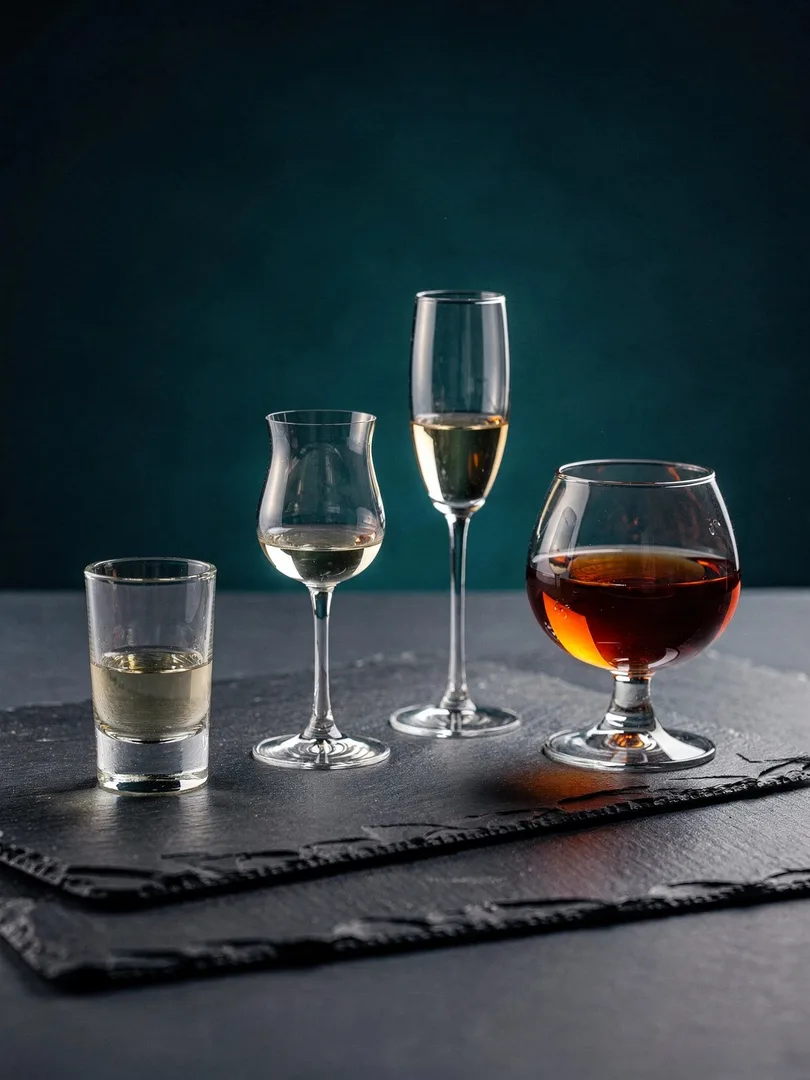
A tulip, not a shot glass
Which glass for fruit brandy, Cognac and grappa?
For fruit brandy, grappa and Cognac, a small stemmed tulip glass works best: the bulbous bowl collects the aroma, and the narrowed opening channels it toward the nose. The large Cognac snifter looks festive, but lets a lot of alcohol vapour rise and masks delicate fruit aromas.
Which glass for fruit brandy? The tulip beats the shot glass
The classic schnapps glass, called a Stamperl in Bavaria and Austria, has straight walls and almost no air above the liquid. It's made for knocking back. For a brandy whose value lies in its aroma, it's the wrong tool, since the aromas escape over the wide rim before the nose can catch them.
A tulip glass is better, often also called a nosing glass or fruit-brandy glass. It has a bulbous bowl at the bottom, narrows toward the top, and sometimes flares slightly outward at the rim. The bowl collects the evaporating aroma compounds, and the narrow opening concentrates them. The stem keeps the hand from unintentionally warming the brandy.
Such a glass is only ever filled a small amount. Space should remain above the brandy for the aroma to gather. Two centilitres is enough for a tasting sample. Glassmakers also argue that a flared rim directs the liquid first to the tip of the tongue, where sweetness and fruit are perceived earliest. Whether you notice that so distinctly is a matter of individual taste. That the tulip shows the aroma better than the shot glass, though, is something almost everyone notices immediately.
Cognac snifter or tulip: which glass for Cognac?
The Cognac snifter, also called a balloon glass, is the glass from countless film scenes. It has a wide, round bowl that you cup in your whole hand, and a comparatively large opening. The idea behind it: the hand warms the brandy, and the large surface lets it breathe.
That's exactly what often becomes a drawback when tasting. The large surface sends up a lot of alcohol vapour, which numbs the nose and masks finer notes. In professional tastings, slimmer tulip glasses are therefore more common, for Cognac often with a somewhat larger bowl. In these, wine aromas, dried fruit and the vanilla from the oak cask come through more clearly.
The same applies to brandy, Armagnac and Calvados. All three are wood-aged and can take a glass with a bit more volume than a delicate raspberry Geist calls for. If you love the snifter, you don't need to banish it — just fill it sparingly and don't cradle it too long in a warm hand.
Grappa glass: why narrow and stemmed
Grappa is a pomace brandy, distilled from the fermented skins and seeds left over from pressing grapes. A young grappa is colourless and smells of grape, blossom and sometimes herbs. Italian glassmakers have developed a dedicated, very slender tulip with a long stem for it, which tightly concentrates the aroma.
Aged grappa — labelled "invecchiata" after at least twelve months, or "riserva" after at least 18 months in wood — can be served in a glass with a somewhat wider bowl. In aroma it then moves closer to the wood-aged brandies. The same rule of thumb applies to French marc, Spanish orujo or Greek tsipouro: colourless and young in the narrow glass, wood-aged in the slightly rounder one.
Nosing glass, white wine glass, tasting glass: what's enough at home
Nobody needs a separate glass for every type of brandy. A universal nosing glass, originally from the whisky world, or a small stemmed white wine glass covers almost every need. Professional judges often reach for the standardised ISO 3591 tasting glass, which was actually developed for wine but also suits spirits.
More important than the exact shape is cleanliness. A glass that smells of dish soap, tea towel or cupboard will distort any brandy. Many tasters therefore rinse it briefly with plain water before tasting and let it drip dry. The glass isn't chilled, otherwise it fogs up and holds back the aroma. When comparing several spirits, use the same glass for all of them, so only the spirit accounts for the difference.