Gascony versus Charente
Armagnac or Cognac? The difference explained
Armagnac differs from Cognac mainly in distillation: it usually passes just once through a continuous copper column, the alambic armagnacais, retaining more of the wine's aroma. It comes from Gascony, matures at least one year in oak, and often carries a vintage.
One pass instead of two: the Armagnac column
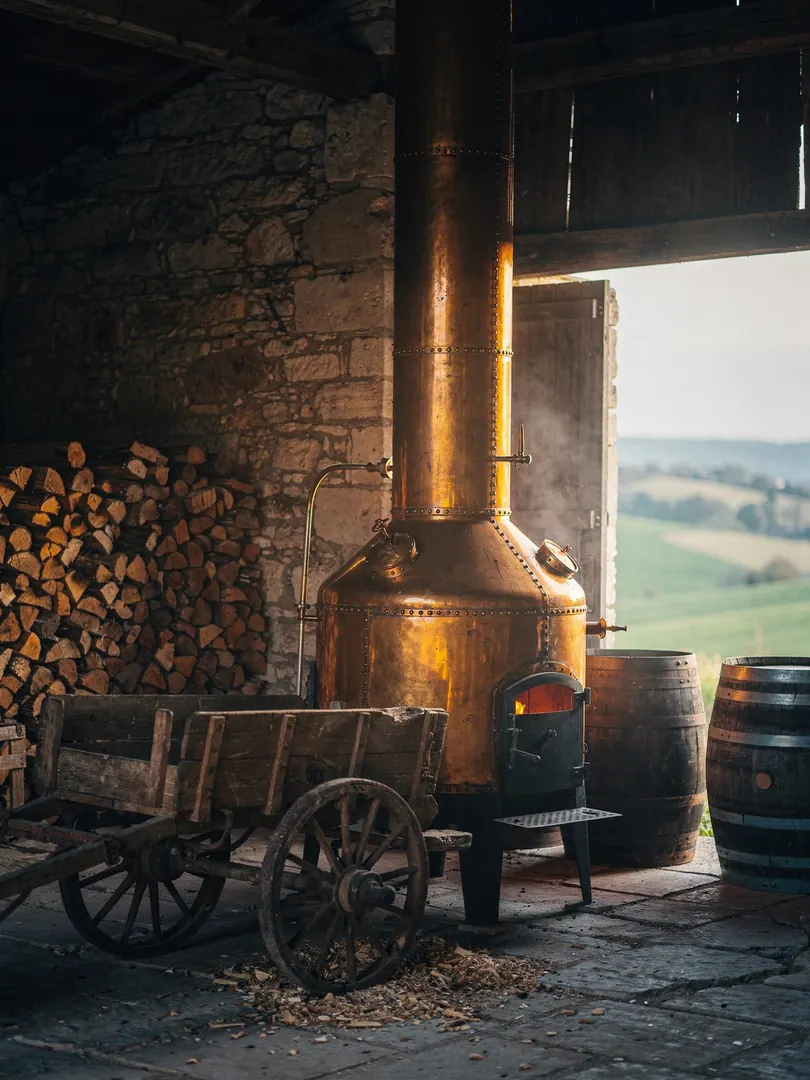
The biggest difference is visible in the distillery itself. Instead of a rounded pot still, there's usually a slender copper column with multiple plates, the alambic armagnacais. Wine flows in continuously from the top, steam rises up through it from below, and the spirit emerges in a single pass. Experts call this continuous distillation.
The resulting spirit typically runs between 52 and 72.4% ABV, often noticeably lower than a Cognac distillate. Because less alcohol is separated out, more of the wine's congeners remain. The young Armagnac therefore comes across as more rustic and robust, but needs time in the cask to round out. Double distillation in a pot still is also permitted but remains a minor method: in 2012, 95 percent of the base wine passed through the column.
Many winegrowers don't own their own equipment. Mobile distilleries travel from farm to farm each winter with their column still — a sight unknown in the Charente.
Territory, sub-zones and grape varieties of Armagnac
Armagnac lies in Gascony in southwestern France, spread across the départements of Gers, Landes and Lot-et-Garonne. It was delimited in 1909 and divided into three sub-zones: Bas-Armagnac in the west with sandy soils, Armagnac-Ténarèze in the center, and Haut-Armagnac in the east, where today only a small amount of base wine is grown.
Ten grape varieties are permitted, including Ugni blanc, Folle blanche and Colombard, as in the Charente. A specialty is Baco blanc, a crossing bred by François Baco in 1898. It yields soft, fruity spirits and is closely associated with Armagnac. The specifications also recall history: in 1310, Vital Dufour, Prior of Eauze, described the forty virtues of "aygue ardente," the burning water.
The spirit was traded over long distances for a long time. In the 17th and 18th centuries, Dutch merchants were important buyers. The region also has a technical history: in 1814, Tuilière of Auch received a patent for a continuously operating still. Today's alambic armagnacais works on the same principle and is still heated over an open flame.
Vintage, XO and Blanche Armagnac
The legal minimum aging period is shorter than for Cognac: one year in oak, counted from April 1 following the filling of the cask, with sale permitted from 40% ABV. For XO, a minimum age of ten years has applied since 2018, as with Cognac.
Vintages, called millésimes in French, are typical of Armagnac. Many producers bottle spirits from a single harvest, often in small quantities. According to the industry association, a vintage statement requires at least ten years in wood and refers solely to the harvest year shown on the label.
Blanche Armagnac is a different matter entirely. It rests for at least three months in a vessel that imparts no color and is bottled colorless. It falls under the AOC Armagnac and is not a separate EU-protected category.
How does Armagnac compare in taste to Cognac?
As a rule of thumb, Cognac tends to be more elegant and polished, while Armagnac is earthier, spicier and sometimes wilder. Typical notes include prune, fig, leather and roasted aromas, with great depth in old vintages. The cask contributes to this: many houses use oak from the forests of Gascony, whose wood is considered rich in tannins and quickly gives young spirit color and spice. Many years in the cask tame this power again. The structure also plays a role: many Armagnac producers are winegrowers who distill and bottle their own harvest. Production is considerably smaller; in 2012 it stood at 19,000 hectoliters of pure alcohol.
Both spirits follow the same basic idea, a distillate from wine matured in oak. Yet they show just how strongly the still and the origin shape the result. A glass of each side by side reveals the difference faster than any description could.