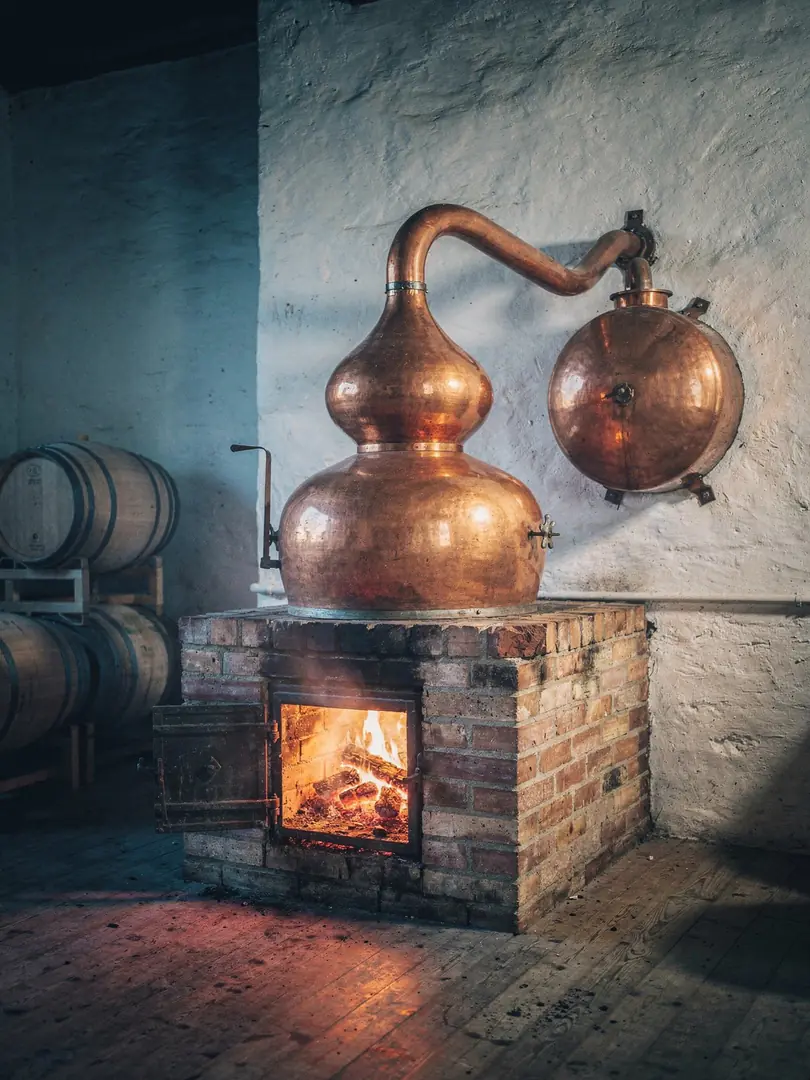
Still and cellar
How is Cognac made? From Ugni Blanc to the cask
Cognac is made from an acidic, light white wine, usually Ugni Blanc, which is double-distilled in a Charentais copper pot still over an open flame by March 31 following the harvest. The distillate ages at least two years in oak, after which the cellar master blends it and reduces it to drinking strength.
The wine behind Cognac: tart, light, and unsulfured
It all starts with a wine that hardly anyone would want to drink. Ugni Blanc, known in Italy as Trebbiano, yields a thin, highly acidic white wine with low alcohol in the Charente. For distilling, that's precisely the advantage: a lot of wine yields little distillate, concentrating the aroma compounds in the process. The acidity keeps the wine fresh until it reaches the still.
Sulfur, usually a standard protective agent in the wine cellar, is undesirable here because it would make itself unpleasantly known during distillation. For this reason, the wine is distilled soon after fermentation. The specification sets the deadline: distillation must be completed by March 31 following the harvest. According to figures from the industry body BNIC, nearly 3,000 pot stills operate across the Charente, often running day and night through the winter.
Twice through the Charentais pot still
The Charentais pot still is a copper still heated over an open flame. For the second pass, the still may hold no more than 30 hectoliters and be charged with no more than 25 hectoliters. Copper binds sulfurous compounds in the process, while the size limits the volume per run. A column still, which runs continuously, is not permitted for Cognac.
The first distillation yields the "brouillis," a cloudy spirit at roughly one-third alcohol. Only the second pass, the "bonne chauffe," produces the actual distillate. During this run, the distiller separates the heads, with their sharp, highly volatile compounds, as well as the tails, with their heavy, fusel-like notes. What remains is the heart, the "coeur," at a maximum of 72.4% ABV. How tightly the cuts are made, and whether portions are redistilled, reflects each house's individual style.
A common misconception speaks of triple distillation. A third pass is reserved only for "Esprit de Cognac," a distillate at 80 to 85% ABV used exclusively in the production of sparkling wine.
Oak, chai, and the Angels' Share
The fresh distillate is colorless and still rough around the edges. It goes into casks made of sessile or pedunculate oak, often from the Limousin forest or the Tronçais forest, and ages in above-ground warehouses that in the Charente are called "chais." The specification requires at least two years, though many batches remain far longer. New casks quickly impart tannin and color, while older ones work more gently.
Each year, part of the contents evaporates through the wood. The industry body puts this loss—the Angels' Share—at roughly 41 million bottles a year. By its figures, around 2.2 billion bottles currently rest in casks. Over time, alcohol content drops, the liquid grows denser, and notes of dried fruit, nuts, and spice come to the fore.
The spot in the cellar matters too. In humid warehouses, proportionally more alcohol evaporates than water, so the Cognac grows softer and rounder. In dry warehouses, it's the reverse, and the distillate stays firmer. Cellar masters place their casks deliberately with this in mind. Anyone driving through Cognac country can see the effects of this evaporation on the buildings: a black fungus that feeds on the alcohol vapors darkens the walls of many warehouses.
Cellar master, blending, and drinking strength
Almost every Cognac is a blend. The cellar master, the "maître de chai," assembles a consistent house style from distillates of different vineyards and vintages. Many houses don't distill their own spirit at all: according to the BNIC, the region is home to 251 houses, 4,252 winegrower-distillers, and 131 professional distillers, who buy and sell wine and distillate among themselves.
Before bottling, the Cognac is gradually reduced with water to drinking strength, a minimum of 40% ABV. Caramel coloring, a small amount of sugar, and an infusion of oak chips are permitted, but capped together: they may mask the measured alcohol content by no more than four percentage points. The age stated on the label always reflects the youngest distillate in the blend.