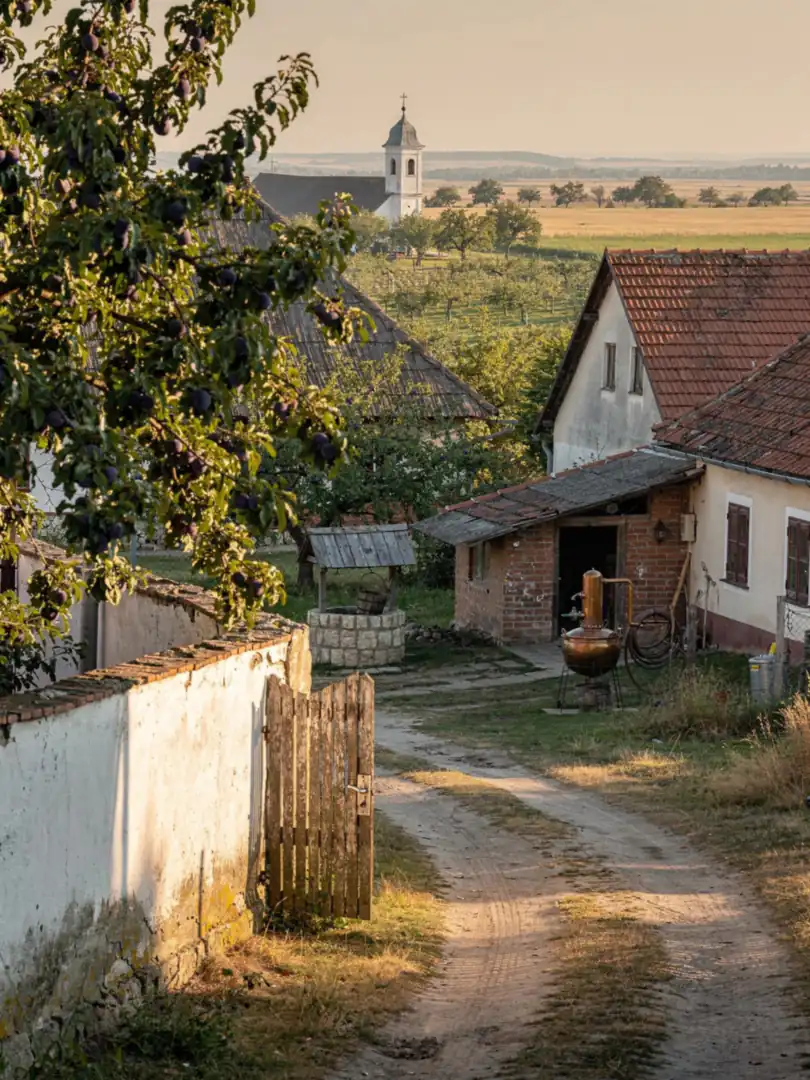
Pálinka in the Northeast
Region & History
In Hungary's northeast, the Tisza winds its broad loops through flat land, and orchards stretch right up to the village edges. Szabolcs, Szatmár and Bereg are the names of the three regions on the border with Romania and Ukraine. In Tarpa stands a Pálinkaház that presents the village as the Pálinka capital of the area.
What is Pálinka? In Hungary, the name doesn't apply to just any spirit, but only to a fruit brandy that satisfies Law 2008. évi LXXIII. The fruit must be one hundred percent grown in Hungary, mashing, distilling and bottling must take place within the country, and sugar, flavorings or foreign alcohol are forbidden. The spirit must reach at least 37.5% ABV. Hungary shares the name at EU level with Austria, where apricot brandy from certain federal states may also be called Pálinka.
Beyond this basic rule, the EU protects several regional Pálinkas with their own geographical indication. From the northeast come Szatmári Szilvapálinka, Szabolcsi Almapálinka and Újfehértói meggypálinka, while from the Körös region in the southeast comes Békési Szilvapálinka. The difference between Pálinka and ordinary fruit brandy thus lies less in the process than in the origin of the fruit.
Then there's distilling in the yard. In September 2010, a regulation came into force in Hungary allowing private individuals to produce Pálinka for personal use without a permit and without paying spirits tax. The EU Commission opened infringement proceedings, since excise duties on alcohol are harmonized across Europe. In Germany, the rule still stands: distilling without official permission is a punishable offense.
Today, distilling takes place in family businesses and in distilleries that guide visitors through their houses and their spirits.