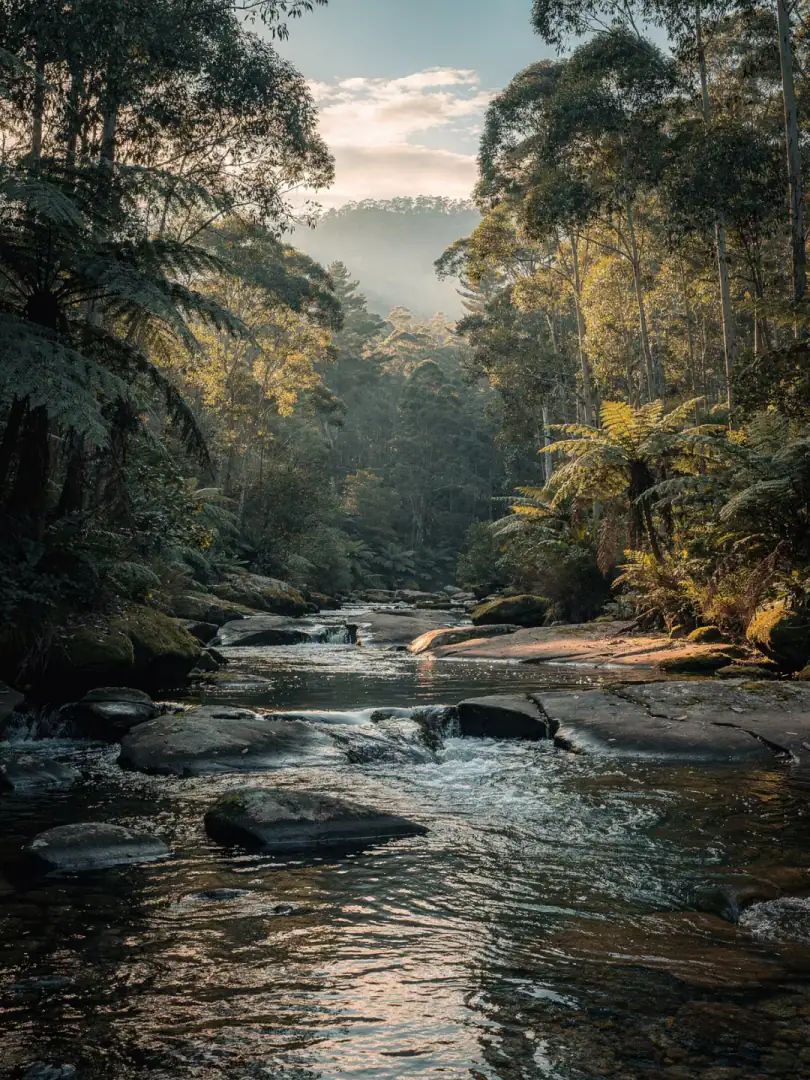
The Yarra Ranges Source
Water & Climate
The Yarra rises in Yarra Ranges National Park, high in the Great Dividing Range, at about 792 meters above sea level. From there it flows 242 kilometers through the Yarra Valley and through Melbourne. Near Hobsons Bay, it finally empties into Port Phillip Bay. Its catchment area covers a good 4,100 square kilometers.
The upper, forested part of it is protected. It supplies much of Melbourne's drinking water, collected among other places in the Upper Yarra Reservoir. The bedrock the river crosses is unusually mixed: sandstone, siltstone, and mudstone from the Devonian period, interspersed with granite. Further down the valley lies basalt from volcanic eruptions many millions of years younger than the surrounding rock. Between the Devonian rocks run narrow bands of rhyodacite and older Silurian siltstone as well.
This rock filters the water long before it ever reaches a distillery. That's why both Four Pillars and the Melbourne Gin Company emphasize how soft their water is.
For the gin itself, the water matters most at the end of production. The base spirit comes off the still at high strength, often above 80 percent ABV. It then needs to be cut down to drinking strength, usually just above 40 percent ABV. If hard, mineral-rich water is used for this, calcium salts can bind with the botanicals' essential oils. This slightly clouds the gin during dilution.
Soft Yarra water largely avoids this risk. It lets the delicate aromas of pepperberry and lemon myrtle come through clearly, instead of hiding them behind a haze.