Juniper & Moutwijn
Botanicals
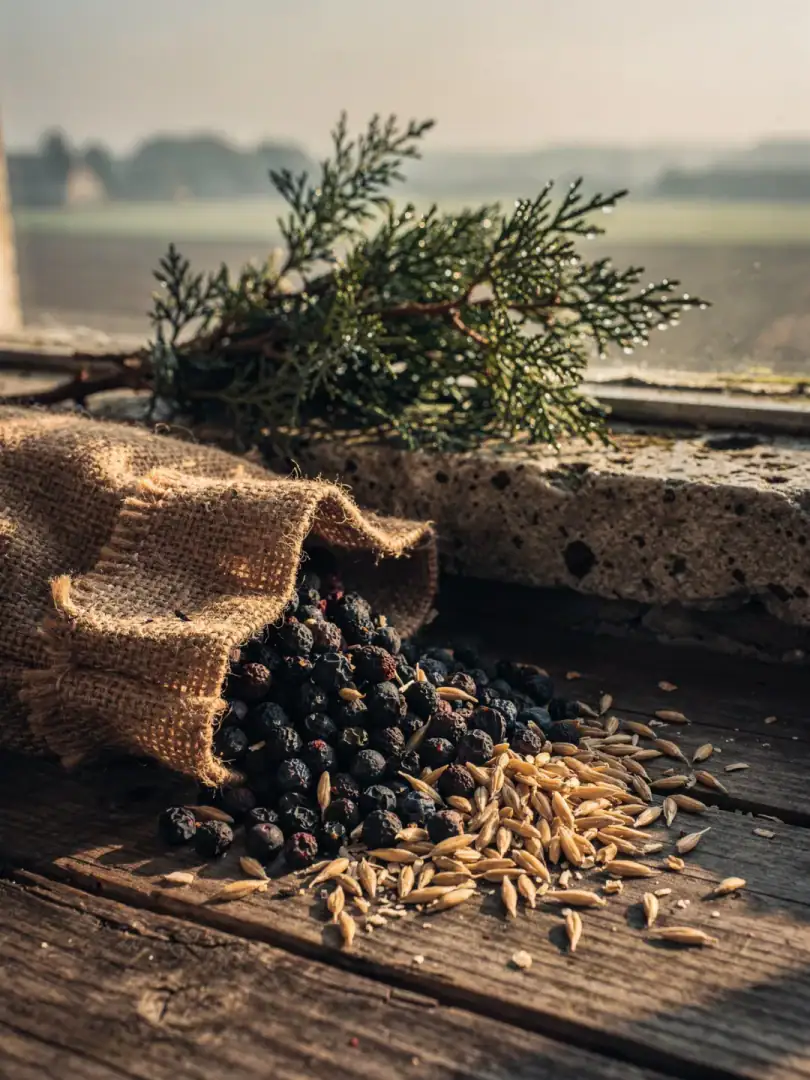
Gin thrives on a whole basket of herbs and peels. Jenever needs far less of that. Here, the juniper doesn't have to compete against a dozen other aromas. Legally, adding juniper berries or their distillate is already enough. In Hasselt, this was for centuries the only firm rule besides the grain base.
The real flavour doesn't come from the juniper but from the grain. Rye and barley are malted and fermented. From this, distillers produce what's known as moutwijn, a malt wine with plenty of character of its own. Neutral alcohol, as used as the base for classic gin, tastes like almost nothing by comparison. Moutwijn tastes bready, slightly nutty and sometimes a touch sweet, even before any juniper is added.
The grain itself often comes from the Haspengouw, the fertile hill country south of Hasselt. There lies deep, calcareous loess soil, well suited to rye and winter barley. Juniper, on the other hand, grows nowhere here in any meaningful quantity in the wild. Like almost all distillers across Europe, the Limburg producers also bought in dried berries, usually from warmer, more southern regions. This added a fine, resinous note to the floury character of the moutwijn in Hasselt, without ever overpowering it.
So in a true graanjenever, the juniper remains a quiet companion rather than the star turn familiar from London Dry Gin. Filliers in East Flanders, Belgium's largest jenever producer, follows the very same principle: grain first, juniper second. Anyone tasting a Hasseltse Jenever notices the grain first, and only in the finish does the resinous herb appear.
Dark, calcareous loess soil of the Haspengouw, loose and rich in humus.
The root: Rye and barley root here quickly and densely.