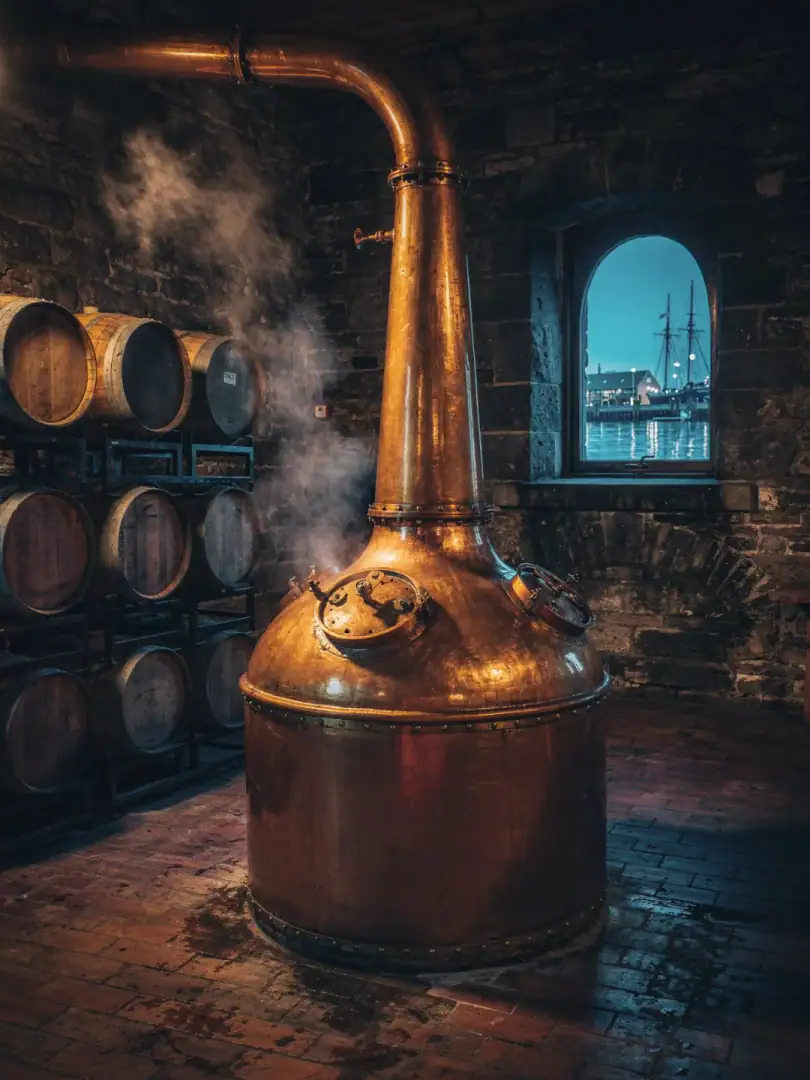
Pot Still
Distilling & Production
It all begins with neutral grain spirit, usually made from wheat. It serves as the base for every gin and carries almost no character of its own. Only through the botanicals and the method of distillation does the character emerge that defines a region like Plymouth.
At Black Friars Distillery, the seven botanicals macerate together in the alcohol. They steep together in the same copper pot still. In some modern methods, botanicals are instead steamed separately, say via a vapor basket or a vacuum column. Direct maceration is considered the older, more robust method, yielding an oilier, denser gin.
After steeping, the entire mixture is redistilled in a single pass. This method is called one-shot. In the end, exactly the amount of finished gin that will later be bottled comes out. Concentrate methods, where a strong extract is diluted later, play no role at Plymouth.
The spirit leaves the still at a much higher strength than what ends up in the bottle. It's then brought down to drinking strength with soft Dartmoor water. The standard bottling sits at 41.2 percent alcohol, an unusually specific figure that has been fixed for a long time.
There's also the Navy Strength version at 57 percent, the historic cask strength of the Royal Navy. This higher strength also changes the taste in the glass. More alcohol draws out more oil from the botanicals. The gin therefore comes across as sharper and more intense, noticeably spicier on the nose than the standard bottling.