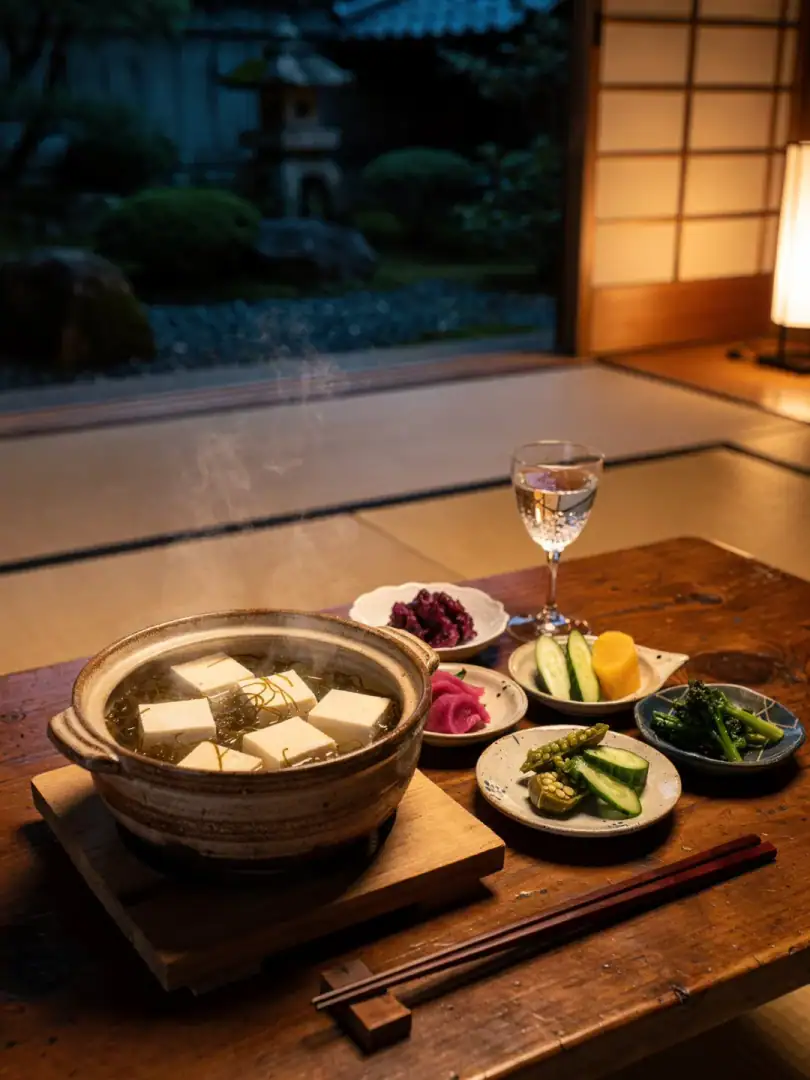
Yudofu and Tsukemono
Gin & Food
Kyoto's cuisine is regarded across Japan as the refined, restrained counterpart to Osaka's hearty street food. Kaiseki, the multi-course sequence of small, seasonal dishes, emerged here from the tea ceremony. It puts each ingredient in the spotlight individually, rather than blending them together.
One dish closely tied to Kyoto is yudofu: tofu simmered in lightly salted kombu broth. It's traditionally served in the temple district around Nanzen-ji, where Buddhist monks have cooked meat-free meals for centuries. The mild, almost neutral flavor of yudofu pairs beautifully with the tea depth of Ki No Bi, whose gyokuro note echoes the tofu's quiet umami sweetness rather than overpowering it.
Alongside it come tsukemono, pickled vegetables of which Kyoto boasts a particularly rich variety. One example is red-hued shiba-zuke made from eggplant and cucumber; another is the paper-thin radish slices of senmaizuke. Their acidity and salt play beautifully against the citrus sharpness of yuzu in Ki No Bi, without overwhelming each other.
Osaka is known for heartier street food like takoyaki, fried dough balls filled with bits of octopus, and okonomiyaki, a savory pancake with cabbage and sauce. Suntory Roku's floral, mellow character suits these richer, sweet-savory dishes better than Ki No Bi's concentrated tea note. The cherry blossom sweetness offsets the bold sauce nicely.
Ki No Bi and Roku are rarely promoted openly as food pairings in restaurants. In Kyoto's kaiseki establishments, though, a small glass of Ki No Bi served neat occasionally appears between courses, much like a sorbet, resetting the palate for what comes next.