Jonge, Oude, Korenwijn
Style & Regulation
In Schiedam, Genever isn't a single style but a small family of drinks. The boundaries are clearly regulated. The basis is EU Spirits Regulation 2019/787. Genever and Jenever are protected as geographical indications within it, covering, among others, the Netherlands, Belgium, and certain regions in France and Germany. The minimum alcohol content is 30 percent ABV.
Central to it all is the term Moutwijn, the malt wine made from grain. It must be distilled to between 40 and 80 percent ABV. How much of it ends up in the finished Genever determines the name on the label. For Jonge Genever, the young style, Moutwijn may make up at most 15 percent, along with no more than 10 grams of sugar per liter.
Oude Genever, the old style, conversely requires at least 15 percent Moutwijn. Up to 20 grams of sugar per liter are allowed. It tastes rounder and grainier than its younger relative, often with a bit more color too, since it's more frequently aged in barrels. Both names, then, say nothing about the age of the bottle, but about the recipe.
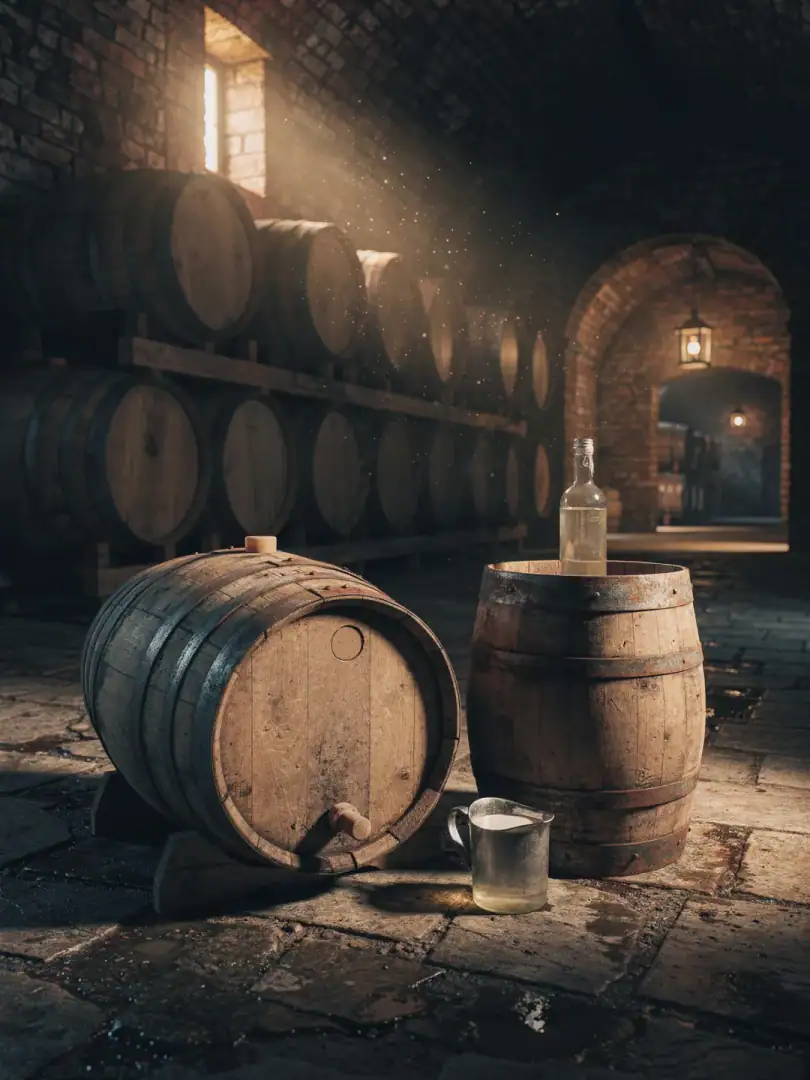
Korenwijn, sometimes spelled Corenwyn, goes even further. It requires between 51 and 70 percent Moutwijn, with up to 20 grams of sugar per liter permitted. This makes Korenwijn closest to the old-style grain spirit. Distilleries like Nolet Distillery typically age it in oak barrels, which further shapes its color and depth of flavor.
Anyone wanting to make a London Dry Gin instead would have to forgo Moutwijn entirely in Schiedam. According to the regulation, London Gin may only be distilled. After that, only water, ethanol of the same quality, and at most 0.1 grams of sugar per liter may be added. That would strip away exactly the character the city is known for.