Rain, Rock, Loch
Water & Climate
The Atlantic sweeps almost constant rain across the Highlands and islands. Islay ranks among the wettest spots in Scotland, Harris nearly as much, and even in summer sunshine can give way to showers within the hour. The mild, damp climate keeps the soil saturated year-round, letting heather and juniper stay green throughout the seasons.
Bruichladdich draws its water from a private spring on the island, filtered through peat and limestone until it turns soft, low in calcium and magnesium. The distillery uses this same soft water to bring The Botanist down to drinking strength. Without hard minerals in the mix, the gin stays clear when diluted.
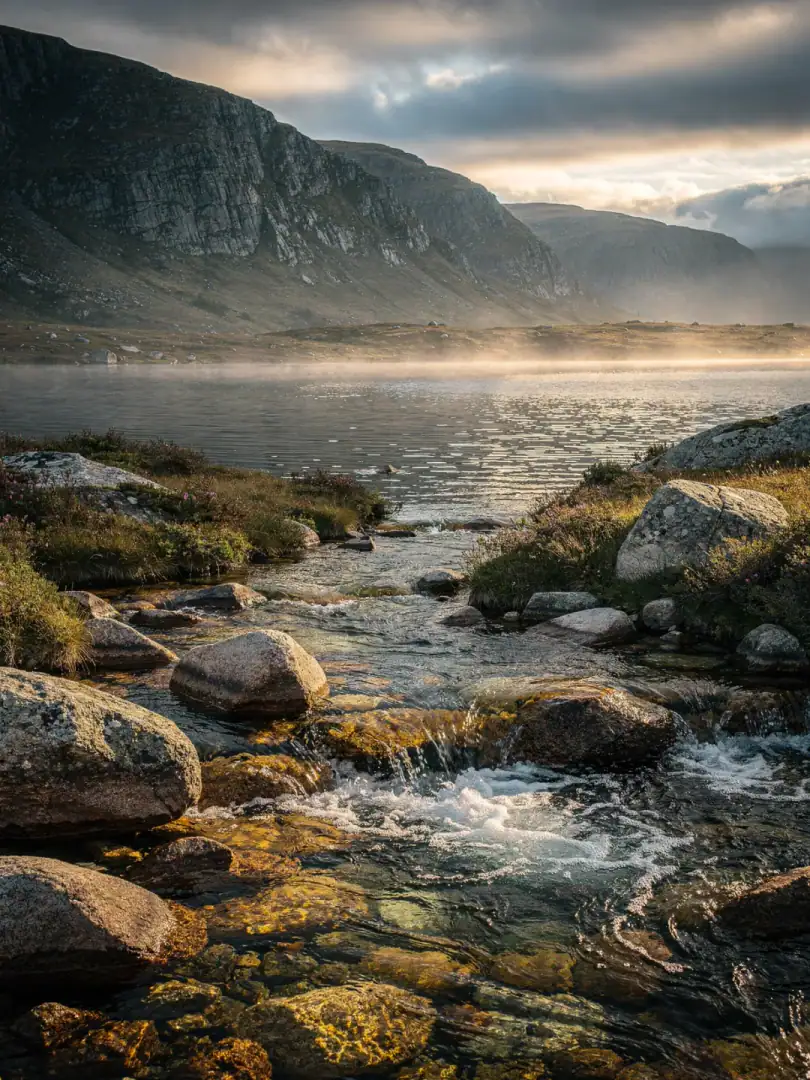
On Harris, the water comes from Loch a Sgàil, a reservoir above Tarbert that also supplies the island with electricity. The bedrock beneath belongs to Lewisian gneiss, among the oldest rock formations in Europe, through which the water picks up only trace amounts of dissolved minerals. So the water stays soft despite flowing through hard rock.
At Balmenach in Speyside, the Cromdale Burn, a stream flowing down from the Cairngorms, supplies the distilling water. Granite filters it hard here too, yet low in minerals, much like on Harris.
Soft water dissolves the fine oils of the botanicals cleanly, without leaving any haze. Hardness in the water would bind certain aromas and cloud the gin. When cutting down to drinking strength, this softness plays a key role in whether a gin stays crystal clear or turns cloudy.